Original Video
Nobody Taught You The True Meaning of “TAKE UP YOUR CROSS AND FOLLOW ME” | Joel Goldsmith
Disclaimer: All words as concessions! 🌸
NotebookLM.Google.com:
Ai Intro Text
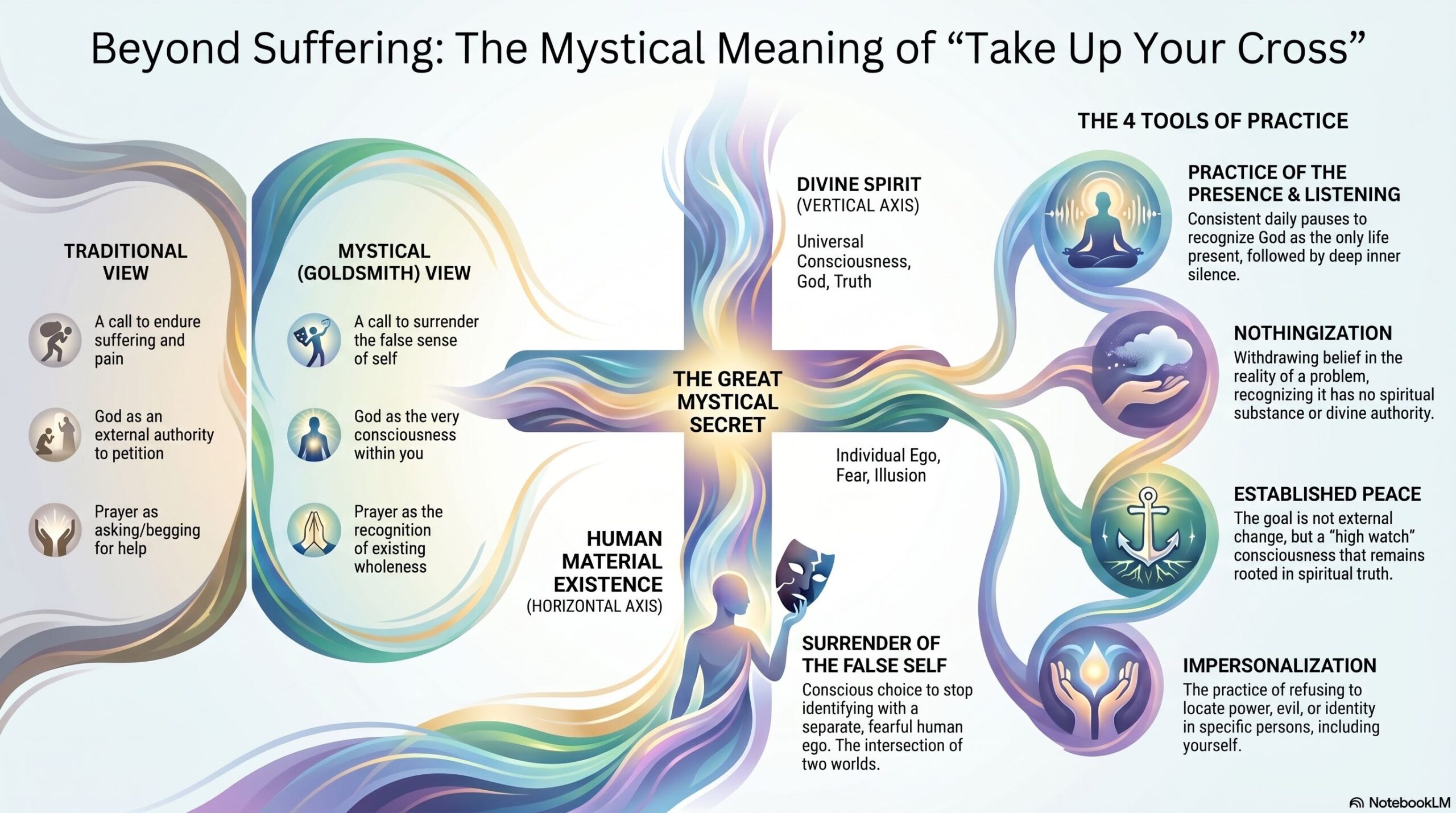
In this exploration of Joel Goldsmith’s mystical teachings, the source redefines the biblical command to “take up your cross” as a radical invitation to spiritual freedom rather than a call to physical suffering or endurance. The text argues that the cross represents the intersection of the divine spirit and human material existence, where the true “cross” is the surrender of the false, personal ego that believes it is separate from God. To “follow” Jesus is described as attaining a state of complete spiritual transparency, allowing divine consciousness to flow unobstructed by personal agendas or fears. Goldsmith provides practical tools for this transformation, including practicing the presence, spiritual listening, and impersonalizing problems to see through the illusion of limitation. Ultimately, the purpose of the text is to guide seekers toward an established inner peace and a life lived from an invisible spiritual foundation, where the end of the separate self marks the beginning of an authentic, healed identity.
Ai Infographics
Ai Explainer
Ai Post Copy
The Geometry of Your Soul: Why the Cross Is the Key to Absolute Freedom
1. Introduction: The Familiar Made New
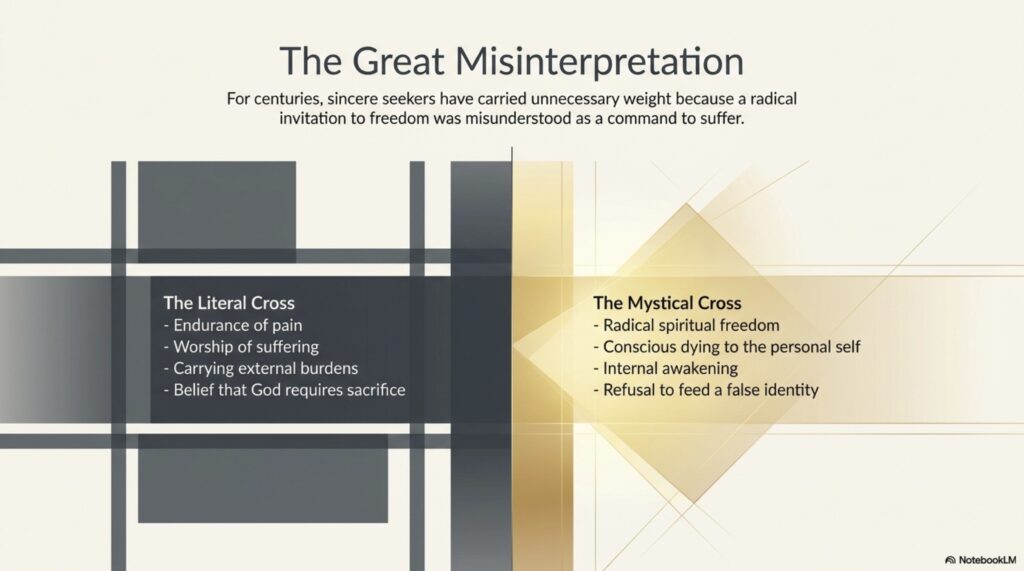
In the hushed corridors of mystical tradition, few phrases are as ubiquitous—or as profoundly misunderstood—as the command to “take up your cross and follow me.” For centuries, this has been interpreted through a lens of somber endurance, casting the cross as a heavy timber of suffering, a divine tax of pain paid in the currency of illness, lack, or brokenness. We have been taught to drag our burdens through the dust of mortal life, viewing the cross as a static artifact of historical sacrifice rather than a living map of the soul.
However, the mystical insights of Joel Goldsmith reveal a radical counter-narrative: the cross is not an invitation to endure pain, but a revolutionary architecture of spiritual freedom. It is an ontological shift, moving us from a life of burdened materiality to one of divine transparency. When we peel back the layers of religious conditioning, we find that “taking up the cross” is actually the most liberating act a human can perform—a total surrender of the very mechanisms that create suffering in the first place.
2. Takeaway 1: The Cross is the Intersection of Your Two Worlds
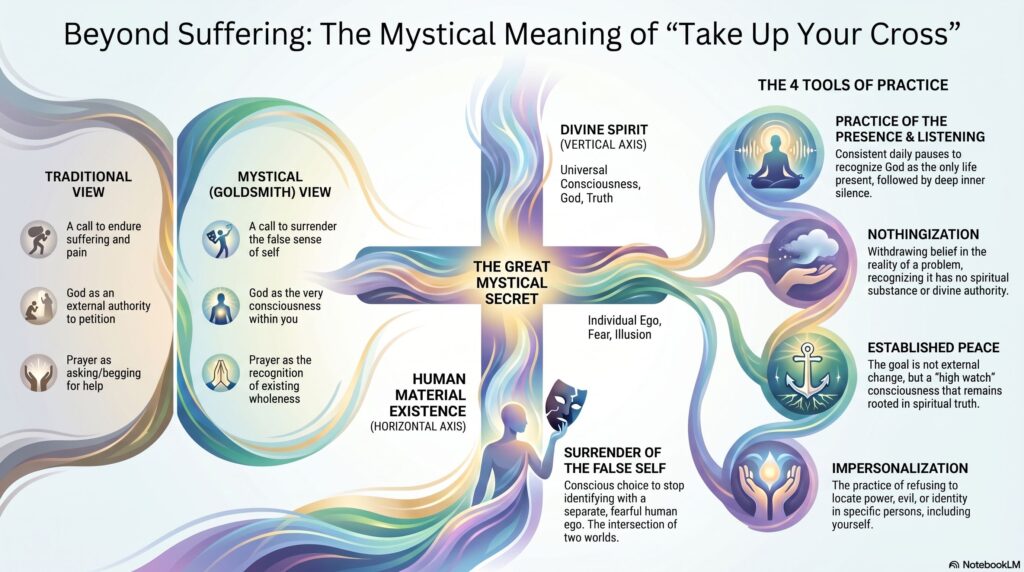
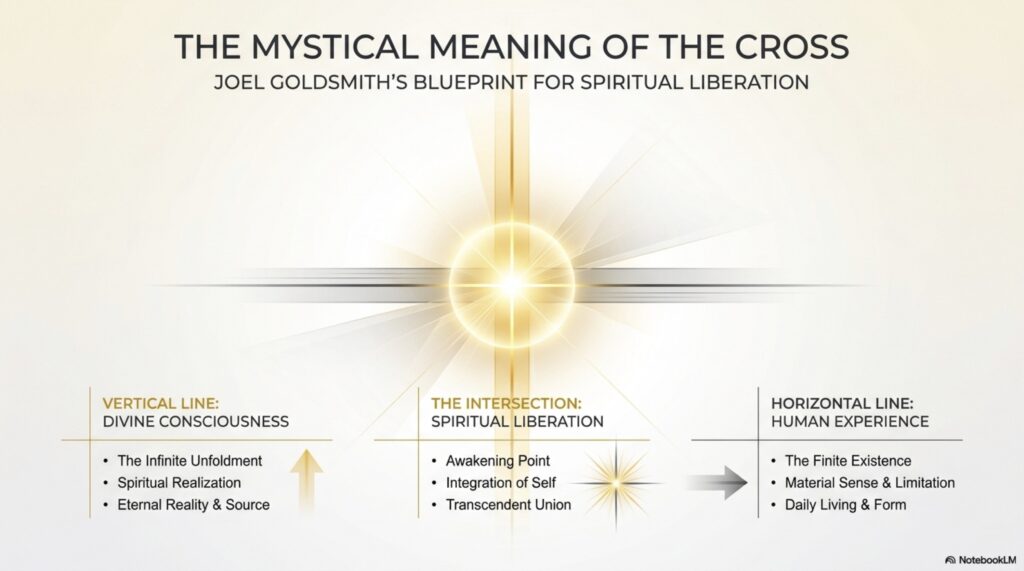
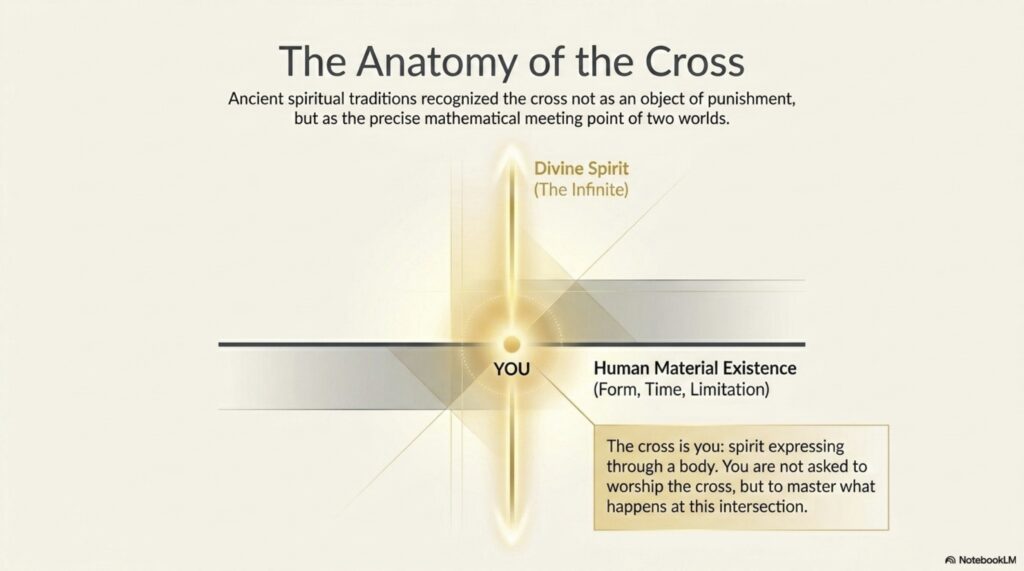
To the mystic, the cross represents a precise geometry of human consciousness. The vertical axis represents the descent of Divine Spirit, the infinite and eternal, while the horizontal axis represents the plane of material existence, the finite world of form and time. You exist at the exact point where these two lines intersect; you are the meeting point of the infinite and the finite.
The fatal error of conventional religiosity is the tendency to worship the external symbol of the cross while remaining blind to its internal reality. Goldsmith taught that “the cross is you”—the structural reality of your own existence as Spirit expressing through a body. When we shift our focus from an external object of historical suffering to this internal intersection, we stop being victims of the horizontal plane and begin to live from the vertical power of the Spirit.
3. Takeaway 2: “Dying” is an Act of Ego Surrender, Not Physical Sacrifice
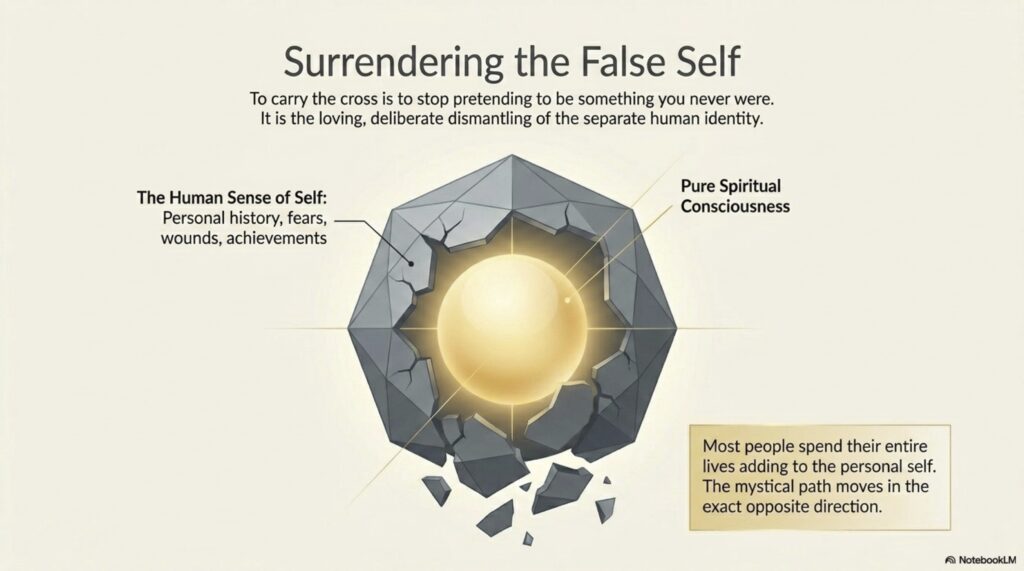
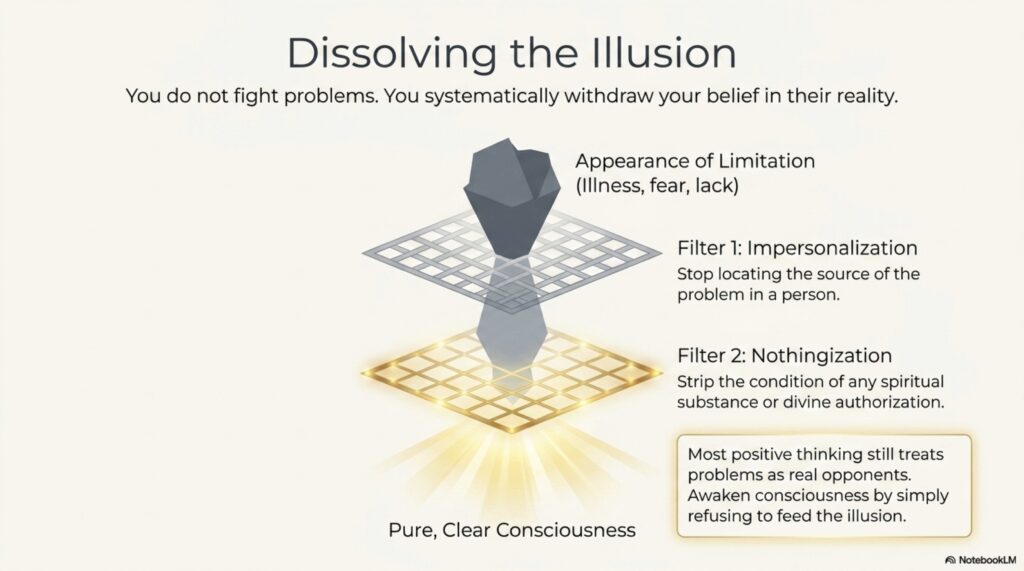
The “death” demanded by the cross is not the cessation of the physical body, but the systematic dismantling of the “human sense of self.” This false identity is the egoic construct that believes it exists independently of its Divine Source, fueled by personal history, wounds, and social standing. Goldsmith called the remedy “impersonalization”—the rigorous practice of refusing to locate power, evil, or identity in any person, including oneself.
“The cross is a symbol of conscious dying to the personal self. In every mystical tradition—Sufi, Kabbalistic, Hindu, and Christian—there is a recognition that the spiritual journey requires a death… the death of the ego’s claim to be the source of your life.”
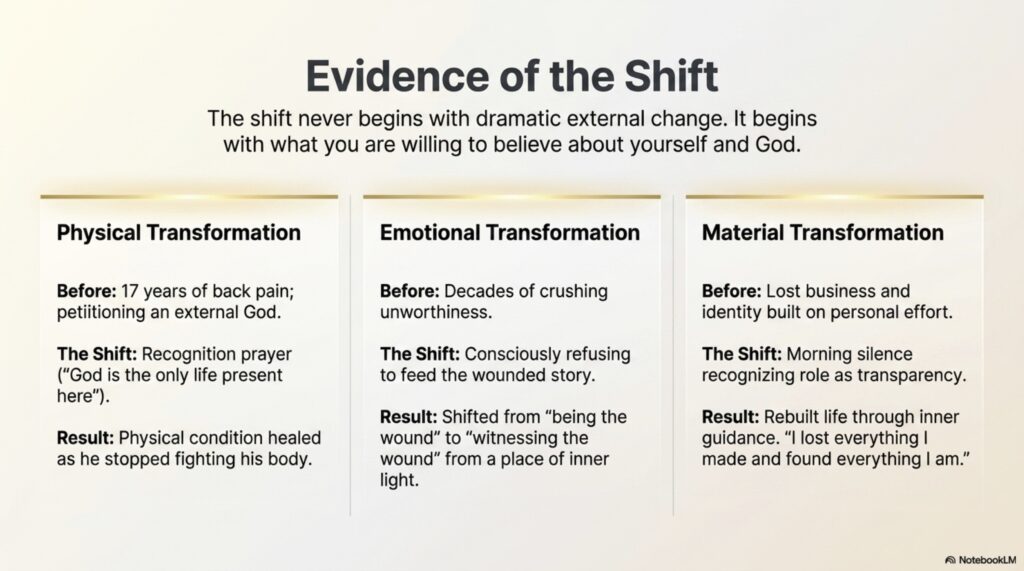
This process is illustrated by the story of Leonard, a man who built a successful business through sheer personal effort only to watch it collapse during an economic crisis. Initially crushed because his entire identity was tied to his achievements, Leonard used the cross to surrender his “builder” identity. He eventually realized that he had lost everything he had made, only to find everything he actually was—a foundation of spiritual consciousness that remained untouched by the wreckage of his horizontal world.
4. Takeaway 3: Stop Praying for Change; Start Practicing “Recognition”
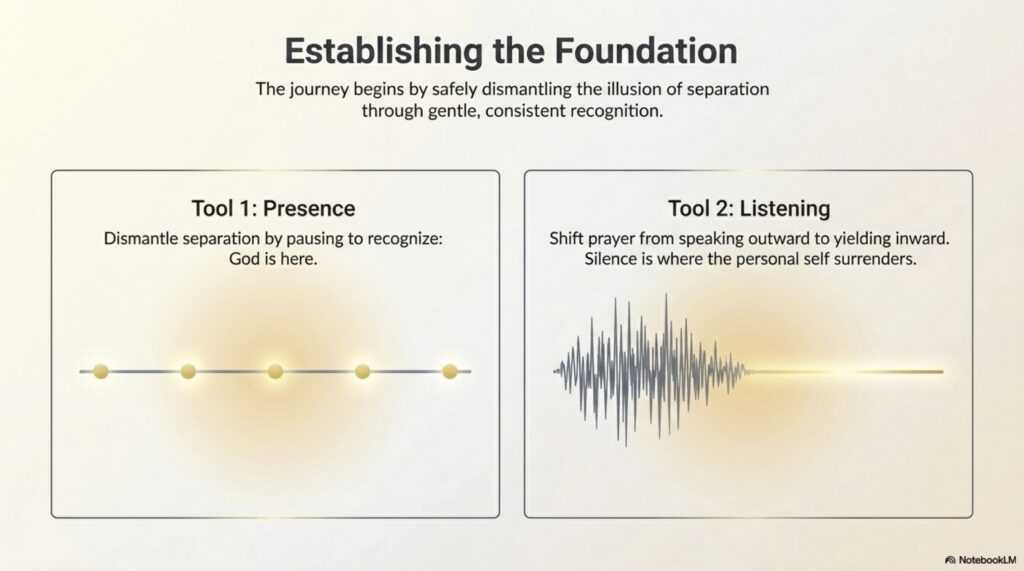
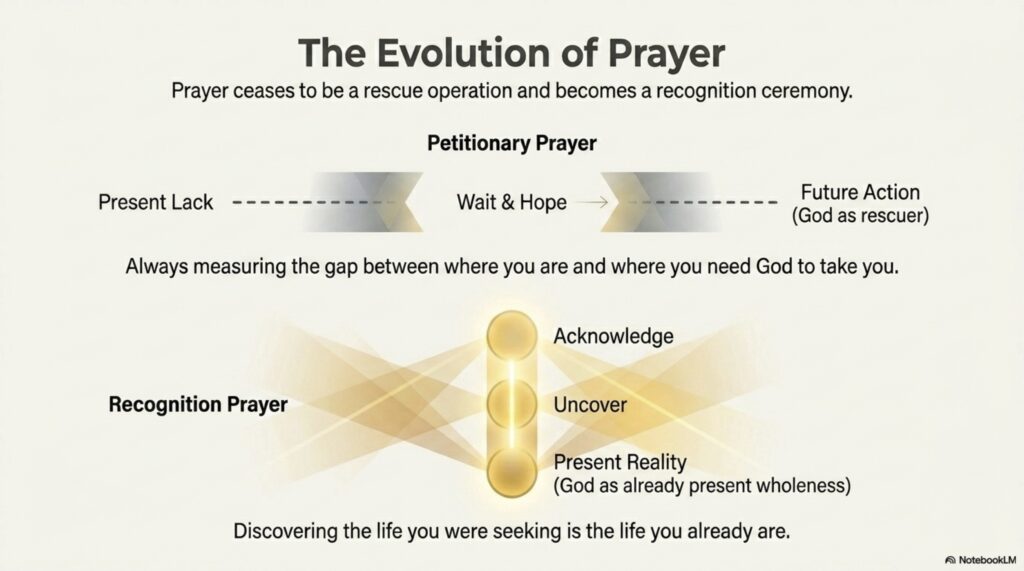
Most traditional prayer is “petitionary,” a form of begging an external God to intervene and alter material circumstances. Goldsmith suggests that this mode of prayer actually reinforces the problem because it is rooted in the assumption of separation—the belief that wholeness is missing and must be granted. True mystical practice utilizes “recognition prayer,” which acknowledges the Divine Presence as the only life and power already active in the moment.
Consider Harold, who sought relief from seventeen years of chronic back pain. Goldsmith’s teaching delivered a staggering realization: “God is not withholding your healing.” Harold had spent nearly two decades praying from a sense of lack, which only solidified his experience of being a separate, suffering human. By shifting to the “Practice of the Presence”—a consistent, gentle acknowledgment that God is the only life present—Harold moved from fighting a condition to recognizing a truth, and the physical symptoms eventually dissolved into that new clarity.
5. Takeaway 4: The Radical Power of “Nothingization”
Once we stop personalizing a problem, we apply the technique of “Nothingization.” This is the disciplined refusal to grant a problem “divine authorization” or ultimate power. It is not a psychological denial of physical symptoms or reality; rather, it is a withdrawal of belief in the problem’s spiritual substance. If a condition has no author in the One Presence, it is revealed as an appearance in consciousness without a foundation in truth.
The practice of Nothingization is performed in the sanctuary of silence. The practitioner sits quietly and recognizes that the appearance of lack or illness has no spiritual power over the life that is God. Crucially, Goldsmith warned: do not check for results. Checking for a physical change is a sign that the personal self is still in control, anxious for a specific outcome; instead, we rest in the recognition and leave the manifestation to the Divine.
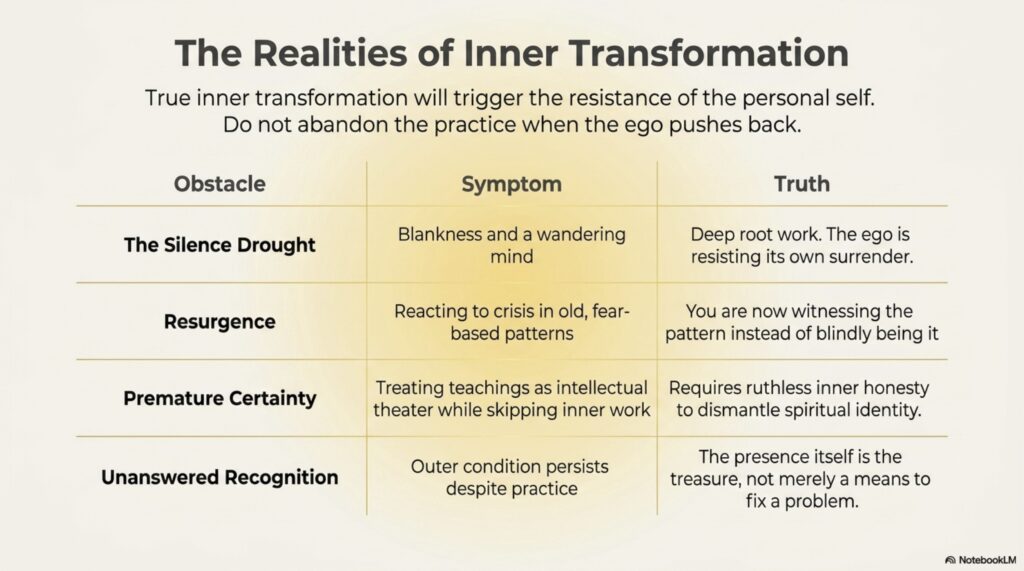
6. Takeaway 5: The “Silence Drought” is a Sign of Progress, Not Failure
The mystical path eventually leads to the “silence drought,” a season where the practitioner feels absolutely nothing—no peace, no presence, only a wandering mind. This discomfort is not a failure, but the resistance of the personal self as it feels its own irrelevance. Goldsmith likened this experience to “tending a garden in winter”; though the surface appears frozen and barren, the roots are deepening in the hidden soil.
This stage demands “spiritual integrity,” the ruthless honesty required to distinguish between true surrender and a mere “spiritual performance.” It is easy to adopt the vocabulary of mysticism, but the drought tests whether we are performing a role or truly practicing the presence. Navigating this challenge requires us to value the consistency of the work over the “feeling” of success, trusting that the Spirit is working beneath the vestiges of our personal perception.
7. Conclusion: Living from the Invisible
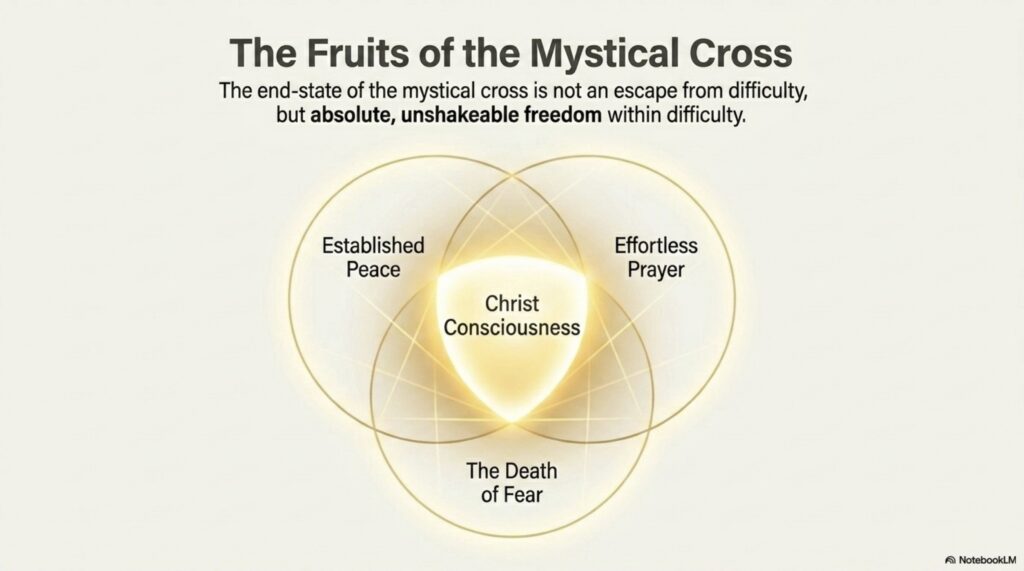
Living from the invisible results in an “established peace”—a groundedness that exists within difficulty rather than after it. This is the advanced integration of the teaching: the ability to meet the world not through egoic reaction, but from a center of spiritual transparency. Progress on this path is measured not by the absence of trouble, but by our “speed of return”—the ability to return to a state of peace in seconds rather than hours, whether we are in a boardroom or a grocery store.
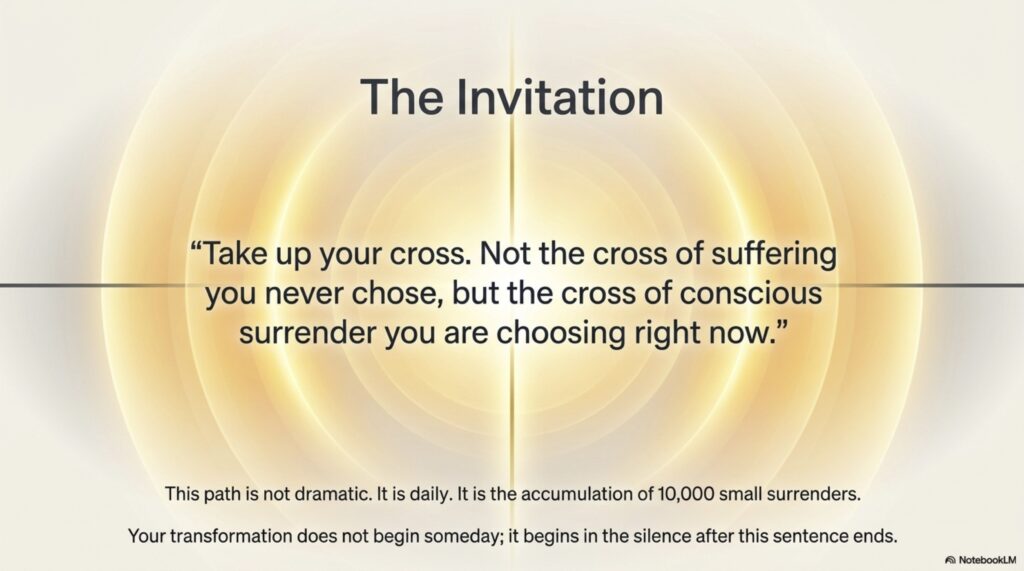
This journey from the visible to the invisible guarantees a rootedness that external events cannot disturb. It is a transition from a life organized around the shifting sands of material reality to one governed by the absolute reality of Divine Consciousness. We must eventually confront the ultimate question of the cross: Are you ready to die to the small, separate self to find the life that was never born and cannot die? The transformation begins the moment you decide to stop carrying your burdens and start carrying your cross.
Ai Executive Summary
The Mystical Interpretation of the Cross: The Teachings of Joel Goldsmith
Executive Summary
The traditional interpretation of the biblical mandate to “take up your cross and follow me” has historically been associated with the endurance of suffering, pain, and life’s burdens. However, the mystical teachings of Joel Goldsmith present a radical departure from this view. According to Goldsmith, the cross is not a symbol of suffering but a call to spiritual freedom through the surrender of the “personal self” or ego.
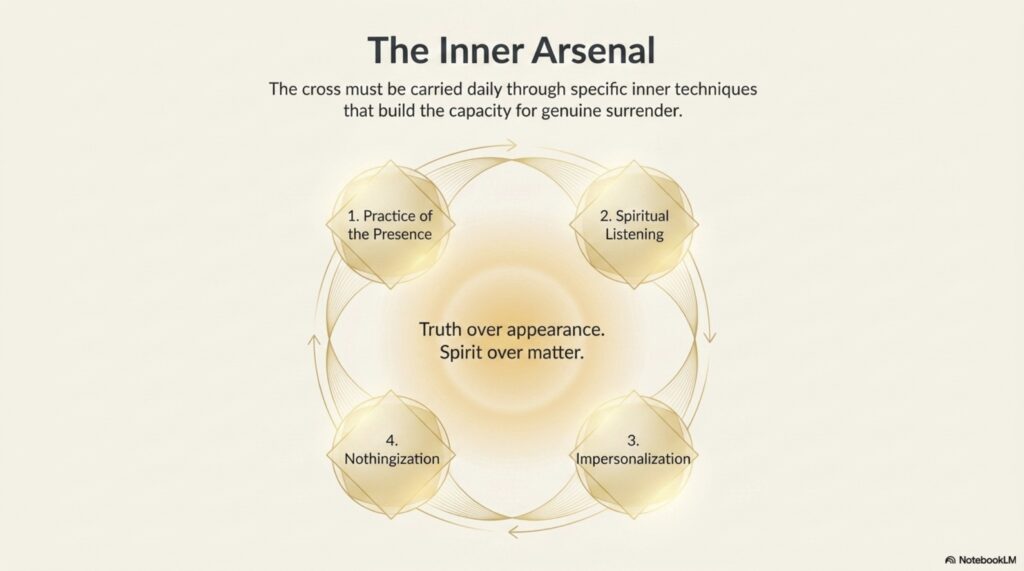
The core of this teaching lies in the transition from a sense of separation from God to a realization of oneness. The “cross” represents the intersection of the divine (vertical axis) and the human (horizontal axis). To “carry the cross” is to consciously choose to stop identifying with the fearful, striving, separate human identity and instead recognize one’s true nature as spiritual consciousness. This process is supported by specific meditative practices—Practice of the Presence, Spiritual Listening, Impersonalization, and Nothingization—which aim to transform consciousness from the inside out. Ultimately, this path leads to an “established peace” and a life no longer dependent on external circumstances for fulfillment.
Redefining the Cross and the Command to “Follow”
The source context outlines a fundamental shift in understanding the symbols of the cross and the act of following Jesus.
The Symbolism of the Cross
In the mystical tradition, the cross predates its use as an emblem of crucifixion. It represents the meeting point of two worlds:
- The Vertical Axis: Represents the divine spirit.
- The Horizontal Axis: Represents human material existence, form, time, and limitation.
- The Intersection: Every human being lives at this point, where the infinite meets the finite.
Goldsmith asserts that the fatal error of mainstream religion is teaching the worship of the cross rather than understanding the surrender required at that intersection. The “cross” is the false identity—the human sense of self—that must be released.
The Meaning of “Follow Me”
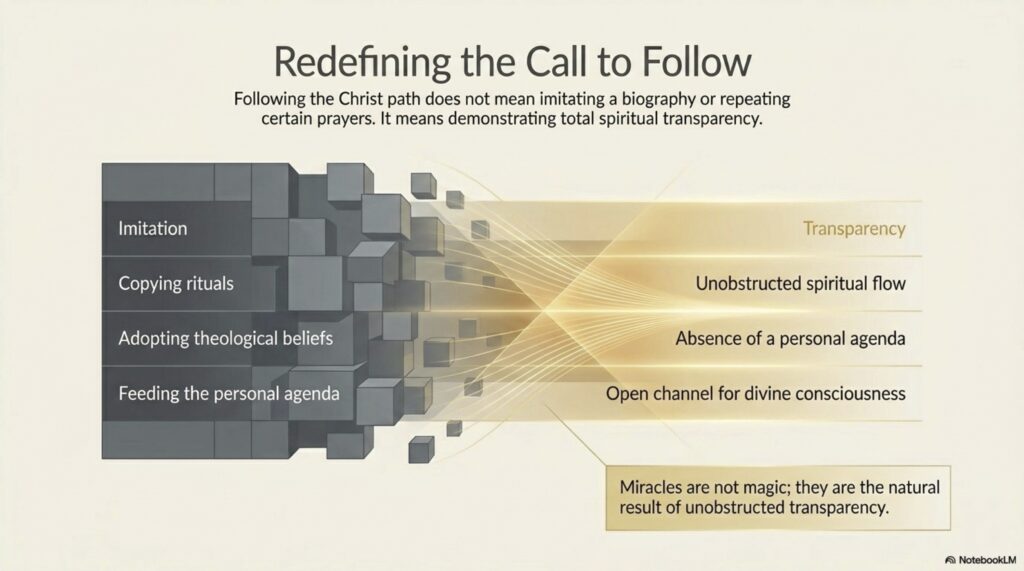
To follow Jesus in a mystical sense is not to imitate his biography, rituals, or prayers. Instead, it means:
- Total Transparency: Following the inner path Jesus demonstrated, which was a life characterized by the absence of a personal agenda.
- Unobstructed Flow: Achieving a state so surrendered to divine consciousness that “miracles” become the natural result of spiritual flow rather than external interventions.
The Practice of Transformation: Four Essential Tools
Goldsmith developed specific techniques to transition from intellectual understanding to lived experience.
| Tool | Definition and Method | Purpose |
| Practice of the Presence | Pausing three to five times daily to acknowledge God as the only life operating within. | Dismantles the assumption of separation from the divine source. |
| Spiritual Listening | Moving beyond outward-bound petitionary prayer to a state of inner silence. | Silences the personal self to allow the “still small voice” of divine consciousness to be heard. |
| Impersonalization | Refusing to locate the source of problems or goodness in specific persons, including oneself. | Prevents the practitioner from accepting the appearance of limitation or illness as the final truth. |
| Nothingization | Recognizing that a problem has no spiritual substance or divine authorization. | Withdraws belief in the reality of a problem as a power, rather than fighting it. |
Recognition Prayer vs. Petitionary Prayer
A critical distinction in Goldsmith’s teaching is the move away from petitionary prayer.
- Petitionary Prayer: Approaches God as an external authority who might grant relief, which reinforces the belief in separation and lack.
- Recognition Prayer: Recognizes that God is the only life present and that wholeness is already an established spiritual fact.
Challenges on the Spiritual Path
The journey of carrying the cross involves significant psychological and spiritual obstacles that require persistence and honesty.
- The Silence Drought: Periods where the practitioner feels nothing during meditation. This is interpreted not as failure, but as “depth work” where the personal self is losing control.
- Resurgence of Old Patterns: The return of fear-based reactions during crises. Success is measured not by the absence of fear, but by the development of enough inner space to witness the fear without being consumed by it.
- Premature Certainty: An intellectual mastery of the concepts without the actual inner work of surrender. Goldsmith refers to this as a lack of “spiritual integrity.”
- Unanswered Recognition: When external conditions do not change despite sincere practice. This requires the realization that the practice is a reorientation toward God, not a transaction for specific results.
Advanced Integration into Daily Life
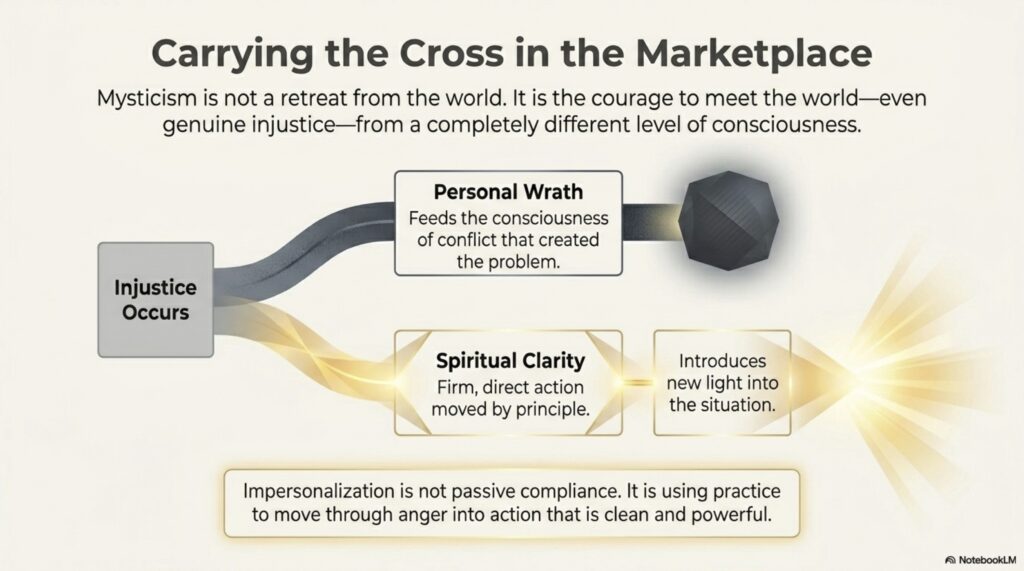
The mystical path is not a retreat from the world but a new way of engaging with it.
Keeping the Consciousness
This is the development of “spiritual muscle memory”—the ability to return to spiritual awareness within seconds when provoked by ordinary life. The goal is rapid return to peace rather than total immunity to disturbance.
Addressing Injustice and Others’ Suffering
- Non-Passivity: Impersonalization does not mean being a “doormat.” Actions against injustice should be taken from a center of spiritual clarity and love rather than personal wrath.
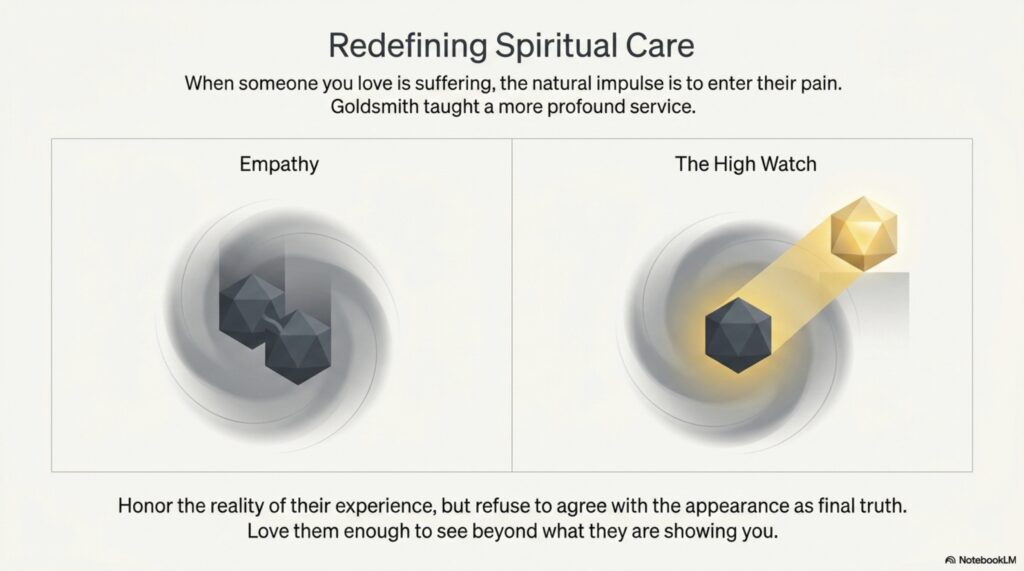
- Holding the High Watch: When seeing others suffer, the practitioner honors their experience but refuses to accept the appearance of suffering as the final truth, instead recognizing their spiritual wholeness.
Living from the Invisible
This involves organizing life around the invisible reality of divine consciousness rather than visible material reality. It allows a person to remain content and rooted regardless of whether external circumstances are pleasant or difficult.
The Fruits of the Path
Sincere practice leads to a permanent transformation of the individual’s experience of reality.
A Shift in Relationship with Time: Recognition prayer discovers good as already present, removing the need to wait for a future intervention from a separate God.
Established Peace: A background peace that persists through conflict. Emotions are felt but seen as experiences passing through a vast inner space rather than as a trapped self.
Radiant Presence: A natural groundedness and calm that others notice, described as a transparency to divine life.
The Dissolution of the Fear of Death: By repeatedly “dying” to the ego, the practitioner touches a part of consciousness that was never born and cannot die. This removes the root of nearly all human suffering.
Related:
Leave a Reply to Tabernacling – Heart-Posture.com Cancel reply