The following has been generated by notebooklm.google..com, based on a short paragraph, shared by Ralph:
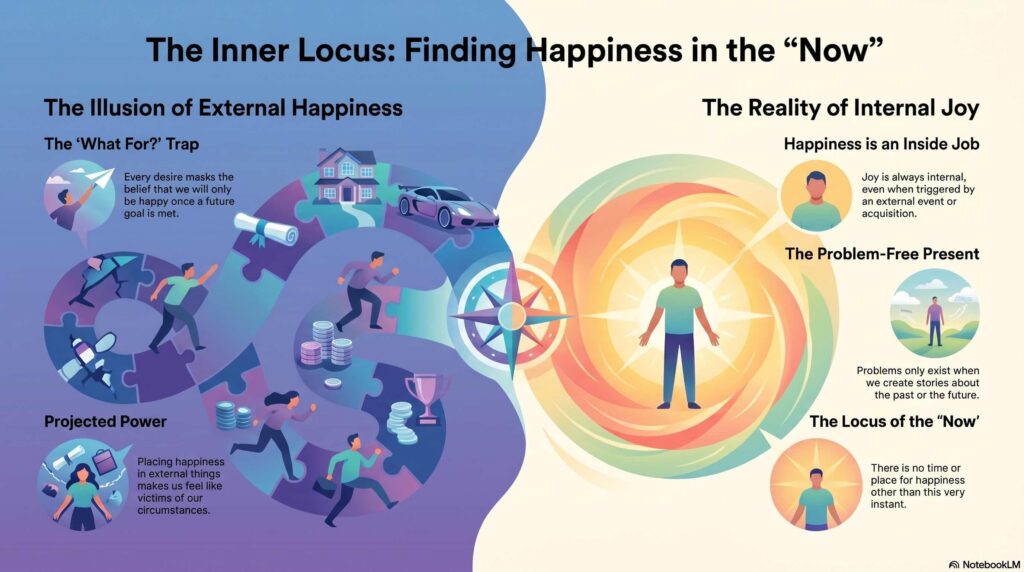
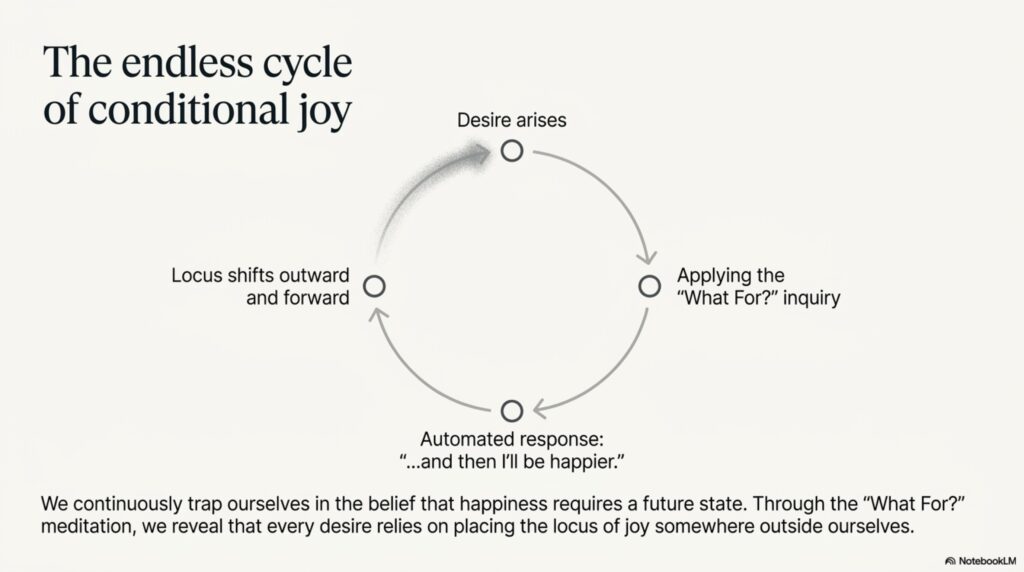
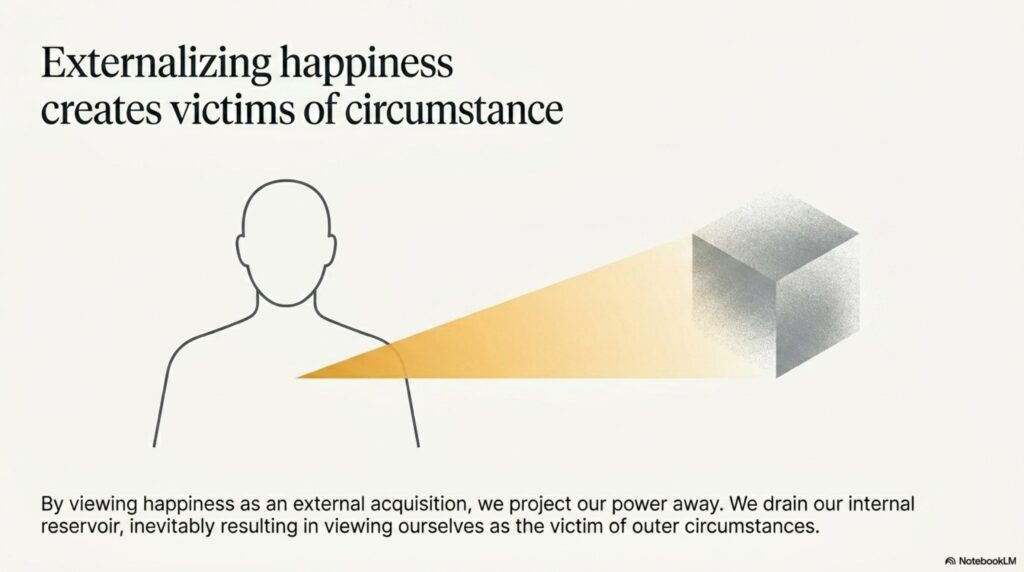
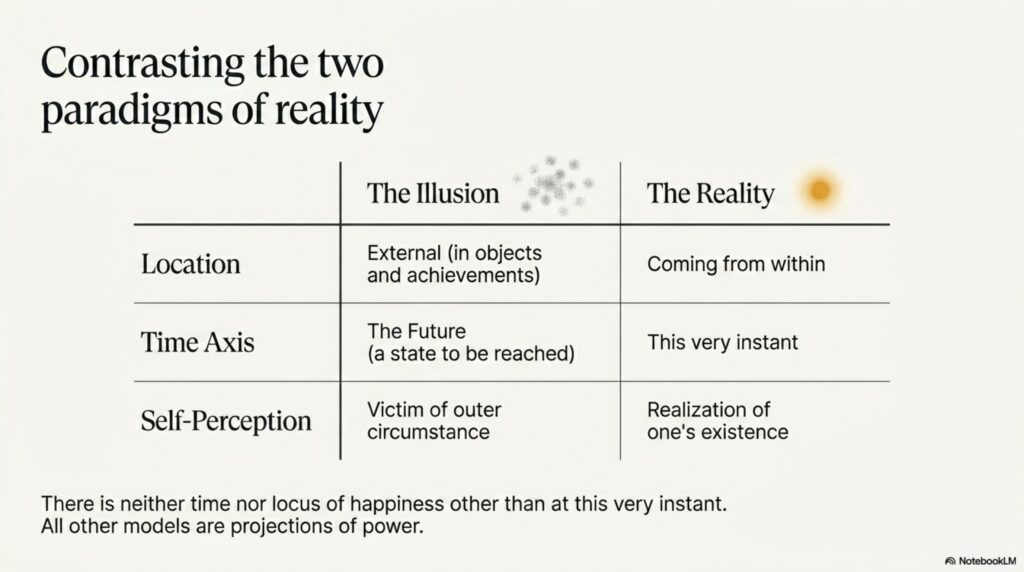
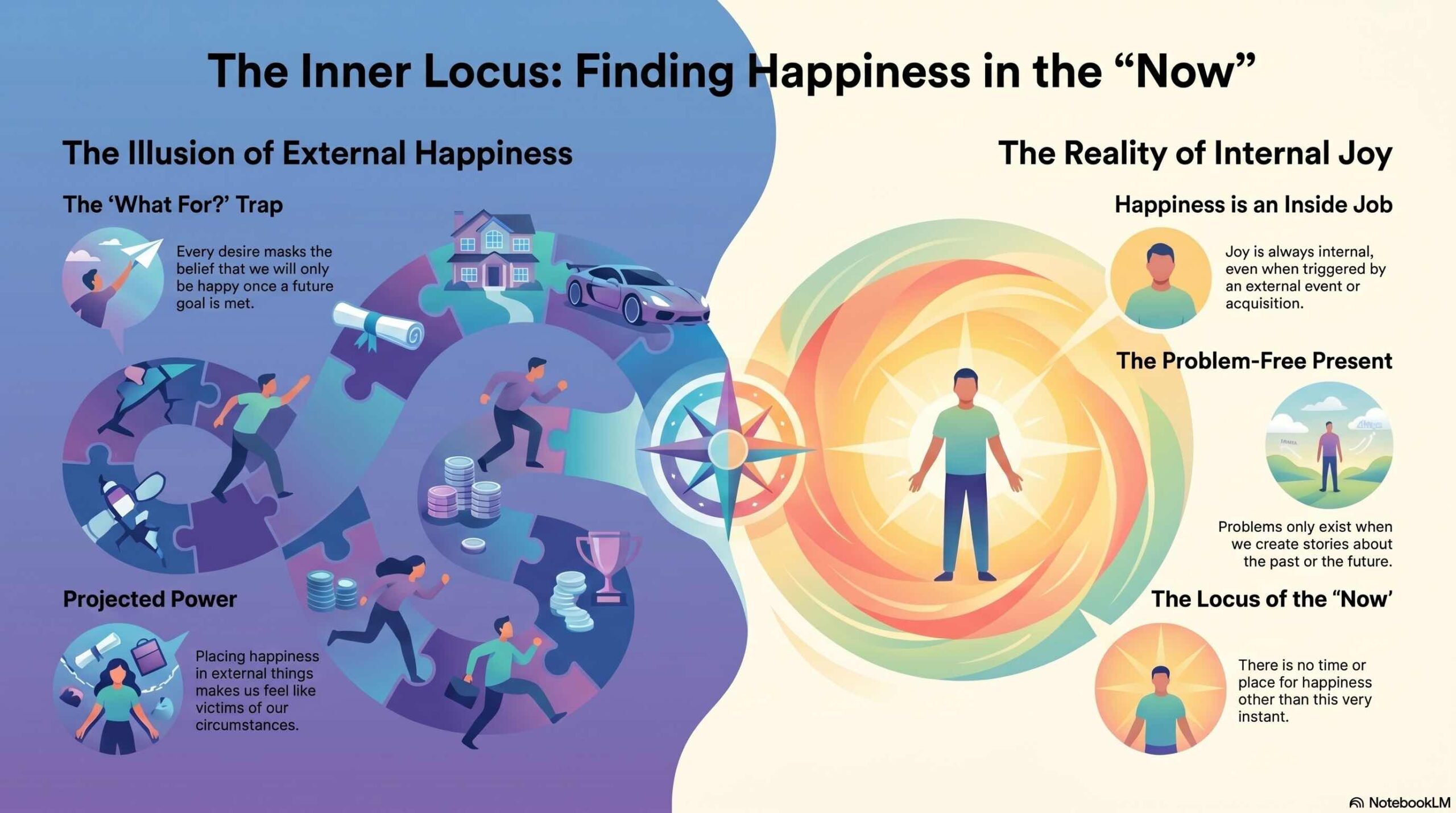
There is a meditation we might call “What For?”. When we note a desire, we can ask, “What For?” The answer is always “ … and then I’ll be happier”. Thus, the locus of happiness is always something that is outside oneself and in the future. The result in viewing oneself as the victim of outer circumstances. This is also a projection of one’s power. The possible source of happiness is actually coming from within. There is neither time nor locus of happiness other than at this very instant.
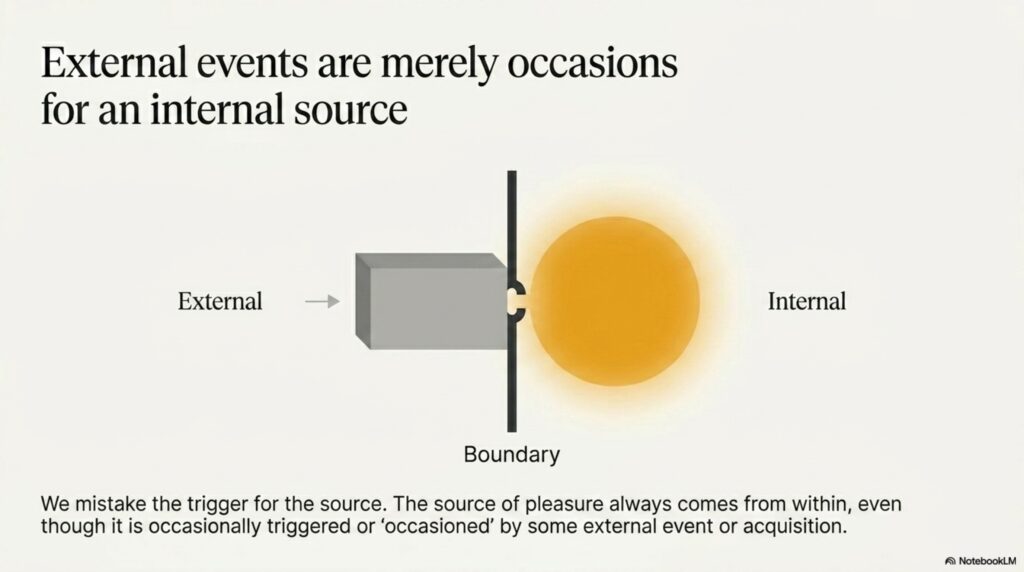
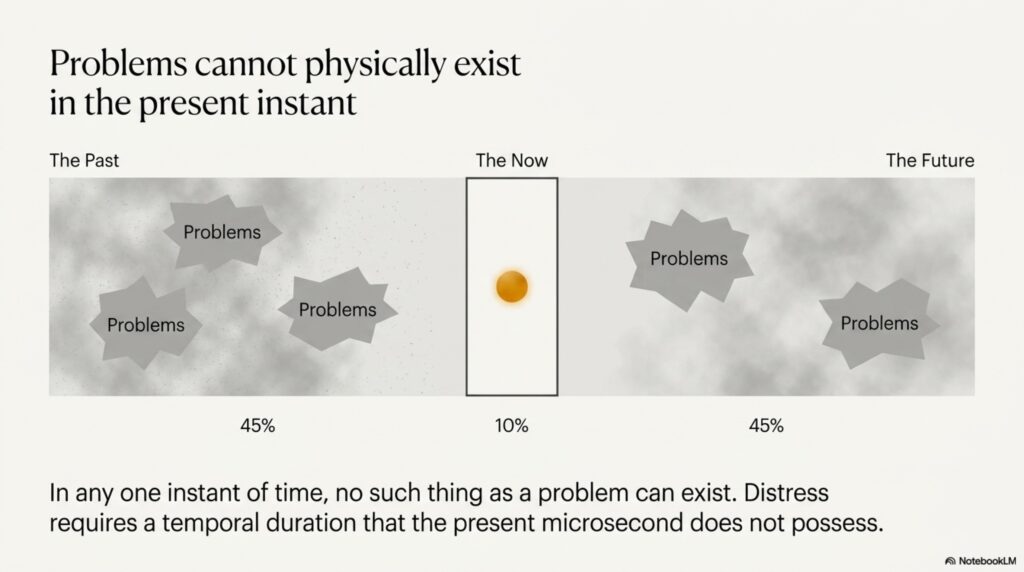
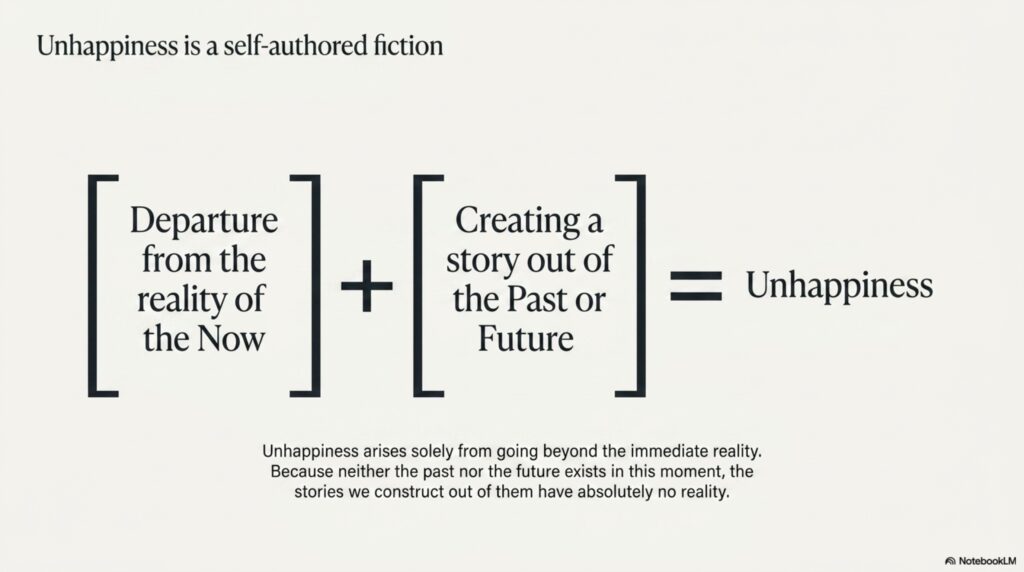
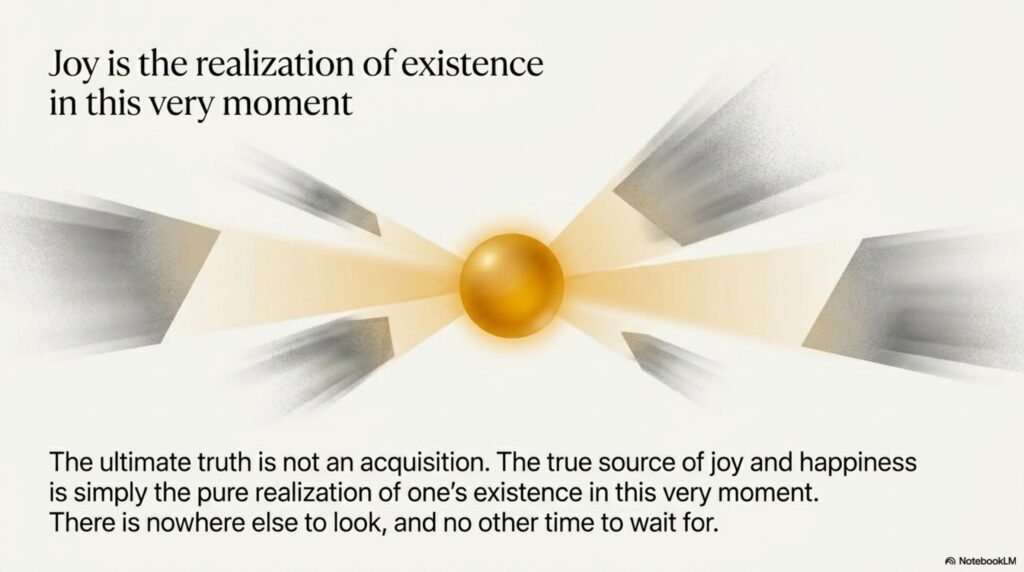
The true source of joy and happiness is the realization of one’s existence in this very moment. The source of pleasure always comes from within, even though it is occasioned by some external event or acquisition. In any one instant of time, no such thing as a problem can exist. Unhappiness arises from going beyond the reality of the Now and creating a story out of the past or the future which, because neither exists in this moment, has no reality.
1. The “What For?” Inquiry: Unmasking the Chase
To the unexamined mind, desires appear as a chaotic map of needs—for a better career, a deeper relationship, or a specific possession. Yet, the transformative educator invites you to peer beneath these surface cravings through the “What For?” inquiry. This is not a tedious exercise in logic, but a direct shortcut to the root of the human condition. It reveals that every movement of our will is fueled by a single, hidden expectation.
The “What For?” Meditation: A focused moment of self-inquiry where we confront a current desire with the question, “What for?” This inquiry bypasses the superficial object to uncover the psychological aim.
This investigation unfailingly reveals a three-step cycle of projection:
- Observation of Desire: You notice a pull toward an external acquisition or future event.
- The Question: You ask, “What for do I want this?”
- The Realization: You discover that the answer is always, “…and then I’ll be happier.”
The “So What?”: This inquiry exposes a profound misplacement of life. By tethering your well-being to a future outcome, you inadvertently exile your happiness to a location (the future) and a state (the “not yet”) that you can never actually inhabit. We treat happiness as a ghost we are constantly chasing, rather than the ground upon which we currently stand.
This inquiry unmasks a deeper tragedy: the unconscious surrender of our own sovereignty and the projection of our inherent power onto things that have no life of their own.
2. The Power Shift: Victimhood vs. Internal Agency
When we believe that happiness resides in external circumstances, we perform an act of “power projection.” We strip ourselves of spiritual autonomy and hand the keys of our well-being to a world that is inherently unstable. To return to the “Inner Locus” is to move from being a casualty of fate to becoming a witness to your own being.
| Feature | External Locus (The Projection) | Inner Locus (The Reality) |
| Where Power Resides | In external acquisitions and the alignment of future events. | Within the fundamental fact of the individual’s own being. |
| View of Self | A victim of outer circumstances, waiting for permission to feel whole. | A realizer of one’s own existence, self-contained and sovereign. |
| Dependence | Emotional well-being is a hostage to events beyond one’s control. | Joy is a self-arising state, independent of the shifting tides of fortune. |
The “So What?”: Recognizing the internal source of happiness restores your agency. To be a “realizer of existence” means your wholeness is rooted in the simple fact that you are, rather than the complex story of what you have achieved. By withdrawing your power from the “out there,” you become the master of your internal climate.
If happiness is not “out there,” we must realize it is also not “back then” or “yet to come”—it exists only in a specific dimension of “when.”
3. The Temporal Reality: Happiness in the “Now”
The most radical insight of this teaching is that happiness is strictly bound to the present. It is not merely that the present is a better time to be happy; it is that the present is the only time happiness is possible. To live in the past or future is to live in a desert of non-reality.
- The Instant: The only locus of reality. It is the only “place” where life—and therefore happiness—can actually occur.
- The Past: A collection of stories and memories. While they may feel heavy, they lack current reality and cannot host genuine joy.
- The Future: A projection of the imagination. It is a phantom that distracts from the truth of the current moment.
The “So What?”: Consider this revolutionary truth: In a single instant of time, a problem cannot exist. Unhappiness is a narrative structure; it requires a “story” that stretches across time, linking a painful past to a fearful future. When you collapse your focus into the singular, vibrating reality of this very instant, the oxygen is cut off from suffering.
Once we anchor ourselves in the Now, we can finally understand the difference between the sparks that trigger us and the eternal fire within.
4. Triggers vs. Sources: The Mechanics of Pleasure
We often mistakenly attribute our joy to the objects we acquire. We think the new house or the sudden praise “makes” us happy. However, the wisdom tradition clarifies that external things are utterly devoid of inherent pleasure.
Concept Spotlight: The Internal Origin
An external event or object can occasion pleasure, but it can never source it. Think of the external object as a spark and your own being as the fuel. The spark provides the occasion for the fire, but the warmth and light come from the fuel itself.
- The Occasion (The Trigger): This is the external event. It is temporary, shifting, and has no happiness of its own to give.
- The Source (The Origin): This is your internal realization of existence. It is the fundamental spring from which all feeling flows.
The “So What?”: You are the author of every ounce of joy you have ever felt. When an object “makes” you happy, it has simply provided a temporary excuse for you to stop seeking and relax into your own natural state. You are not receiving joy from the world; you are experiencing your own internal light reflected back at you.
This shift moves you from being a passive recipient of luck to an active realizer of the joy that is your very nature.
5. Summary of Insights for the Aspiring Learner
To transition from being a victim of circumstances to a realizer of existence, apply these shifts to your daily awareness:
- Apply the “What For?” Inquiry: Whenever you feel the pull of a new desire, immediately ask “What for?” and catch yourself in the act of projecting your happiness into a non-existent future.
- Dissolve the Narrative: When unhappiness arises, notice the “story” you are telling about the past or future. Deliberately return to the single, problem-free instant of the absolute Now.
- Recognize the Occasion: When you feel pleasure from a success or a purchase, remind yourself: “This object possesses no inherent pleasure; I am the source of this joy.”
The true source of joy and happiness is the realization of one’s existence in this very moment.
Leave a Reply