
Disclaimer: All words as concessions! 🌸
From: Ralph
To: Holger
Subject: stuff
Date: Tue, 17 Mar 2026 16:37:55 -0400
Excerpts from “The Way of the Bird” quotations of Ranjit Maharaj.
The Realized Person:
12.1 “The body has no free will. Free will is always for the realized person.”
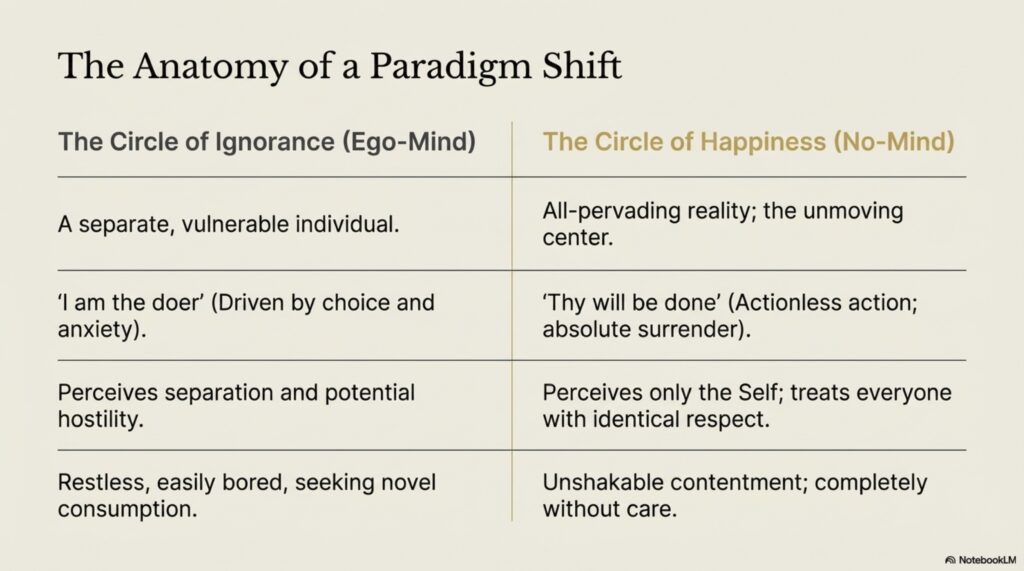
Free will is a concept that is considered almost sacred in the West, but which has no foundation in reality. It simply does not correspond to the way things are and, sooner or later, it has to be abandoned in favor of surrender to a higher power. The “free will” that the realized person enjoys comes from complete surrender. To see and experience the perfection of things as they are and to accept without reservation is true freedom of the will. The realized person always has the attitude “Thy will be done.”
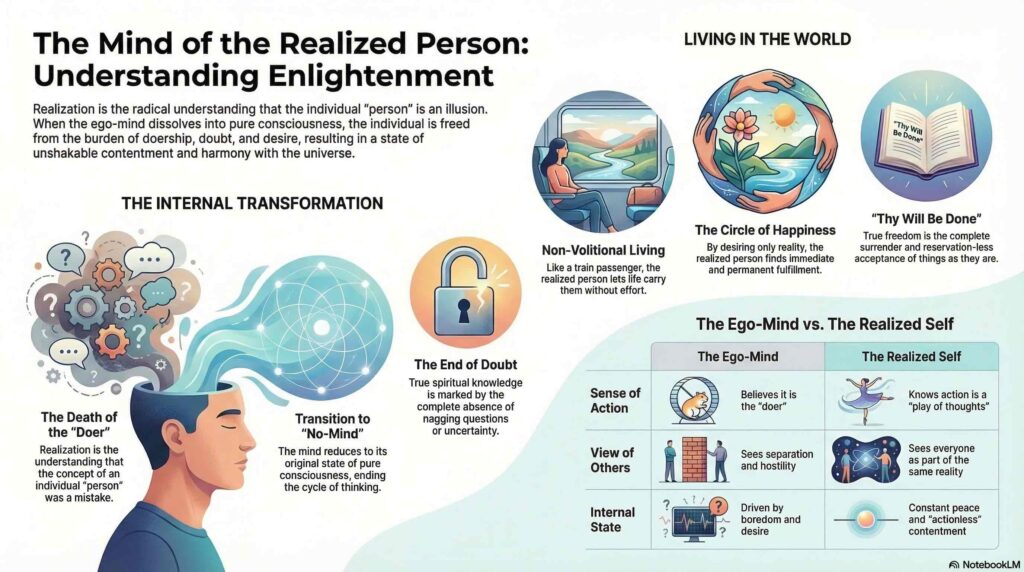
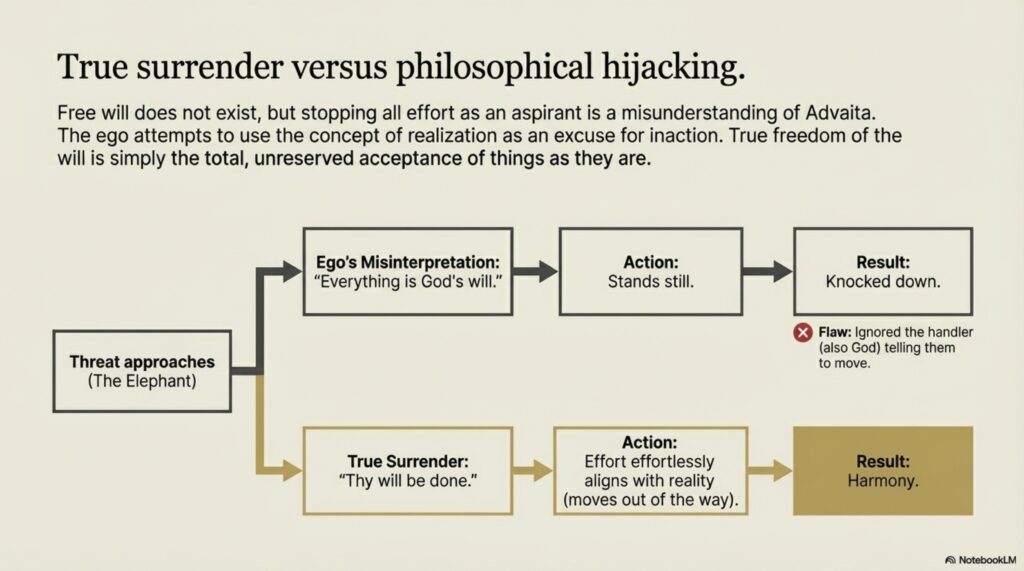
As an aspirant, however, you cannot simply say “thy will be done” and stop making any effort. To go that way is to misunderstand Advaita. This mistake is illustrated by the story of the man who stood in the way of the elephant. The elephant’s handler called out to the man to move but the man just said “I am God, the elephant is God, everything is God’s will.” Of course, he was knocked down and injured by the elephant. When he complained to his guru, saying that he had only repeated what the guru had told him, the guru said “the elephant’s handler, who told you to get out of the way, was also God, but you chose to ignore Him at that point.”
12.2 “Realized persons understand by mind only.”
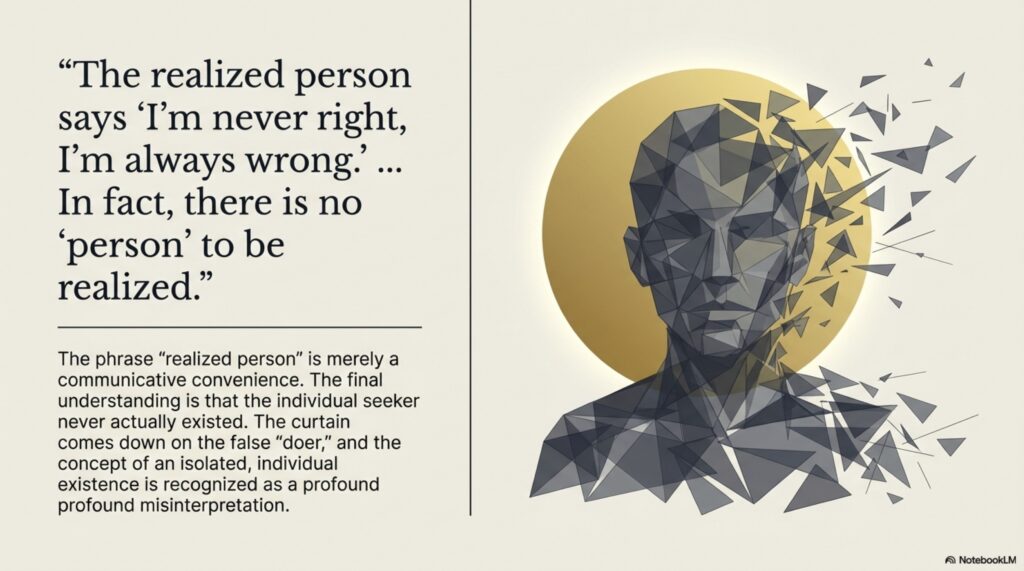
The real, or final, understanding, is that there is no one who has anything to gain, no one who is seeking, and no one to understand. This understanding is what the apparent journey of spiritual seeking is heading towards. It should be clear, though, that the mind itself meets its death in this realization (which is why it is called “final” understanding). Unwittingly, the ego-mind brings about its own death. The ideas of the Master, once accepted and absorbed, transform the mind completely, reducing it to its original state of no-mind, or pure consciousness. Realization is the last scene of the last act for the purified mind. The curtain comes down on the false “doer.” There is no repeat performance.
12.3 “The realized person says `I’m never right, I’m always wrong.’”
The phrase “realized person” is only used for the purposes of communication, to indicate that there is a fundamental change that occurs, and which is called realization or enlightenment. In fact, there is no “person” to be realized. Realization is really the understanding that the concept of individual existence as a “person” was an illusion, a mistake, a misinterpretation. The so-called realized person knows this very well and so he
or she says “I’m never right, I’m always wrong.” After realization, you may answer when someone calls your name and may continue to act in the world, but you will never take yourself to be an individual entity, separate from your source as pure consciousness.
12.4 “The realized man’s wish is always fulfilled. He wants reality. So he is never unhappy, he is always happy.”
The paradox of spiritual seeking is that you have no free will but at the same time you have to act as though everything depends on your own choices and your own efforts. This is the humor of the situation from the “divine” point of view. What you want is what you get. Seek and you shall find. This is right and appropriate and you should persist until you know that you have got what you want and found what you were seeking. Then you are out of the circle of ignorance.
The realized person has got out of the circle of ignorance and into a “circle of happiness.” If the question arises “What do I want?” the answer comes “I want only reality, the Self.” Then it is immediately understood that I already am that reality. In that understanding there is happiness and fulfilment. Consequently, there is no need, and no room, for any other desire.
12.5 “When you understand, then the power is there and everything you do is `correct.’”
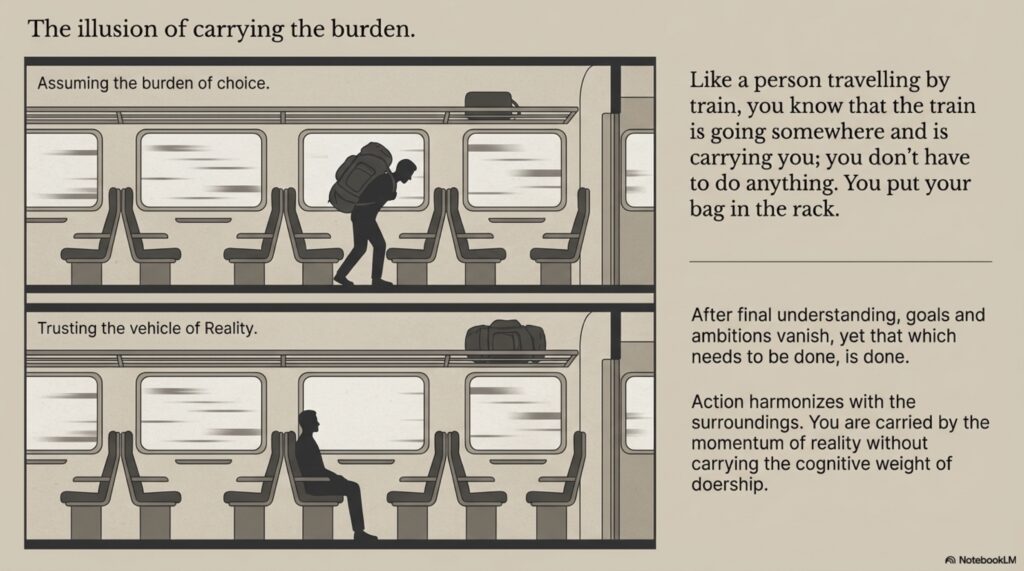
After final understanding, you find that you understand whatever you need to understand. Ideas which were previously unclear become clear as daylight to you. That understanding is like a power that is manifest in you. You feel in harmony, in tune with your surroundings. You feel that what is happening is right, and could not be otherwise. Because you feel this power in you and around you, your actions are also “correct.” You find yourself without goals or ambitions, but still, that which needs to be done, is done. Like a person travelling by train, you know that the train is going somewhere and is carrying you; you don’t have to do anything. You put your bag in the rack. You don’t carry it on your back any longer.
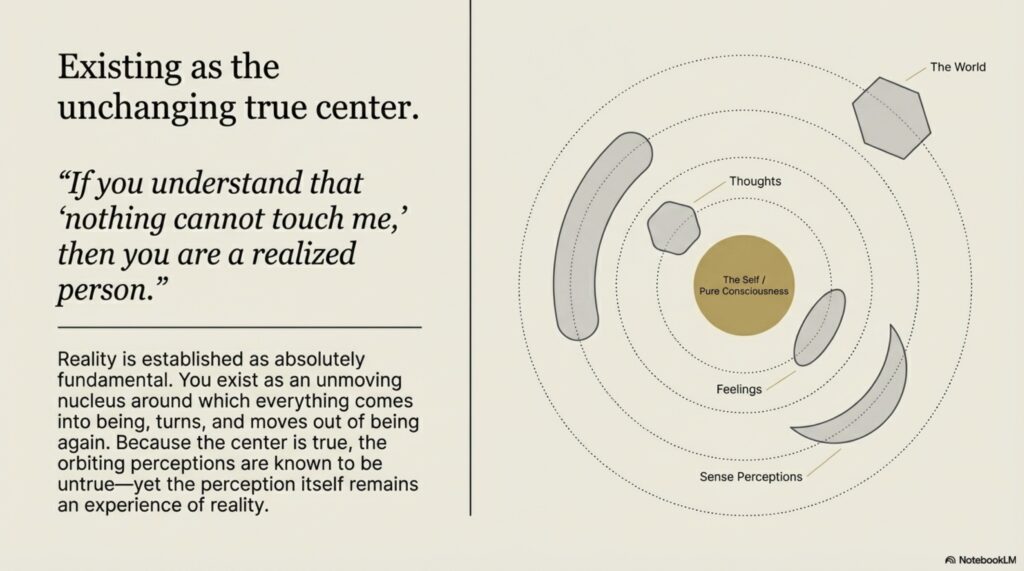
12.6 “If you understand that `nothing cannot touch me,’ then you are a realized person.”
To say that the world is nothing is not to belittle it or make light of the sufferings that others are experiencing. All that is as it is. You cannot change it. However, for you, when final understanding is there, the world is as nothing. It doesn’t disappear, your wordly troubles don’t go away, and you do not become suddenly a better person. Nevertheless, you understand at the deepest, most intuitive level that it is all nothing and it cannot touch you in any way. It is not really possible to describe this in words.
What seems to happen with final understanding is that you become established in a sense of reality that is absolutely fundamental, as though you were existing as an unmoving center, around which everything was turning, coming into being, and moving out of being
again. Because you always know yourself as this unchanging, true center, you automatically have the knowledge that what you perceive is not true, because, as perception, it is other than that center. On the other hand, because you always experience that true center, you do not experience your perceptions as false. You are always experiencing reality, even while you are perceiving something, and so perception is also an experience of reality for you.
12.7 “When you know everyone is myself, then what you do, it’s all the same to you.”
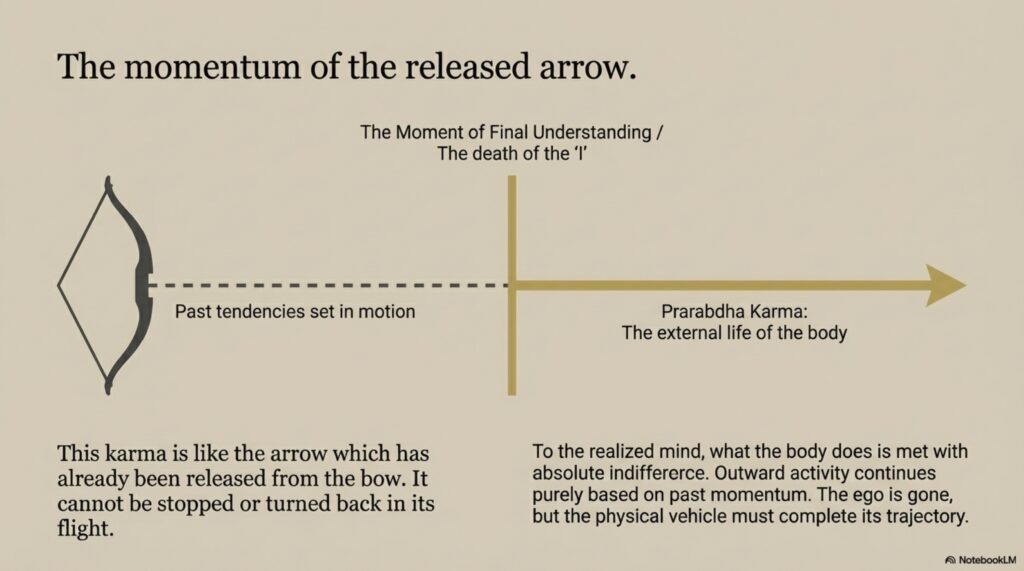
After realization, you find that you don’t mind how things go, whether you do one thing or some other thing. Why do you feel such indifference? Because you know that all that activity doesn’t really have anything to do with you. It is all happening according to the prarabdha karma, that is, according to those tendencies which have already been set in motion and which must come to fruition through the body and mind. This karma is like the arrow which has already been released from the bow. It cannot be stopped or turned back in its flight. That is your external life after realization. There is nothing for you to do. Similarly, when you know everyone is yourself, you don’t crave the company of particular people. You get on perfectly well with anyone and you are inclined to treat everyone with the same respect.
12.8 “Try to understand the realized person, what they say. They say they have never done anything in their life.”
To imagine that realization is a state of great personal power is wrong. Realization is the essence of impersonality. In the realized person, the concept of the individual has been effaced. It is fully understood that the notion of being a person was an illusion. You know that it is an illusion, even though that notion is the whole basis for society, culture, philosophy, psychology, and so on. This understanding is so completely radical that very few people can even hear it without rejecting it outright. Of those few, still fewer will actually accept the truth of it.
The acceptance and understanding that there never has been any “doer” is one of the characteristics of the realized person. He or she knows that everything that has happened, from birth in a particular body, through the beginning of spiritual seeking, to the final understanding, has all happened without the intervention of any individual, and that the concept of the individual itself was only a wrong assumption.
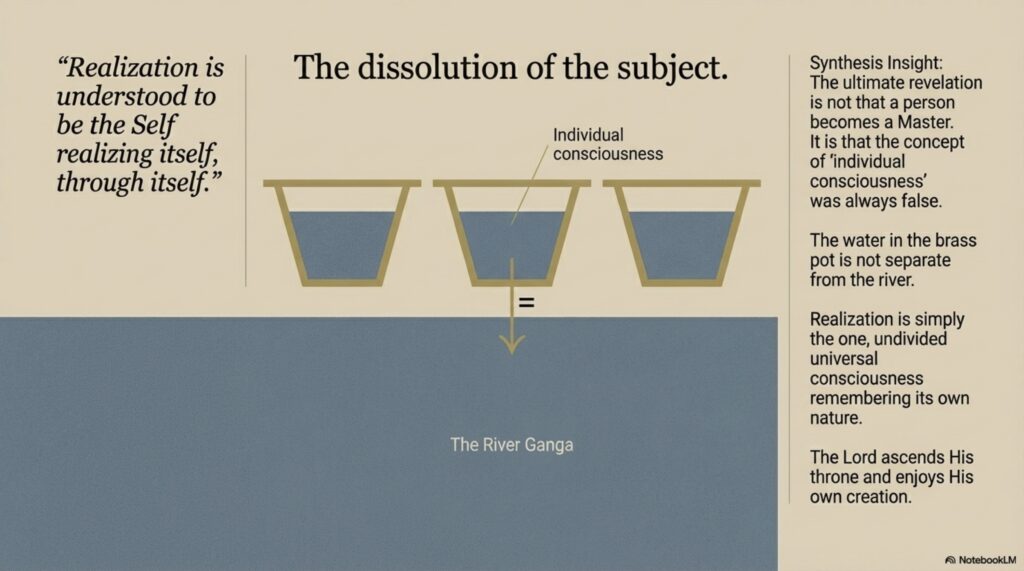
The realized person may be very reluctant to use the word “I,” because it is understood that there is no “I” in the sense in which it is usually taken. He or she may therefore attempt to speak without it, perhaps using a phrase such as “this one” instead of using the personal pronoun, or may speak in a passive voice, using phrases such as “realization has occurred,” instead of “I have realized.” Realization is understood to be the Self realizing itself, through itself. The realized person will generally never say “I am a realized person,” because it simply doesn’t make any sense. Realization happens, but it does not happen to an “I.”
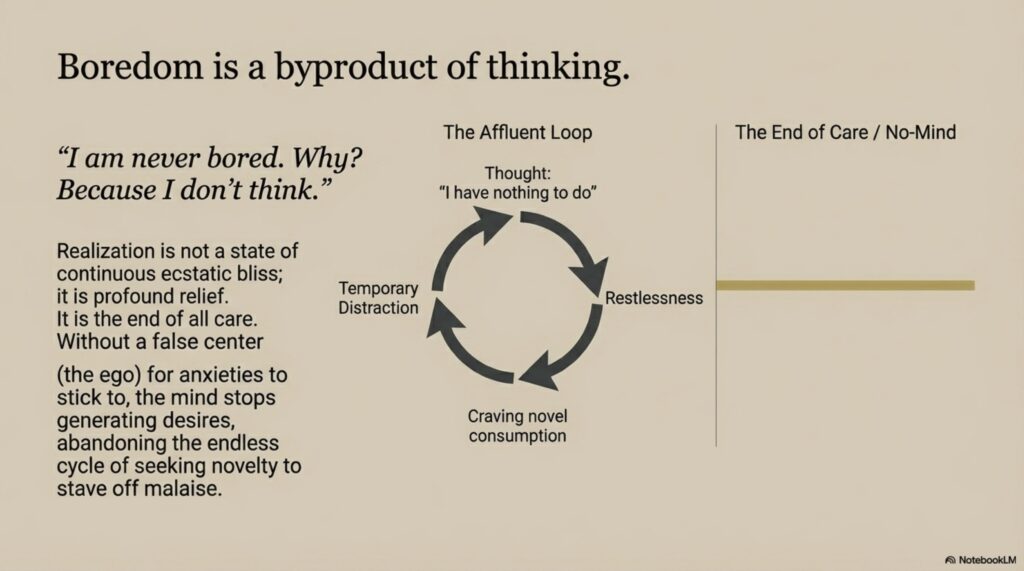
12.9 “I am never bored. Why? Because I don’t think.”
It is not usually understood that boredom comes from thinking and leads to a negative emotion. As soon as the thought comes “I have nothing to do, I’m bored,” the mind becomes restless and unhappy, and the body starts looking for something to occupy its attention. The more affluent the society, the more emphasis there is on finding novel ways to stave off the malaise of boredom. People are bombarded with advertisements and tantalized with suggestions for further consumption, all of which have the effect, intentional or otherwise, of making the mind think “oh, if I only had that/was there/could do that, I wouldn’t be so bored.”
The realized person, on the other hand, does not think about anything. Who thinks? Thoughts may occur when they are appropriate (or even when they are not appropriate!) but what effect can they have if no one claims them? The enlightened one does not crave this rather than that and so does not indulge in desire nor experience the thoughts that follow in the train of desire.
12.10 “This Paramatman in the form of Brahman will likewise remain happy whatever the situation.” (Sri Siddharameshwar Maharaj)
Note: The remaining quotations in this chapter are from Sri Siddharameshwar Maharaj.
Paramatman is the final reality. It exists in itself but does not know itself. To know itself, it must manifest. Reality manifests itself as the power of Brahman, or pure consciousness, taking innumerable forms through age after age. None of the forms, however, result in any diminution or change in the reality itself. It is the creating and veiling power of Brahman, called Maya, that causes that pure consciousness to identify itself with the form. In this way, reality gets itself involved with the life of the forms, the world of manifestation, and forgets itself as reality.
From time to time, however, that same consciousness remembers and realizes itself, knowing once again that it is the supreme reality, existing in itself, untouched by the created world, which it now sees as insubstantial, fleeting, amounting to zero. This understanding, or Self-knowledge, means that the pure consciousness remains as happiness, because happiness (ananda) is its nature. This remains the case, whatever the situation of the form in which this realization has occurred. The form in which this Self- knowledge has arisen is called a realized person.
12.11 “That body which has the knowledge of the Self in it will perforce emit light.” (Sri Siddharameshwar Maharaj)
What is light and how can it be emitted from one body and not from another? You have probably had the experience at some time of being in a particularly high state of consciousness, in which you felt your own reality beyond any doubt. Perhaps you felt completely centered in the Self or felt a state of bliss without cause. In any of these circumstances, your body is emitting light. As it says in the Bible:
When the eye is single, the whole body is filled with light. (Luke 11:34)
Usually, this light is not emitted, because it is absorbed by ignorance, doubts, and ego- centered thinking. When these obstructions are removed, the light of consciousness and understanding naturally shines and can be perceived by others as a sense of peace and joy.
12.12 “To see everyone as part of the one reality is the characteristic of such a jnani.” (Sri Siddharameshwar Maharaj)
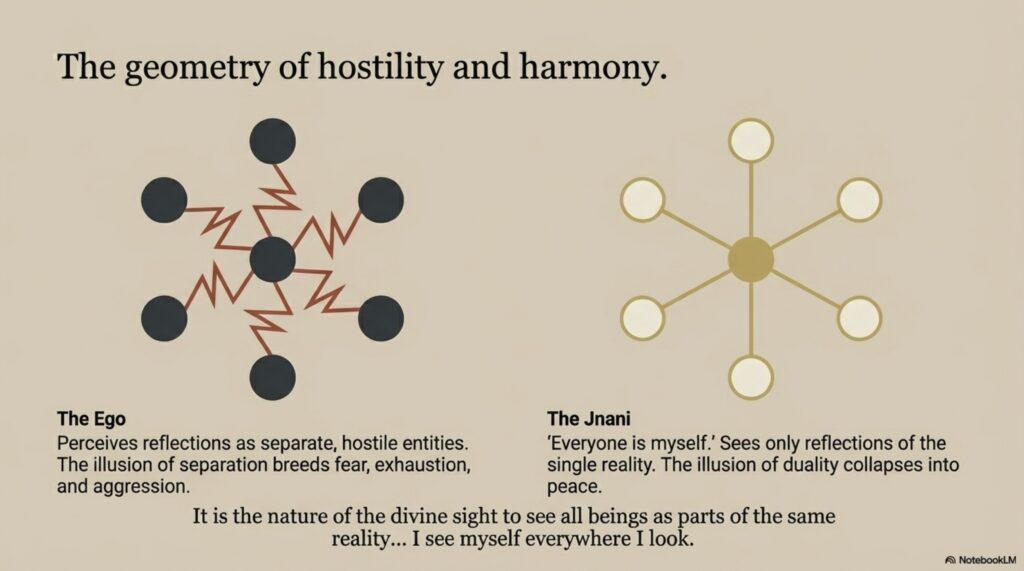
There was a man who built a room full of mirrors. He put them on the ceiling, on the walls, and at all angles. He loved to go in the room and see his reflection everywhere. One day, he left the door to this room open and his dog went inside. Immediately it saw what it imagined to be dozens of other dogs all around it. It started running at them, barking and fighting, becoming more and more exhausted until finally it fell down and died.
It is the nature of the divine sight to see all beings as parts of the same reality, and so the jnani (realized person) thinks “Everyone is myself. I see myself everywhere I look.” The ego, on the other hand, is like the dog. It sees others as separate and as potentially hostile. The sense of separation creates fear, which leads to aggression. There is no peace for the ego, or for a world in which the ego is dominant.
12.13 “After one meets oneself, the body is realized to be untrue.” (Sri Siddharameshwar Maharaj)
To meet yourself is to know yourself, finally, and to know yourself means to know what you are not. You are not any particular form. You are not the body that you happened to identify with. All forms appear in you as a continuous stream: thoughts, feelings, sense perceptions of all kinds, movement and the absence of movement. Your experience of the body is not an experience of a single “thing” but a flow of these various perceptions, all of which happen in your awareness. This is how you see the body after understanding and it makes you free of it.
12.14 “For the realized one, it is all One. There is no duality.” (Sri Siddharameshwar Maharaj)
Many seekers have their own ideas about what it means to be realized. But what does realization really mean? In the first place, there is no duality for such a person. All is One. Again, some people imagine that Oneness means a kind of permanent mystical vision, in which one can automatically penetrate into the essence of things, read minds, see other peoples’ past lives, and so on.
The reality is much simpler and more prosaic. To be realized is natural, normal. It is the ego that is unnatural and abnormal. Therefore, when realization occurs, the one to whom it happens simply reverts to the normal condition. The sense of being a separate
individual is replaced with the sense of simple being. The key fact of realization is its simplicity. It is really “nothing special.” There is nothing more ordinary and obvious than reality. That is exactly why it is overlooked. Often, people are seeking something that they imagine to be extraordinary-some shattering revelation or profound awakening that is somehow prolonged indefinitely. But all such concepts are in the realm of duality, while reality is not. How then can reality be known through concepts? Everything that people imagine Oneness to be is wrong. Oneness is simply what is, as it is.
12.15 “The liberated one just stops worrying about this mundane life. Outwardly and inwardly, there is complete, unshakable contentment.” (Sri Siddharameshwar Maharaj)
When He, the Master, makes you He, who is there left to be concerned about anything? There is literally nothing to worry about. For a realized person to worry, he or she would have to re-adopt a whole series of false assumptions and then re-believe in them. Of course, that will not happen. Therefore, there is an absence of any kind of worry, from the most trivial anxiety to the fear of death. There is contentment that is experienced as being itself. The Self has realized itself and simply lives as pure awareness.
Why does the Self realize itself? Does It realize itself to continue to live as a seeker, as a small creature, as a devotee in awe of the great mystery of reality? No! It realizes itself to live this life as the Self, as God. The Lord ascends His throne and enjoys this world as His own creation. It is only the enjoyment of the moment that is real and alive. The liberated one is aware of what is, but is not concerned, knowing that the Divine Power is making things happen in the only way that they can happen.
12.16 “Just to listen, contemplate, meditate, these are the signs of a realized one.” (Sri Siddharameshwar Maharaj)
After all doubts are gone and you understand that you are He, what is there left to do? “You” no longer exist as a center of volition and so action becomes actionless. Living becomes non-volitional. Desires may arise according to the prarabdha karma, that is, the tendencies that still have to come to fruition, but you know yourself to be beyond that. As long as the body lasts, you remain as its witness. Listening, contemplating, meditating arise naturally. You are satisfied to take a back seat and watch God’s creation play itself out.
12.17 “Once the Self is known, there is no restriction on your action,” (Sri Siddharameshwar Maharaj)
The concept of bondage implies restrictions, limitations. What is the nature of that bondage? It is that you take yourself to be something that you are not. You are bound by your identification with the body-mind. Liberation means that that identification is broken and you remain what you always were in reality. There is no restriction, no
artificial limitation created by the mind’s imaginings. Now you are free to be your Self which you always were, but did not know it.
The ego thinks “after realization, there are no restrictions, so I can do exactly what I like.” The ego always thinks in this way. How can it understand that it is itself the restriction that is removed by liberation? So when Sri Siddharameshwar Maharaj says that there is no restriction on your action, he means that you are free from the burden of self-centered desire, resistance to what is, and non-acceptance. These are the real restrictions and limitations that prevent you from enjoying the beauty and simplicity of pure being.
12.18 “A realized person knows that the Self is the only truth and that all the rest is just a play of thoughts.” (Sri Siddharameshwar Maharaj)
To be firm and secure in reality, it is necessary to know the Self as the truth and everything else as untrue. The truth is overlooked because it is so simple, so obvious. Many people are expecting something else. When you see the truth in all its simplicity, you may be astonished that it is so easy. It is like the experience of a man who, when he gets off a train after a long journey, which he spent in some anxiety because he had no ticket, looks around for someone to pay. He’s amazed that there’s no one to pay, no one to thank. There’s no charge. The journey was free! Now he knows he can get on any train and go anywhere without restriction.
12.19 “The sign of true spiritual knowledge is that one is free of all doubts.” (Sri Siddharameshwar Maharaj)
A doubt means that you are not certain that something is true. For example, the doubt may persist “How can I be He, the reality?” There is a nagging feeling that in fact it may not be true. Even the faith that one has in the Master may not be enough to completely dispel that doubt and silence it forever. As long as there are doubts, there is ignorance, because doubts and ignorance are essentially the same thing. This is why Sri Siddharameshwar Maharaj says here that it is a sign of true understanding that there are no doubts at all. Realization means the destruction of ignorance. Afterwards, there is no possibility of doubt arising. The source of doubt, which is the false thought of separate existence as ego, has been uprooted. It no longer interposes itself, asking useless questions, and wondering “can it really be true?” There is only clear seeing, unimpeded by any doubt.
12.20 “Abide in your being or Self-nature.” (Sri Siddharameshwar Maharaj)
There is no need for any kind of study after Self-realization. The spiritual books that you struggled to understand when you were a seeker no longer have anything to teach you. Before enlightenment, you couldn’t properly understand them, and, after enlightenment, they are of no use!
You don’t have to say to yourself “I am He, I am the Self,” because you just know. Your being is your knowing. You have no further use for “spirituality.” One who has come to the end of the journey no longer needs the map or the directions for how to get there. Even so, you cannot simply let your mind drift and wander wherever it wants, like a bad servant. As long as the body is there, the mind should remain steady in the contemplation of its revealed being.
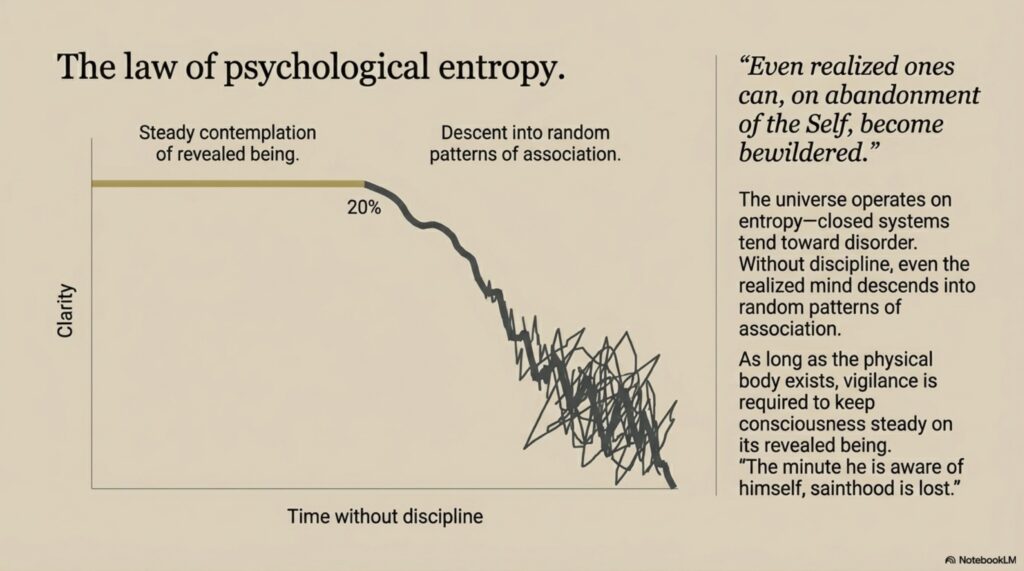
12.21 “Even realized ones can, on abandonment of the Self, become bewildered.” (Sri Siddharameshwar Maharaj)
One of the laws that operate in the Universe is the law of entropy. This law states that every closed system tends to greater and greater disorder. Applying this principle to the mind, it means that whenever there is no discipline, the mind descends into more and more random patterns of association. Simply put, it means that if you don’t keep your mind focused, you will become confused.
This law still applies to the mind after realization. Whether one is an aspirant or a Master, one has to remain vigilant. Sri Neem Karoli Baba said:
The eyes of a saint are always concentrated on the supreme Self. The minute he is aware of himself, sainthood is lost.
12.22 “To be with one’s own nature is the main requisite of a realized person.” (Sri Siddharameshwar Maharaj)
For an aspirant, the realized person is useful because he or she is a living example of the Self. So are you, but you do not know it with conviction. The realized person is one with his or her own true nature. When you sit in their presence, you can experience your own nature. This happens, not because of anything they are doing, but simply because it is a universal law that like attracts like. You are actually experiencing the One true nature; it does not belong to the aspirant or to the Master, but it is apparent in the presence of one who lives as That. This simple being in silence is the main thing that the realized person “does.” Any verbal teaching comes out of that pure silence.
12.23 “All this chaos is the chaos of illusion. Let the objects be whatever they are.” (Sri Siddharameshwar Maharaj)
Why should one who understands and realizes the oneness of the Self meddle in the world of illusory forms? Sometimes there is some karma that causes the realized person to take a very visible and active role: perform miracles, found religions, or become widely known in some other way. These cases amount to what is probably a small minority of the enlightened in this world. Realization means understanding that there is no doer for all the actions that are done. This understanding does not encourage an active, goal- oriented life, but tends to support a passive, contemplative existence, one that leaves the objects of the world as they are.
12.24 “Doership rests in Maya and non-doership in Brahman.” (Sri Siddharameshwar Maharaj)
From the point of view of the ego, the realized person may seem unmotivated, even lazy. This is actually a more or less correct perception, as far as it goes. In the Ashtavakra Gita, it says:
Who is lazier than the Master? He has trouble even blinking!
What this means is that the enlightened person understands that whatever appears to be done in the world, he or she is in fact not doing anything. It is all Maya, the illusion of ignorance.
Sri Siddharameshwar Maharaj tells a story about a princess who decides she wants to marry a truly lazy man. The notice goes out and from all over the kingdom prospective suitors come. Some demonstrate their laziness by refusing to walk and having to be carried on someone else’s back. Others constantly yawn and lie down at every opportunity. In this way, many attempt to convince the princess of how lazy they are. Finally a young man shows up who simply approaches the princess and states that he has come to marry her as he is truly lazy. All the others, by attempting to show their laziness are not really lazy. The truly lazy man is lazy by nature and has no need or inclination for any demonstration. This is how it is when you know that you are Brahman. You simply are that. There’s nothing you need to do about it and you don’t necessarily feel any need to even speak about it, unless someone asks.
12.25 “To the jnani, it is absolutely evident that he is Brahman.” Sri Siddharameshwar Maharaj
When you are in the waking state, you never need to say to yourself “I am alive.” It is obvious to you. In just the same way, oneness with Brahman is evident to the realized person (jnani). This is because, for the realized person, the sense of “I,” which was previously identified with the false center of the ego, has resolved itself back to its true center, which we call the Self. The ego has disappeared because its unreality was understood. It was maintained by the belief that it was real. Once that belief is released, the ego has no support and so it ceases to assert itself. Consciousness is now established in the Self, which is the true center, around which everything revolves and without which nothing can appear.
12.26 “Keep your faith in the unseen, that which is beyond the realm of reason.” (Sri Siddharameshwar Maharaj)
The rest of this quotation is “Jnanis understand this and go their own way.” After realization occurs, life shifts to another level. The ordinary worldly existence continues as before, but something has been added. There is a new understanding, a new consciousness of oneself existing beyond the mind. This new understanding puts everything else into perspective. What is false is seen to be false and is no longer
confused with what is true. No effort is required to see this. It is just seen, just understood. So realized persons go their own way, without worrying about the world. They know that the world will take care of itself.
12.27 “The sign of a saint is that he does not act according to what comes into his mind.” (Sri Siddharameshwar Maharaj)
You can be sure that whatever thoughts come to the mind of a realized person, he or she is not bound by them in any way. In ignorance, thoughts are assumed to be “mine.” If “I” feel angry, “I” have no hesitation to express that anger. “I” feel totally justified in doing so. This is not the case with a realized person. Thoughts are thoughts. They arise from the vast ocean of nothingness that is the causal body and they return to it. If a thought is meant to be expressed in a particular moment, it will be expressed. If it is not meant to be expressed, it will not be. There is no compulsion to act on a desire or to express the thoughts that arise, because there is no identification of the Self with the “I,” which is the sense of doership.
12.28 “One who has understood the path of no-mind has no care. He is always immersed in his own Self.” (Sri Siddharameshwar Maharaj)
Sometimes it is asked “Why seek realization? What is the value of it?” Some seekers want to be reassured that there is some pleasure, some bliss to be had from realization, something that would make all their efforts worthwhile. Such seekers are generally disappointed with the answers they receive, because, in fact, the realization of the Self does not involve any gain or the acquiring of anything new. It is really the loss of what is not true, the abandonment of ignorance. The experience of realization is more like relief than bliss. Blissful experiences that come suddenly tend to be so striking because they are in contrast to the ordinary, rather dull state of the seeking mind. On the other hand, the seeker who has been following the path for a long time and is closer to realization, is already free from many petty anxieties and so, when the final understanding arrives, it may not seem so striking. In fact, it may be a relatively small shift at that point.
However it comes, final understanding means the end of all care. Mind has become no- mind and so there is no longer any false center to which care and anxiety can stick. Consciousness has turned back to its true center, where it remains immersed in itself, contemplating its own existence.
12.29 “The one who is steady in his Self says “I am all pervading, complete, and immanent in every heart.” (Sri Siddharameshwar Maharaj)
When people go down to the River Ganga and take the water back to their homes in brass pots, they do not regard that water as separate from the river that it came from. They use it for worship and, for them, it represents the Goddess Ganga just as the river itself does. This is the correct attitude to have towards consciousness also.
The individual consciousness that each person feels in his or her heart is just the same as the universal consciousness that pervades everywhere. There is no difference at all. “All- pervading” means that it is immanent in all forms. It consists of the totality of the individual consciousness, just as a forest is made up of the individual trees. In fact, the concept of “individual consciousness” is false. There is only the one, undivided consciousness. Ignorance, bondage, consists of the belief that the individual consciousness is really separate. Liberation is seeing through that false assumption.
12.30 “The realized one does not have any concepts or thoughts.” (Sri Siddharameshwar Maharaj)
There is a story about a man who had two sons. Both the sons were sent by their father to seek wisdom in a distant city. After some time, they returned home and their father asked them what they had learned about Truth. The older brother recited to his father many scriptural passages about the nature of Brahman: how the world had appeared in it through the power of Maya, but without affecting its essential Oneness, how the whole universe was contained in Brahman, how each one is That but does not realize it, and so on and so forth. When his father asked the younger son what he had learned of the Truth, he just stood in silence, feeling that to try to express anything of the Absolute Truth in words is to reduce it to the level of relative truth. Then his father knew that this son had found wisdom and had truly understood.
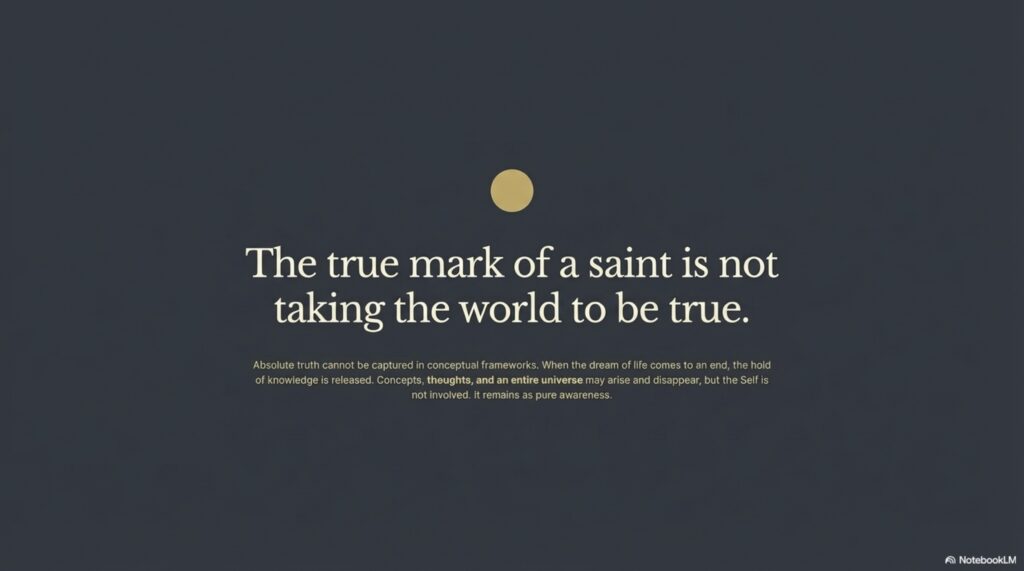
Silence is the natural condition of the realized person. As long as the dream of life continues, silence exists as pure consciousness that is aware of itself. When the dream comes to an end, silence remains as the Absolute, without consciousness of anything. This last statement, although logical, is theoretical. Nothing can be said about the condition of the Absolute after this consciousness has gone. We only know consciousness that is here now. That is the nature of consciousness. It is knowledge. The whole experience of birth, life, and death, occurs in knowledge, in the mind. After realization, this is seen and understood clearly and so the hold of knowledge, and the world that appears in it, is released. Concepts, thoughts, an entire universe may arise and disappear again. The Self is not involved in it and so is not concerned.
12.31 “The true mark of a saint is not taking the world to be true.” Sri Siddharameshwar Maharaj
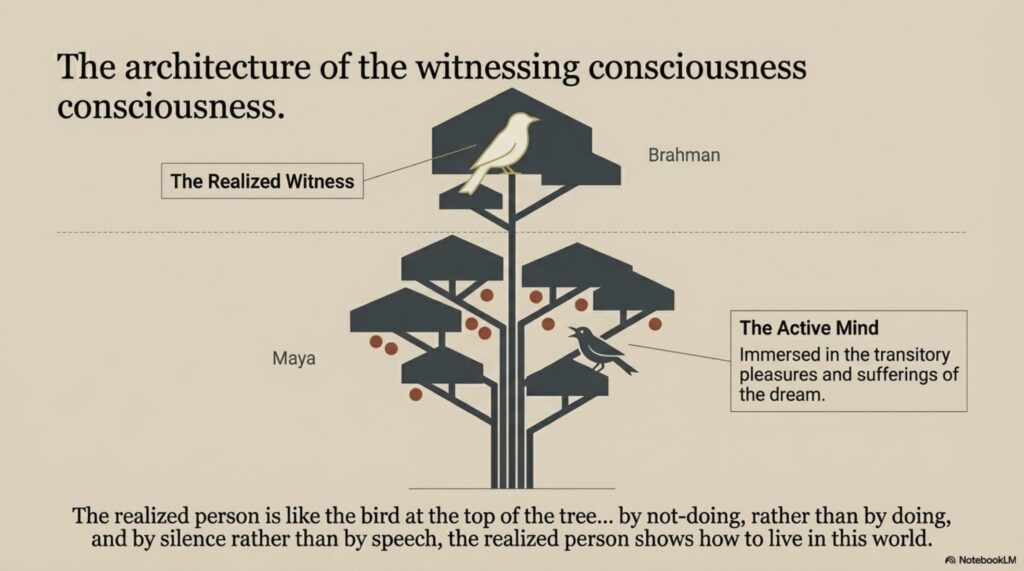
There are two birds in a tree. One of them constantly flits from branch to branch, eating the fruits that grow among the leaves. The other sits quietly at the top of the tree and does not taste or eat any of the fruits. The realized person is like the bird at the top of the tree. As far as he or she is concerned, the world is not true. It is nothing but a long dream. He or she has no desire for the transitory pleasures of life and so does not touch them. In this way, by not-doing, rather than by doing, and by silence rather than by speech, the realized person shows how to live in this world.
Leave a Reply