The following content had been generated by ai, based on 35 books from Joel S. Goldsmith.

Disclaimer: All words as concessions! 🌸
NotebookLM.Google.com:
Explainer: Joel S Goldsmith (Christian Mystic)
Briefing Document: The Art of Spiritual Living
Executive Summary
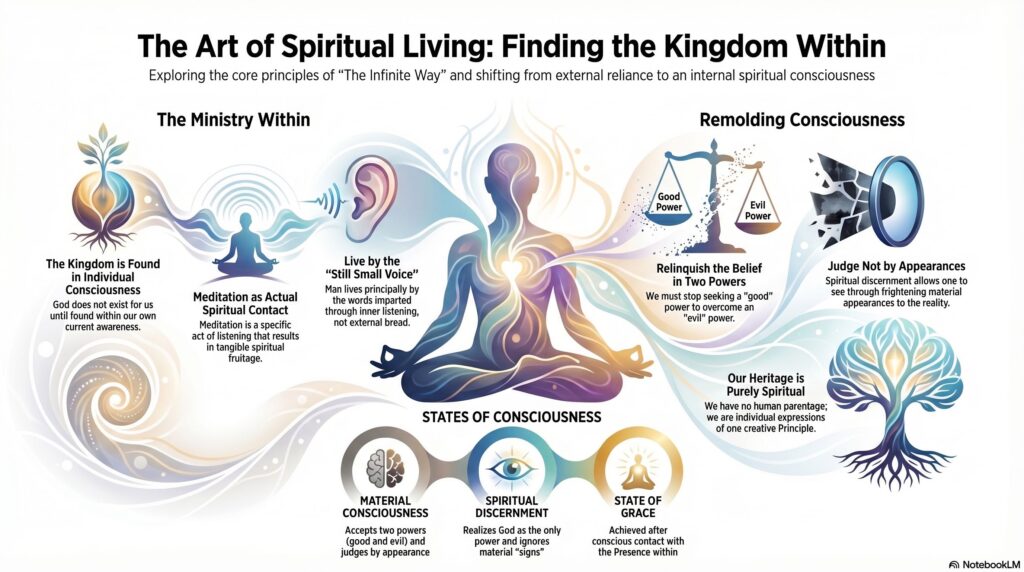
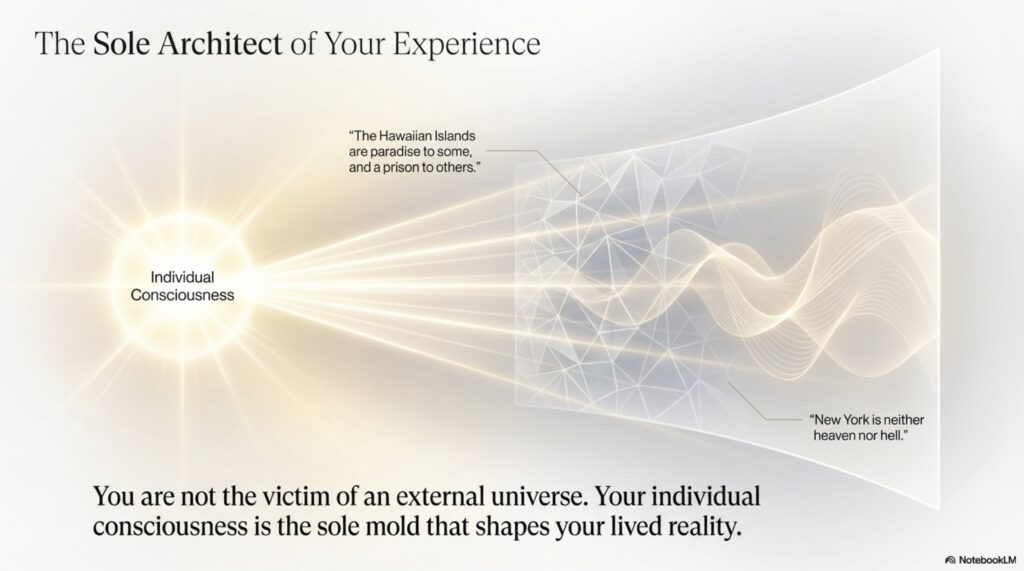
The following briefing synthesizes the foundational mystical principles of the “Infinite Way” as revealed by Joel S. Goldsmith. The core thesis of the work is that the “Kingdom of God” is not a remote location or an external power, but a state of individual consciousness that must be actively realized through inner communion.
The document identifies the primary cause of human suffering—including disease, sin, and lack—as the belief in “two powers” (good and evil) and the reliance on external “effects” rather than the invisible “Cause.” The path to spiritual freedom requires a radical “remolding of consciousness” through meditation and spiritual discernment to move beyond appearances and establish a “conscious union” with the Source.
I. The Nature of the Infinite Way
The Infinite Way is a mystical message focused on the nature and substance of spiritual living. It posits that there is an invisible source, cause, or creative principle behind the visible universe.
Core Axioms
- Absolute Cause: Just as there is no effect without a cause, the existence of the universe, nature, and individual beings proves the existence of a creative principle (God).
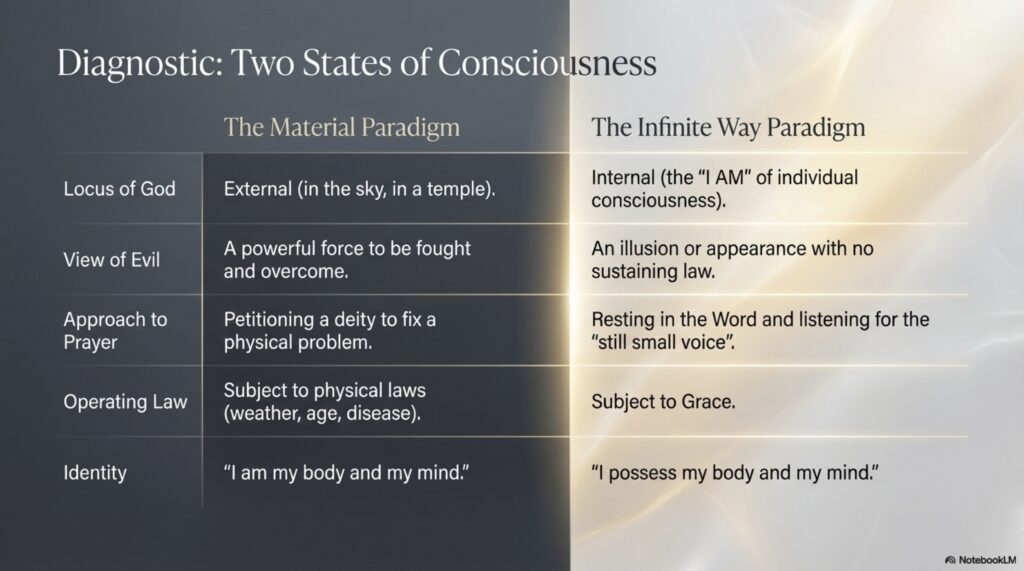
- Internalization of Truth: Spiritual truth remains ineffective as long as “God-consciousness” is viewed as separate from individual consciousness. The kingdom of God must be discovered within the individual’s own awareness.
- The Ministry Within: Every spiritual function—healing, forgiveness, provision, and resurrection—is an activity of the “Christ-ministry” located within the individual soul.
Historical Context of the Message
The teachings were preserved through:
- Monthly Letters: Joel Goldsmith prepared monthly letters based on his class tapes to assist students in their application of truth.
- Compilations: These letters were subsequently published as books, each centered on a yearly theme (e.g., Our Spiritual Resources, The Contemplative Life, The Mystical I).
- Preservation: Following Goldsmith’s transition in 1964, his wife Emma A. Goldsmith and editor Lorraine Sinkler continued to curate his extensive tape recordings (over 1,200 hours) to ensure the continuity of the message.
II. Remolding Consciousness: From Dualism to Oneness
A central theme of the text is the necessity of transitioning from a material state of consciousness to a spiritual one.
The Problem of “Two Powers”
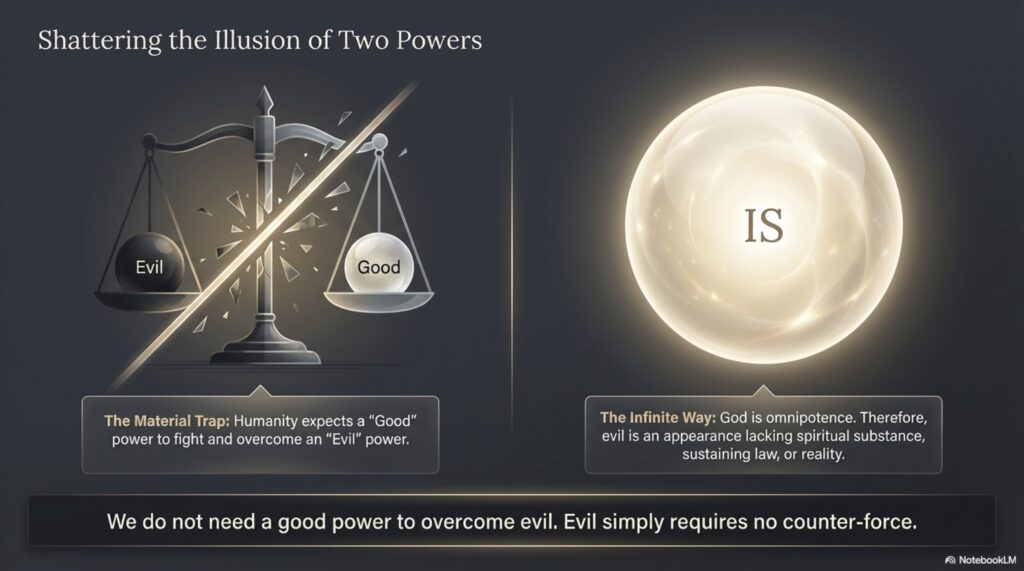
Humanity is born into a state of consciousness that accepts both good and evil as powers, often viewing evil as more potent. The text argues that:
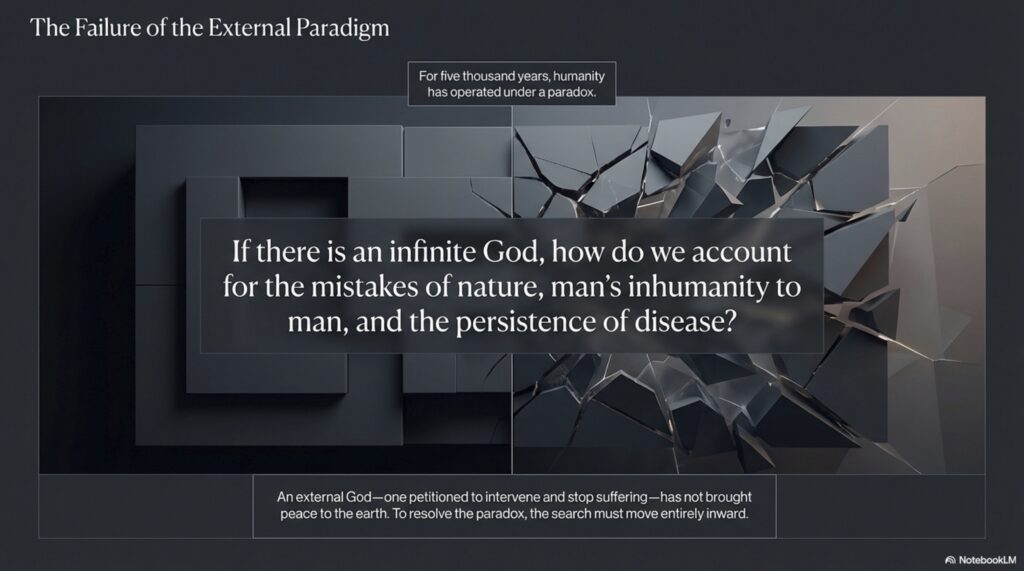
- External forms of worship and ritual have failed to bring lasting peace because they attempt to use a “good power” to overcome an “evil power.”
- True spiritual life requires the realization that evil is not a power. If God is omnipotent, there can be no opposing power to overcome.
Spiritual Discernment vs. Appearances
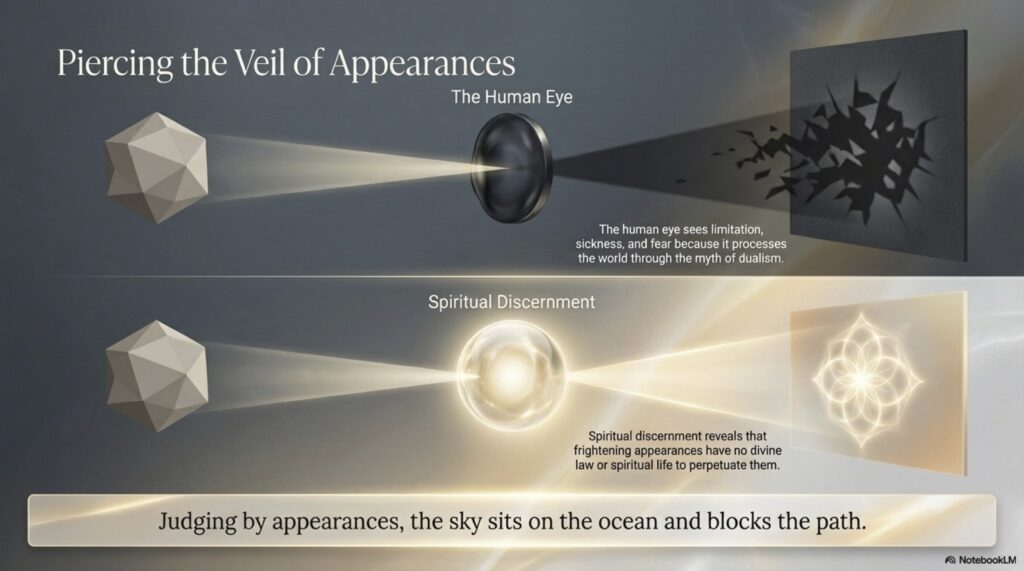
Goldsmith emphasizes the Master’s instruction to “judge not according to the appearance.”
- Material Appearances: Judging by the eyes and ears leads to fear and concern (e.g., fear of disease or lack).
- Inner Discernment: This is the power to see through the appearance to the nature of reality. Just as science moved from believing the sky touches the ocean to understanding the nature of horizon-lines, spiritual living involves seeing the “nothingness” of frightening appearances.
The Concept of Non-Resistance
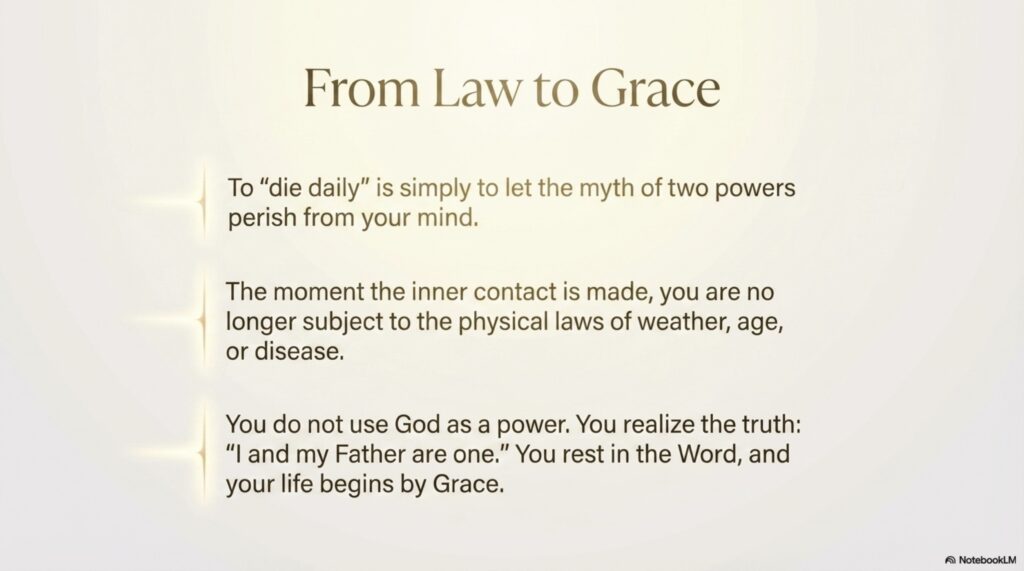
The text revives the dormant instruction to “resist not evil.” By refusing to use God-power as a weapon against a supposed evil-power, the individual moves into a state of “Grace” rather than “Law.”
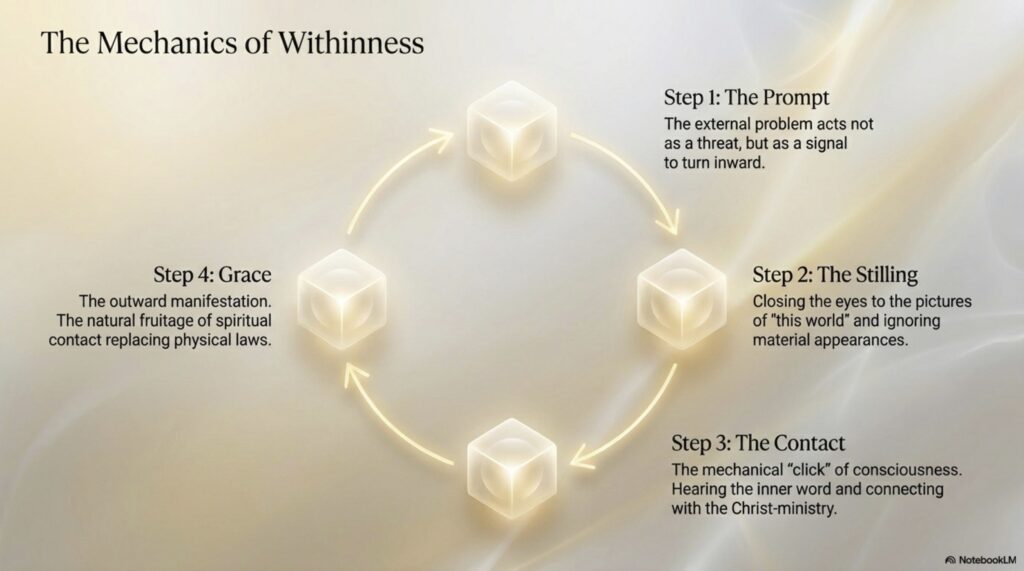
III. The Practice of Meditation and Withinness
Meditation is not described as mere relaxation, but as a specific act that facilitates conscious contact with the Divine.
Features of Effective Meditation
- Fruitfulness: Meditation must result in “signs following” (peace, healing, harmony). If no fruitage appears, the contact has not been made.
- Inner Listening: The goal is to reach a state of stillness where the “still, small voice” of God can be heard.
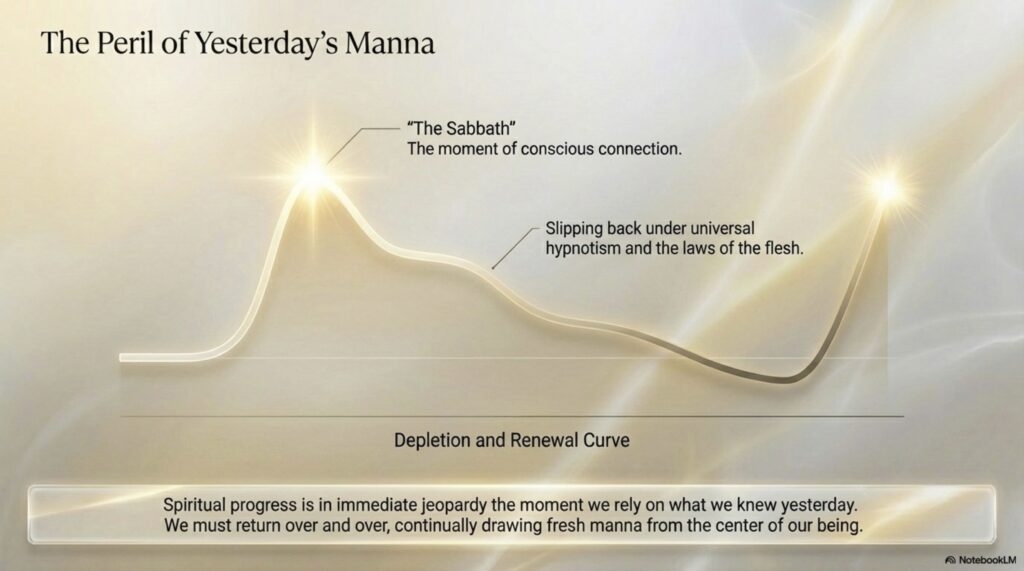
- Constant Renewal: Living on “yesterday’s manna” (past spiritual experiences) is insufficient. Constant contact—praying without ceasing—is required for daily refreshment.
Living by the “Word”
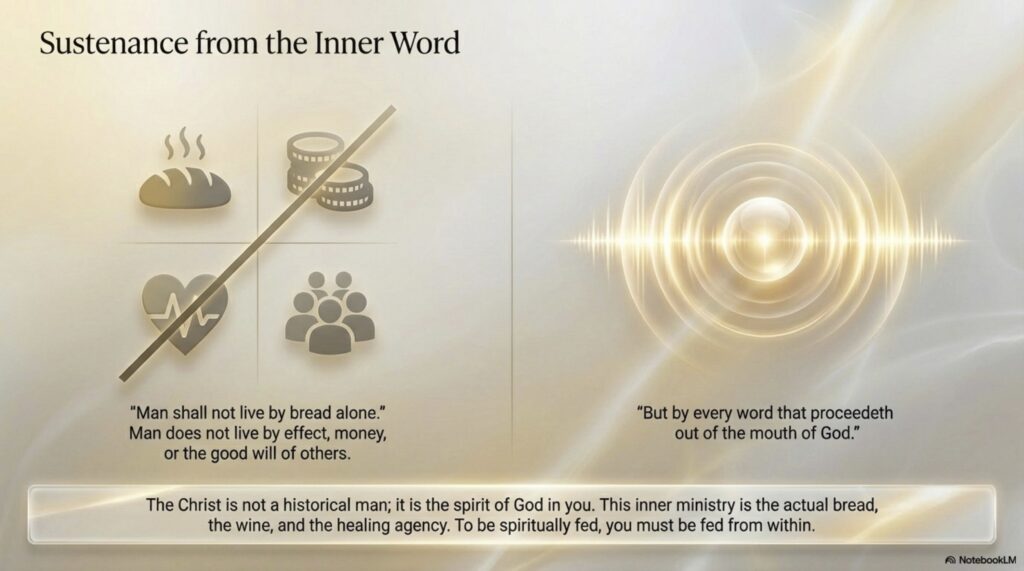
The text reinterprets the scripture “man shall not live by bread alone” as a directive to live by the “Word of God” received internally.
- Bread/Effects: Food, money, friendships, and physical health are “effects.”
- The Word/Cause: Spiritual life is the “life of withinness” where the individual is fed, clothed, and housed by the inner Word.
IV. The Eternal Nature of Being
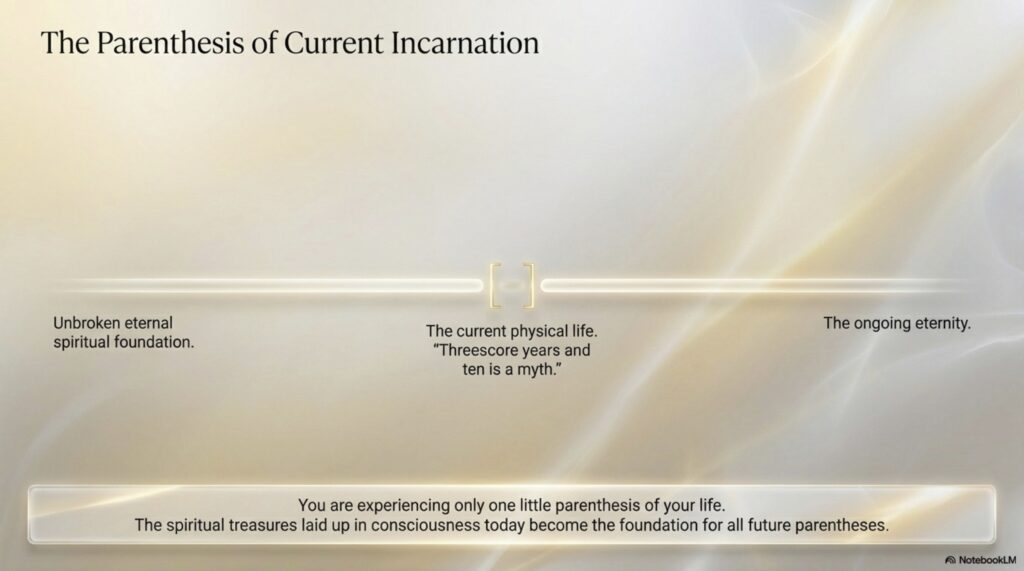
The Infinite Way rejects the “myth” that human life is limited to a single lifespan.
The Parentheses of Life
- Ongoingness: Individual life never began and will never end; the current physical experience is merely a “parenthesis.”
- Spiritual Foundation: Development achieved in this life is not lost at death. It forms the foundation for future spiritual awareness.
- Pre-existence: High degrees of illumination (as seen in figures like Buddha or Christ) are the fruitage of spiritual foundations built in previous existences.
Identification of Self
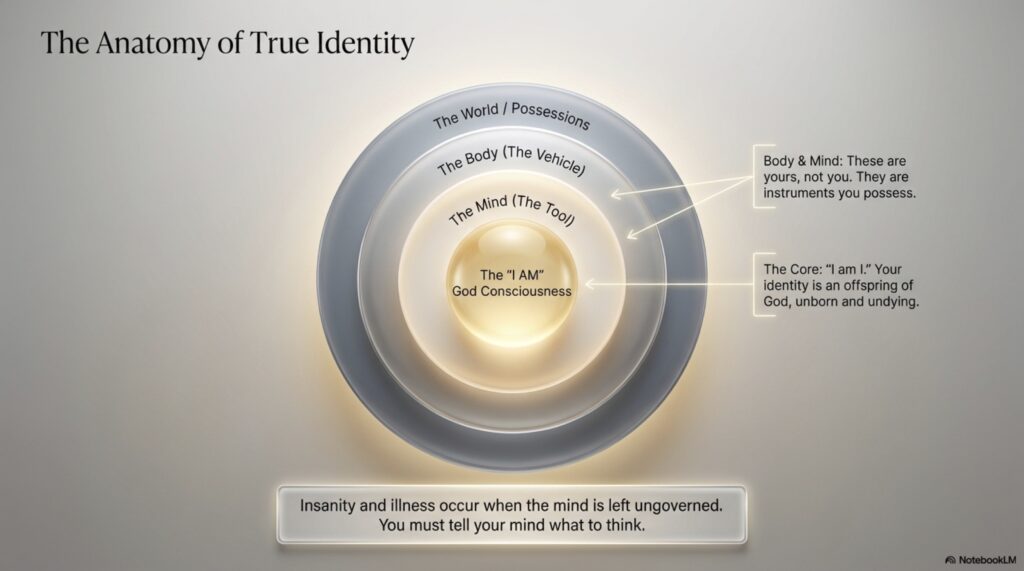
Goldsmith argues that the body, mind, and purse are things the individual has, not what the individual is.
- Self-Governance: The “I” (individual identity) is an offspring of God and should govern the mind and body.
- Substance: God is the substance, law, and activity of individual being.
V. Key Scriptural Interpretations and Quotes
| Theme | Reference | Interpretation / Insight |
| Union | Joel Goldsmith | “Illumination dissolves all material ties and binds men together with the golden chains of spiritual understanding.” |
| Abundance | John 15:7 | “If ye abide in me, and my words abide in you, ye shall ask what ye will, and it shall be done unto you.” |
| Protection | Psalm 91 | Dwelling in the “secret place” is the only way to avoid the snares and pitfalls of human experience. |
| Inner Kingdom | Luke 17:21 | “The kingdom of God is within you.” This negates the need for holy cities, mountains, or external temples. |
| Self-Correction | Isaiah 44:8 | “Is there a God beside me? yea, there is no God; I know not any.” The only God exists within. |
VI. Conclusion: The Goal of the Spiritual Life
The ultimate aim of spiritual living is conscious union with the Source. This is achieved by:
- Surrender: Dedicated each day to God’s use, making oneself an instrument or “transparency” for the divine.
- Impersonalization: Realizing that no human has the power to heal or forgive, but the Christ-ministry functioning through the individual can.
- Grace: Moving from being “under the law” (physical, mental, and social laws) to being “under Grace” once the inner contact is established.
The text concludes that while building circles of friends or achieving professional success may provide temporary pleasure, the only real satisfaction is found in the realization: “I and my Father are one.”
Leave a Reply