Why Your Effort to Find Peace is the Ultimate Noise
Generated by ai, based on an email from Ralph:
On 12 May 2026, at 9:06, Ralph wrote:
> LIFE is full of problems. Always problems…
1. The Problem with Catching Air
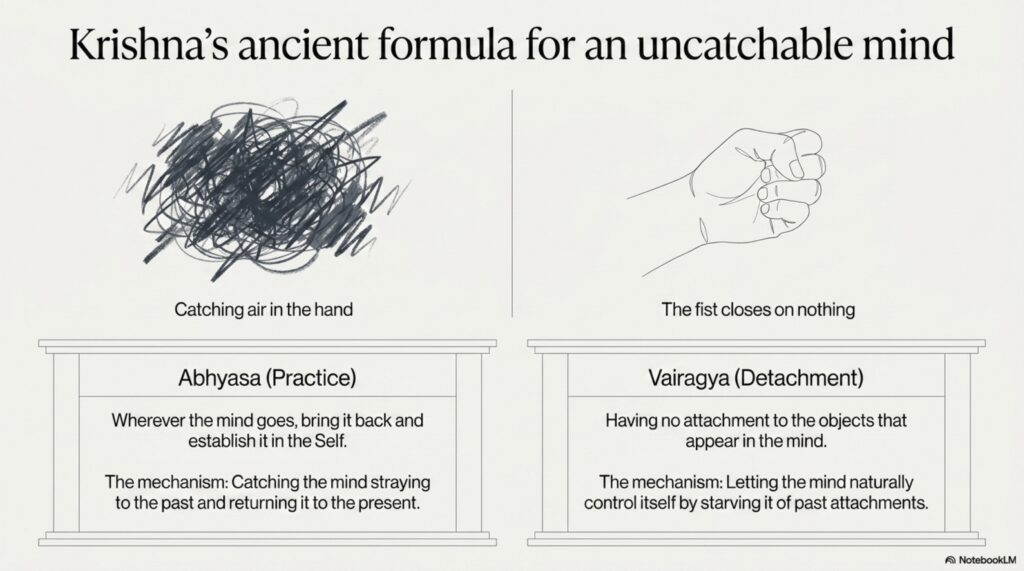
Life is a relentless conveyor belt of problems. We solve one; the next arrives before we’ve even exhaled. In response, our modern culture offers a single, exhausting prescription: “Control your mind.” We treat the mind like a wild animal that must be broken, yet we ignore the fact that this struggle is thousands of years old and consistently futile.
Five millennia ago, the warrior Arjuna stood on a battlefield and confessed the same frustration to Krishna. He argued that the mind is as restless and impossible to grip as the wind. To try and control it through force is like closing your fist around the air—you end up with nothing but a handful of empty space and a cramped hand. True silence is not a trophy for the most disciplined or a destination reached after a spiritual marathon. It is a substratum, a natural state discovered only when the chase stops. Silence is what remains when you realize your very effort to “find” peace is the primary source of the noise.
2. The Thief in Your Head: Why We Suffer the Past
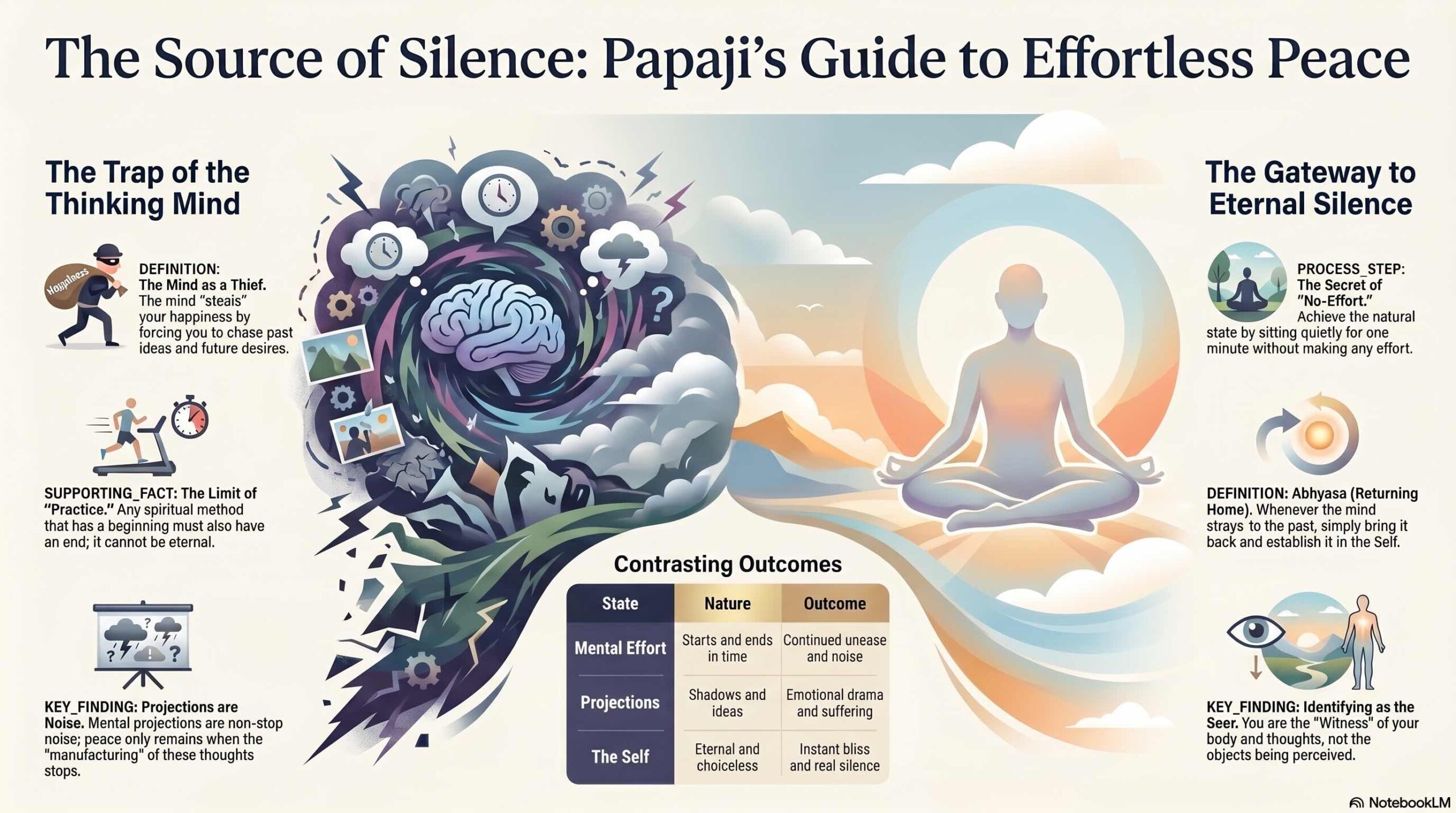
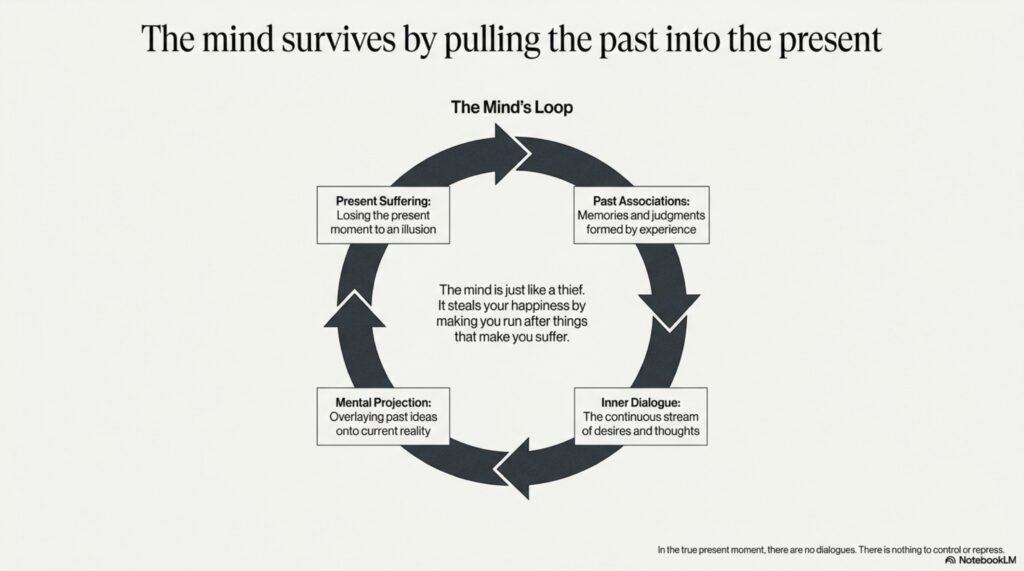
The unrest we feel is rarely a product of the present. Instead, we are victims of a sophisticated internal heist. Papaji describes the mind not as a helpful tool, but as a “thief” that loots our inherent property: happiness. This thief operates through an interminable inner dialogue—a stream of past ideas, thoughts, and desires that keeps our attention tethered to what has already expired.
We suffer because we are replaying the past. We treat our mental dialogue as a confidant, but it is a predator. As Papaji warns, we are “fondling a snake” that is destined to bite. The radical “pattern break” here is the realization that recognition itself is a trap. If you recognize a thought, a form, or a feeling, you are living in the past. Recognition requires memory; memory is the graveyard of the present.
“The mind is just like a thief. It is stealing your happiness by making you run after things and ideas that make you suffer all the time… Why should you fondle and be friends with a snake that is going to bite you and make you suffer?”
3. The Practice of No-Practice: Why Effort is the Enemy
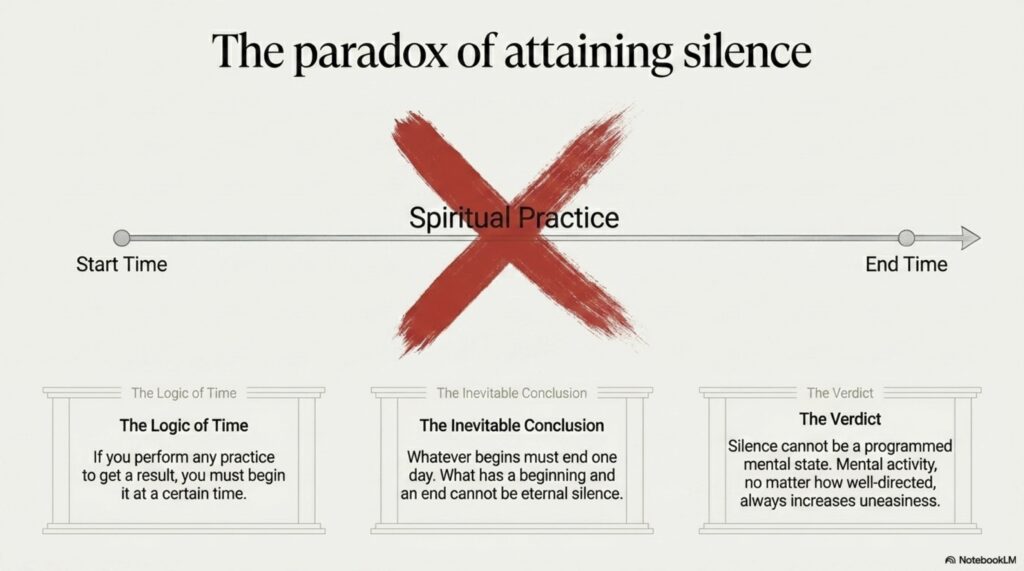
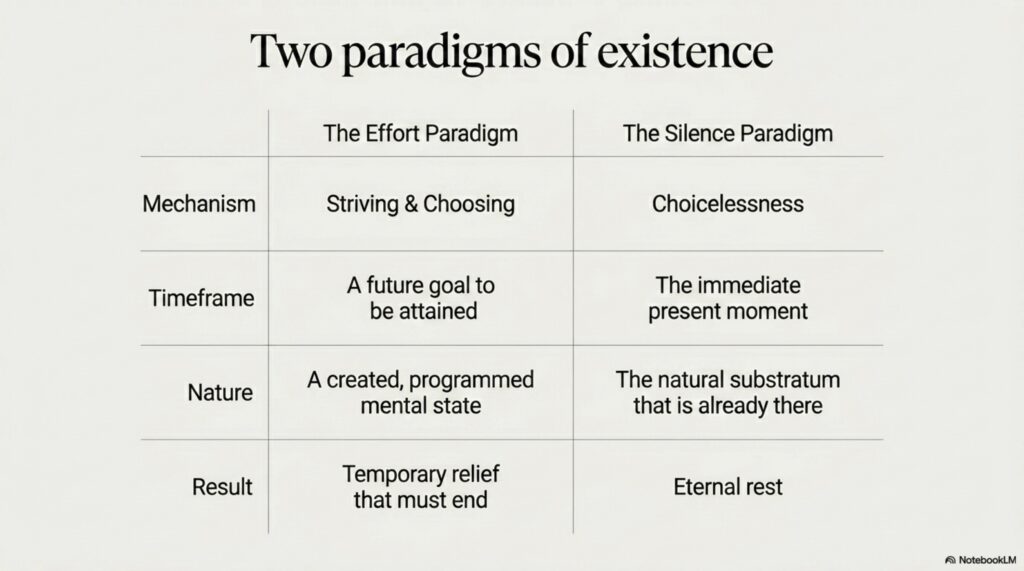
The most counter-intuitive truth of the “Source” is that effort is not the solution—it is the sabotage. Most spiritual traditions offer a method, a remedy, or a practice. But there is a fundamental logical flaw in using a method to reach the eternal: anything that has a beginning must, by definition, have an end. If you work to produce a state of peace, that peace will vanish the moment you stop working.
Working hard to achieve silence is a metaphysical oxymoron. Any mental activity, no matter how “spiritual” or well-directed, only increases mental uneasiness. When you strive for silence, you are simply replacing one mental goal with another, staying firmly within the confines of the mind.
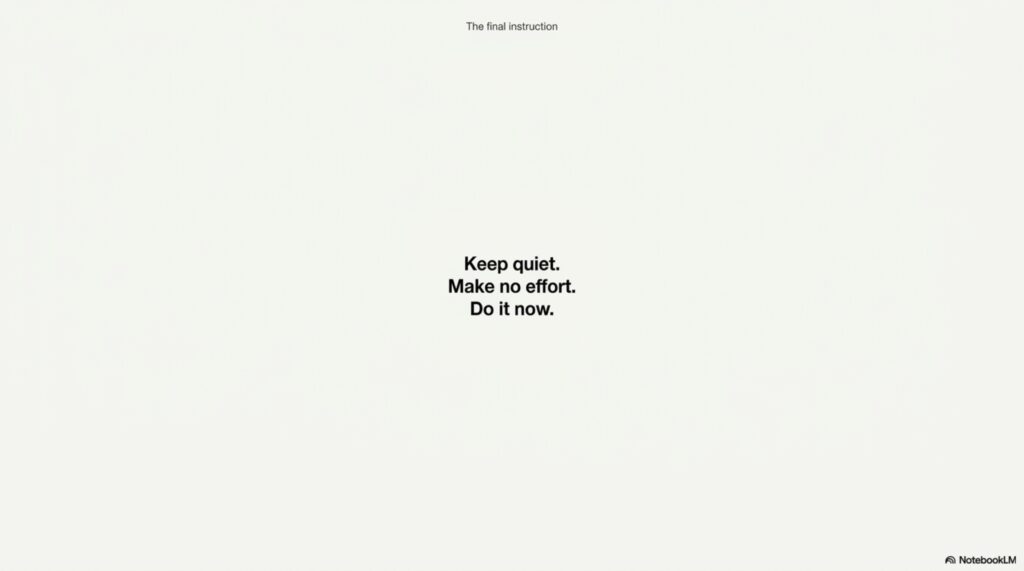
“Keep quiet and don’t make any effort.”
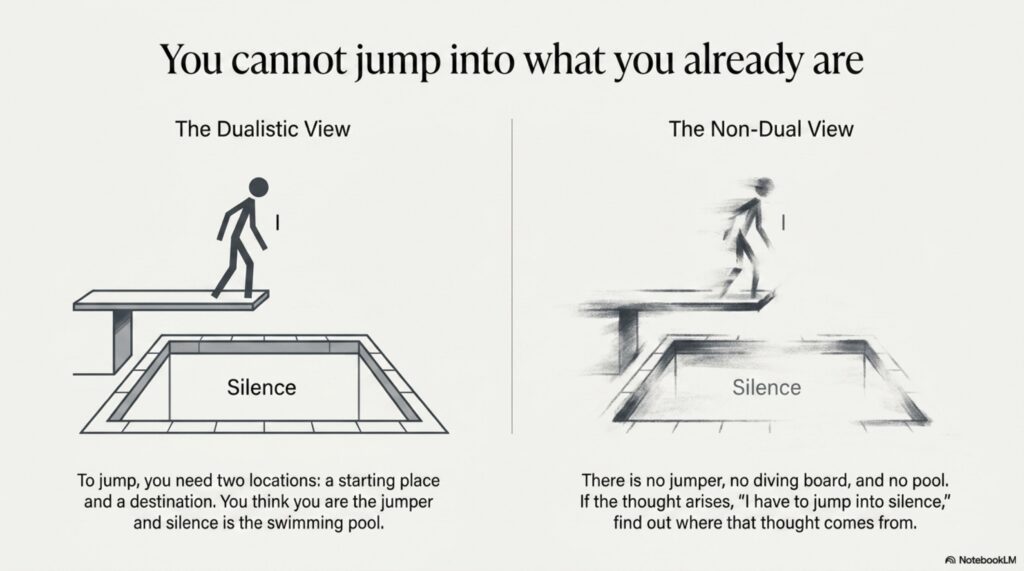
This is not a technique; it is the abandonment of the “jumper.” When you stop looking for peace, you find it was already there, hidden by the very effort you were using to look for it.
4. The Puppet Master: Realizing Who Pulls the Strings
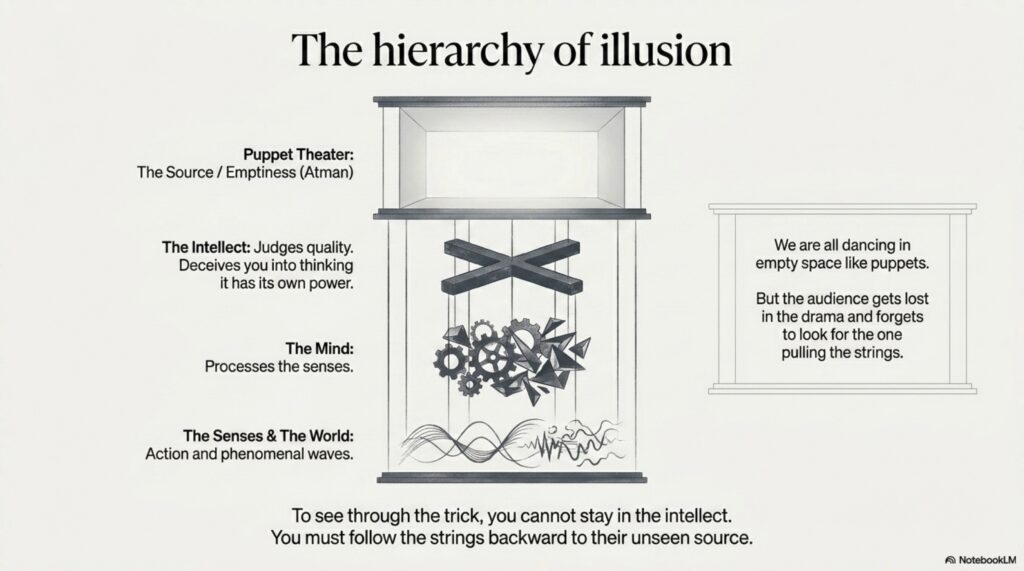
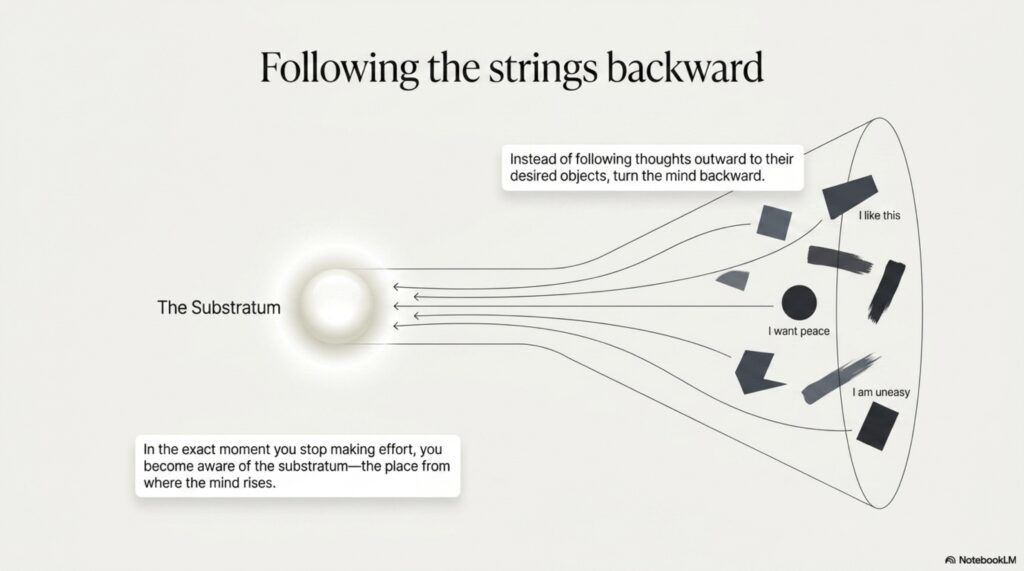
We move through the world like puppets dancing in empty space, deeply and emotionally involved in a drama we mistake for reality. We take the scenes in front of us to be real because we fail to see the single Source manifesting as every actor.
In this play, your intellect is not the pilot; it is just the most talented puppet in the show. It “dances very well,” as the source notes, deceiving you into thinking it possesses its own power and authority. To find true clarity, you must go beyond the intellect and follow the “pull” of the strings back to the source of energy. If you remain identified with the intellect, you remain a puppet. Only by transcending the intellect can you discover the “fountain of energy” that allows it to function in the first place.
5. The Subjectivity of Value: The Diamond and the Goat
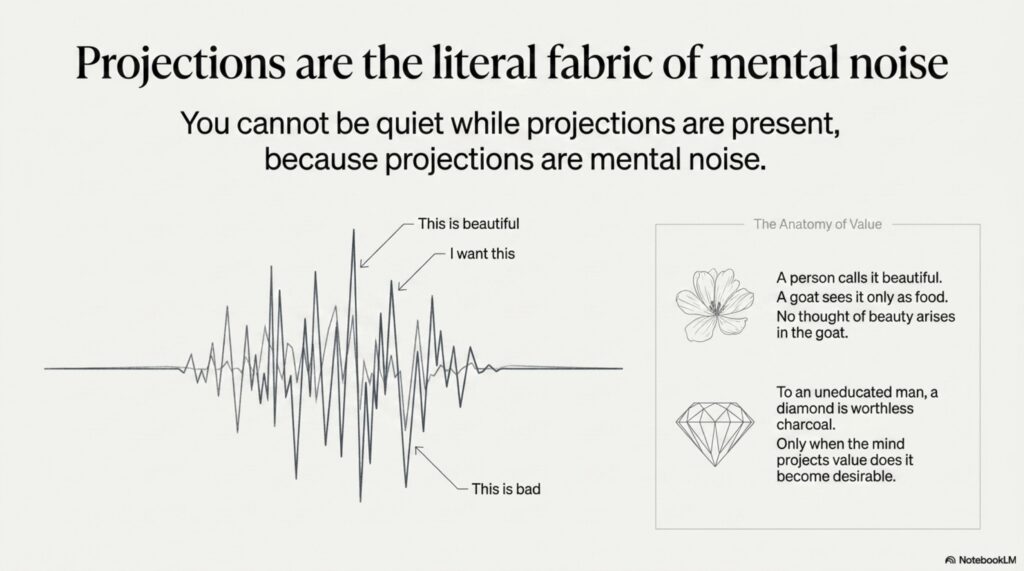
Our internal unrest is fueled by subjective judgments—likes and dislikes rooted in the conditioning of the past. We perceive beauty and value as inherent qualities of objects, but these are merely mental projections dictated by “Goats of the past.”
Consider a flower. To a human, it is an aesthetic marvel; to a goat, it is merely dinner. The goat’s mind is programmed by previous generations to see the flower as food, not “beauty.” Similarly, a diamond is chemically identical to a piece of charcoal. It only becomes “immensely valuable” when the mind, educated by past associations, assigns it that status. When we stop projecting these values, we stop the “running around” that keeps the mind in constant motion. We realize that the world is a shadow, and we have fallen in love with the shadows we created.
6. You are the Seer, Not the Seen
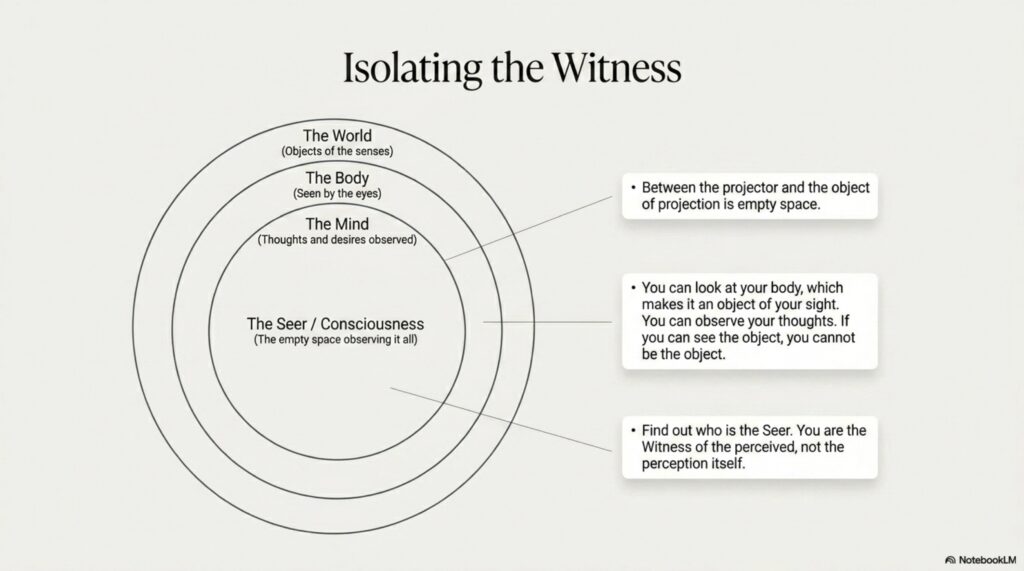
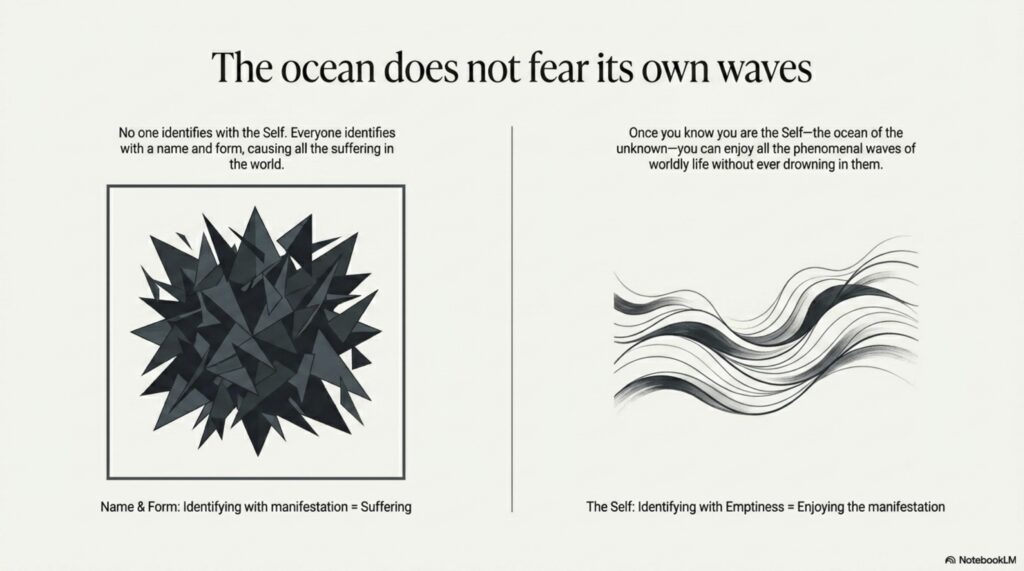
The ultimate shift in perspective is the distinction between the “Seer” (the Witness) and the “Seen” (the Object). Most of us identify with the manifest—the body, the thoughts, the feelings—and consequently, we suffer. But the logic of the Witness is inescapable: if you can observe it, you cannot be it.
You look at your body, and it becomes an object of your sight. You observe your thoughts, and they become objects of your perception. Even the “seeker”—that character in your head who is currently searching for peace of mind—is just another object being watched. If you are the one observing the desire for peace, you are not the desire. You are the Seer, the consciousness, the “Nothingness” that surrounds every form. By identifying with the Self (Atman) rather than the name and form, you gain the confidence to enjoy the waves of worldly life without the fear of drowning. You are the ocean, and the ocean is never threatened by its own waves.
7. Conclusion: The Silence That Was Always There
Real silence is not something to be attained; it is the “substratum” that remains when all manufactured projections stop. It is remarkably simple, yet we make it complicated by imagining there is a “diving board” and a “swimming pool.” We think we have to jump from a state of noise into a state of silence. But there is no diving board, no pool, and no jumper. There is only the Source.
Returning to this Source requires no acquired knowledge and no movement. It has been there since the creation of the world, waiting in the gap between your thoughts. It is the Emptiness that you have spent your whole life trying to exclude yourself from.
What remains when the “you” that is trying to be someone finally clocks out? If you were to sit quietly for just one minute—abandoning every desire, every memory, and every effort to achieve a “result”—what would be left? In that moment of absolute non-effort, you might finally meet the silence that was never actually missing.
Click the colored dots to unfold the nodes: