Kat van Oudheusden,
Group Inquiry (2026-06-29):
Transcript 2026-06-29
I forgot to press record. All right, never mind. So this is the beginning.
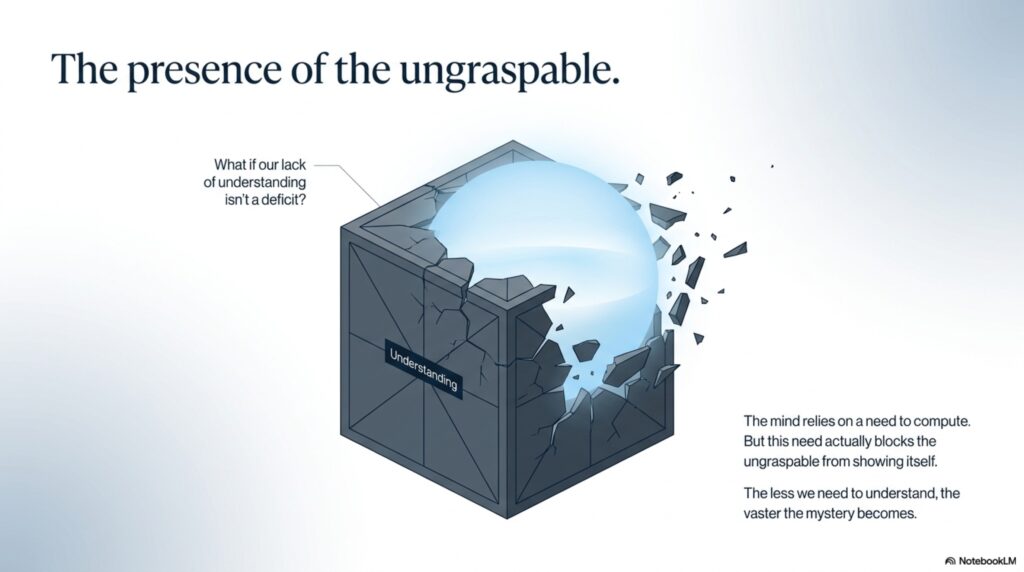
So what if this lack of understanding is not really about what if this is not really a lack of understanding, but the presence of something ungraspable?
So it’s not that we can’t know it. It is known. We just can’t compute.
Do you feel the difference between those two?
So see if you can notice that as you allow that this—whatever this is—to be incomprehensible, that in a way it comes closer.
Our need to understand blocks it. Can block it from just showing itself.
And so the less we need to understand, when we drop that, the vaster it becomes.
So can we just let it be that? Can we let it be incomprehensible and therefore also let it expand into something that the mind can’t grasp?
And it’s okay if not.
There might be a lot of thoughts saying, okay, bullshit alert, or esoteric alerts, or I don’t know, it depends. Or maybe I’m just falling for some belief system or whatever.
See if you can just lay that aside.
Can you let it just be expansively inexplicable?
Maybe you even feel some relief, you know, not needing to find the right concepts to understand this or that—self, no self, doer, no doer, awareness, all these terms.
What if we don’t have to understand any of it?
Maybe if you can let that be and you feel that anxiety or stress of needing to compute kind of dissipate, see if you can notice there might even be some joy in that.
The joy of the unknowable, the inexplicable.
Listening to you is amazing because it’s an invitation to open to this, right, and to stop really the search. To see something, I don’t know what exactly. At least for me, in this moment that I listen to you and being here, it’s a sense of peace and joy, really, contentment.
It’s like, yeah, okay, it’s this. It’s here. I don’t know what to put in that word, but it’s hard to explain, right?
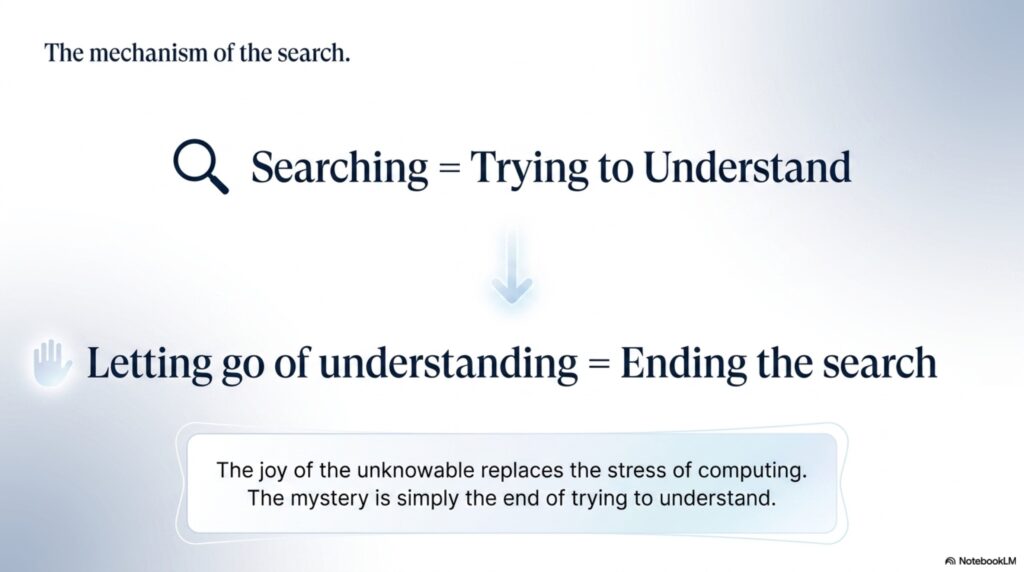
Yeah, and it’s interesting that you connected to not searching. So searching is often trying to understand. And for at least for me, for a long time, that was the same thing. The search was trying to understand.
And so no longer trying to understand, or no longer needing understanding, letting go of the need to understand is the same as ending the search.
Yes.
Even sometimes the mind can become in this tricky situation where it wants to experience some kind of openness or light or profound peace or profound whatever. But it’s a game, right? It’s the mind bringing that kind of achievement, something to get.
Right, something to get.
When the invitation is just to be exactly what is this now? What is this now?
And this brings me, for me, I like that word: mystery.
In fact, I love your post. I really love it. The mystery for me is a word that really connects me with what is this?
Wow. Thank you.
Yeah, it can sound far off. As though, to me, it did. That mystery was something like—it’s esoteric. So it’s not here and now. It’s again something we have to strive to find.
So what this inquiry is trying to show is that if the mystery is just the end to trying to understand, then again it’s just pointing to this as it is—the inexplicable.
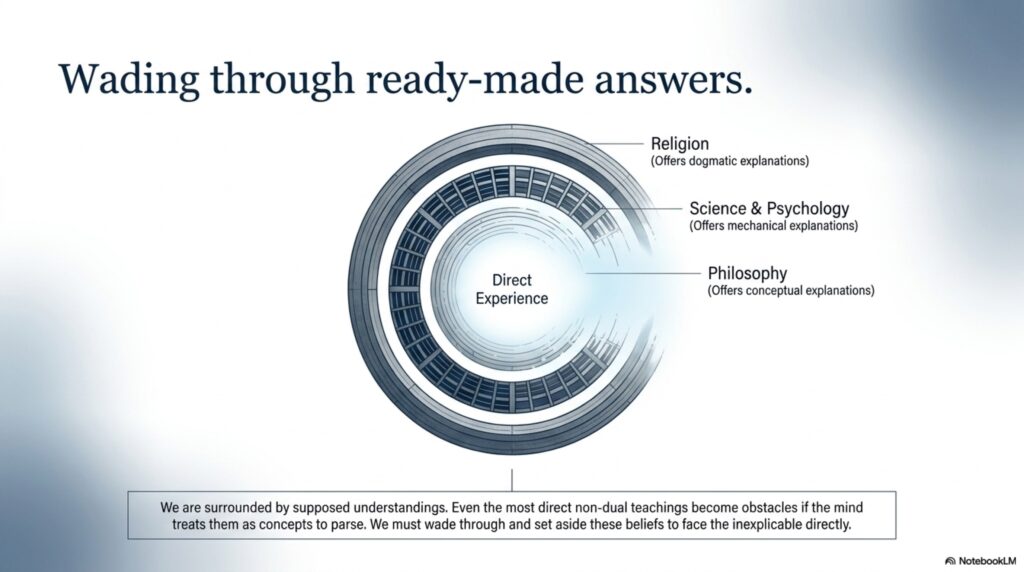
I think one of the obstacles to being open to this is there are so many ready answers that have been given to us. There is religion. Religion has an explanation for whatever the mystery might be. And science also has an explanation now. They might be—and they probably are—bullshit. But they’ve filled us with these beliefs or these supposed understandings.
It’s almost like we have to wade through all of that to get back to the question directly, to ourselves, without those beliefs. Or to put those beliefs aside, whatever they might be.
And what do you mean by wading through?
Well, there are so many explanations. There’s religion or scientific explanations or philosophical explanations or maybe even psychological explanations that surround us, that we grow up absorbing.
And we say, “Okay, well, I guess that must be true then, because these are scientists or because this religion tells me that this is.”
But you said—I don’t know if you meant it that way. You said it seems like we have to wade through them to get to the mystery, right? To put them aside or to see past the explanations that we’ve heard.
Yeah, yeah. Yeah. And that path, even if the explanation is non-dual and it is very direct—it is the most direct teaching ever—it is still in the way. Because it still suggests the possibility of understanding. At least it did to me.
So no matter what I read or heard that was pure non-dual pointing, or as direct as possible, it was still taken by the mind as, “Well, if I can parse this down, if I can compute it, if I can get it, if I can understand, then that will show me.”
Whereas this inquiry is trying to turn that inside out. It’s exactly: if we stop needing to parse, compute, understand, then those pointings are a description of what we find. We’re looking at it.
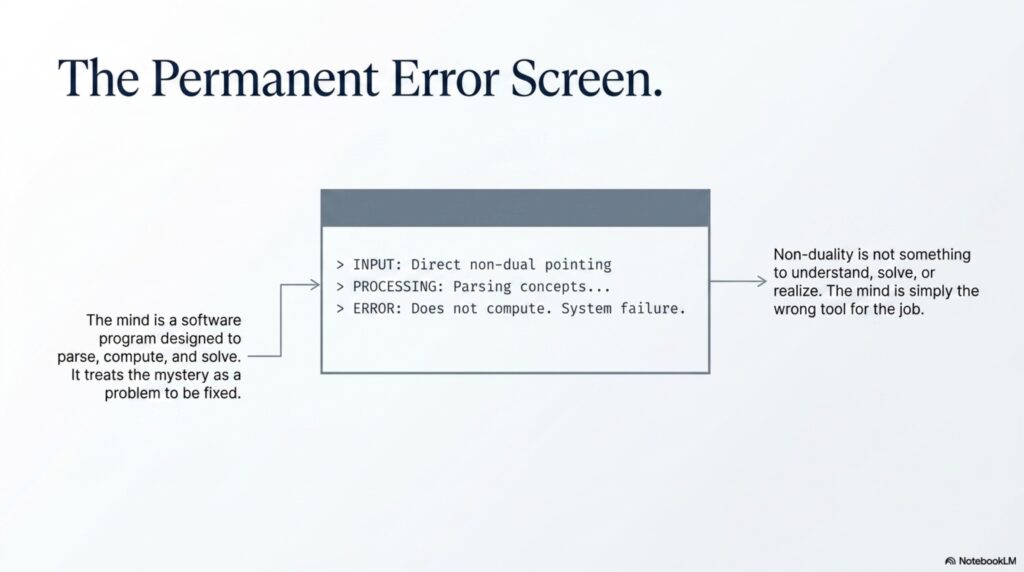
So it’s really—this inquiry is another way of saying that the mind is the wrong tool. Or that non-duality is not something to understand, to solve, to get. It’s not even something to realize. Even the word realizing is too much.
How can we realize something that we already are?
But the weird thing is that even though it is, you know, the software here says, “Does not compute, does not compute,” over and over. You get a permanent error screen.
Even if that is so, the really strange thing is that it is absolutely clear. As presence, just as being, it’s undeniable.
And I think this is what makes it so difficult for many of us for a long time—and it did for me. That it’s about the direct knowing of it, the direct knowing of something that the mind doesn’t understand and being okay with that.
This reminds me of my question last week about why are we here? Yeah, and you didn’t want to tell me why.
So like, yeah, theories came into my mind about what I think is the reason we’re here, and it’s all negative, very negative. And then I finally thought, “You know, it’s a mystery. I don’t think this can be solved.”
Okay. And how does that feel?
I think it gives my mind a break for a while.
Yeah, yeah. Well, that’s excellent, because that is another way of saying peace, right?
Yeah, a break from the mind.
Yeah. So you just made a very, very direct, concrete discovery.
But one thing came up yesterday and it just really bothered me. A situation where I should have spoken what I was thinking, because it was important and it would have solved a lot of problems yesterday if I had just spoken what I was thinking.
I just couldn’t speak. I just—I don’t know what happened. And that happens a lot to me. And then there are times when I do speak and I shouldn’t, and I don’t seem to have any control over that.
And it just really is so weird. And I don’t know why. Am I the one who acts like that?
So, really important sentence: “I don’t have any control over that.”
But it makes me angry that I’m always going to be like this. I always have to deal with this problem.
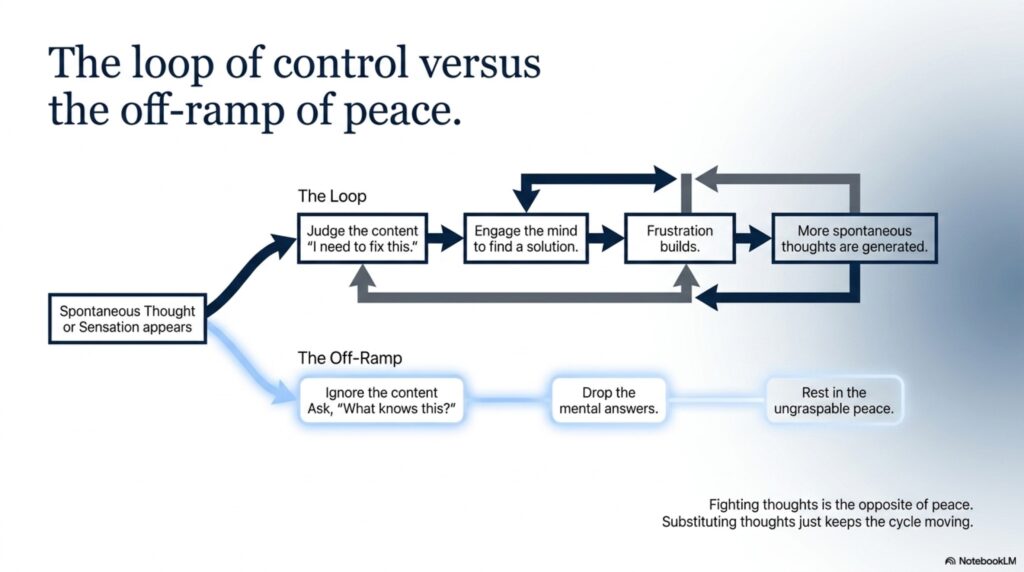
So you know, “has to deal with.” So the thought—the first thought is, “I should have said something,” and I didn’t. Yeah. And then another thought: “It makes me angry,” or “I’m angry that I don’t speak.”
Those thoughts are programming you’ve learned. Maybe as a young girl, in the course of your life, you’ve learned to tell yourself these thoughts, to judge the behavior, right? To understand the Maxine body-mind and its behavior, to understand it, to judge it, to improve it.
I don’t know if there were times when it wasn’t right, when it wasn’t safe to speak or something happened. I don’t know. We don’t have to know the reasons. We just deal with what is here now.
So what if the whole workings of the Maxine body-mind can remain a mystery?
That leads to more suffering, does it?
Yeah, yeah. Because it’s frustrating, you know? When things don’t go the way—they don’t go smoothly. And then, I mean, who’s to blame? But it’s just like something that keeps going and going in this cycle.
It’s just like something that keeps going and going. Cycle. Cycle. Does you know, it’s like so strange.
I don’t know if seeing no self would fix that problem.
This is no self. But seeing it? I don’t know if seeing it would somehow fix that problem.
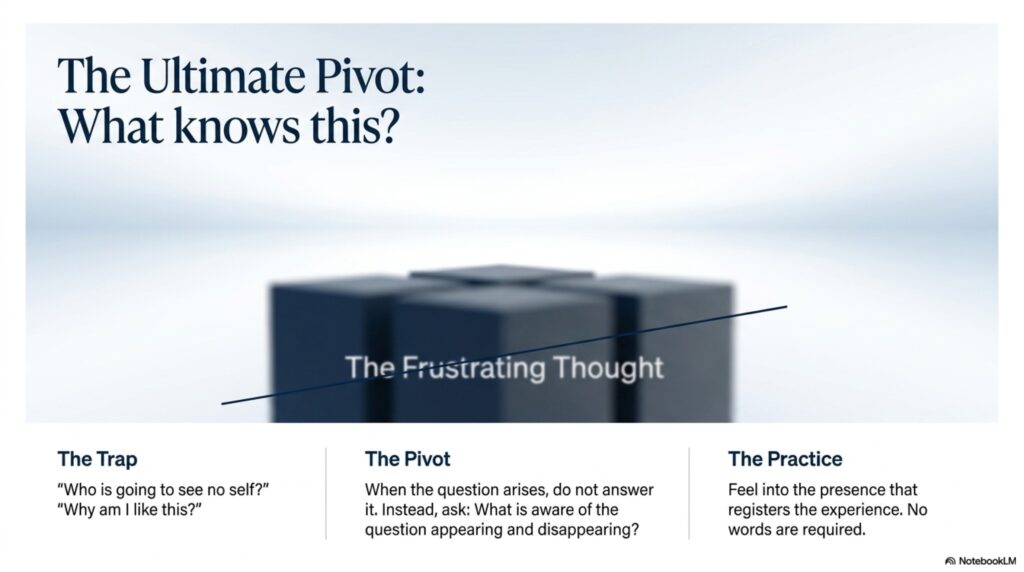
Who is going to see it?
Well, I don’t know. We always talk about seeing no self. Okay, so who is going to see that there is no self?
I think the mind eventually has to be convinced.
When I ask the question—and it’s for all of us, right? Not just Maxine. It’s me too. All of us. Again and again: What knows the question?
So what is aware of the question? Whatever the question was—the question is, in this case, “Who is going to see no self?”
What knows? What is aware of that question?
It’s a presence.
And that presence that we’re referring to, what knows that I just asked that question? What knows the question appearing? What knows the question disappearing? Again, that’s a complete mystery.
We have some very silly words for it: presence, awareness, being. We try to give it some kind of name. But it’s obviously there, right?
So something is deciding how everything’s going to go. Yeah, something is that something is moving. Yeah, decisions, choices, thoughts, judgments—it all comes, goes, moves. And something knows that.
Something is present to that. And that is the mystery.
And if we don’t need to understand what that is, if we drop the need to figure that out—which is really what your question is—you just let it be unknowable.
Okay, all those thoughts trying to understand: “What is this crazy person saying? What is this about?” You just let them be.
Do you feel the peace of that?
I think there’s still going to be frustration, though, you know? Like, oh yeah, but—
So let that thought as well: “This thing happening again and again. It’s a life pattern and it’s never going to stop.”
Yeah, so what? Right now, what knows that?
Put your attention to what right now knows that thought.
The next thought that comes.
Yes, but there’s going to be frustration.
Just what knows that, right now?
Feel into that.
My Maya knows.
That’s a mental answer. Drop that as well. There’s no need for an answer to come. Just feel into it. We don’t need words.
Yeah. That is completely peaceful. Just the presence itself. There’s nothing wrong there, is there?
Before that next thought that comes. Before the next thought. Yes, before the next thought.
I can always find the next thought. I know.
But you see, Maxine? Do you see how, just in the past few minutes, whatever time it was, you were able to just let those thoughts go with a little bit of guidance? That you can do anytime you can do that.
All of us. Anytime we want. Anytime the intention comes, we can just drop the content. Just to give it another stupid name: see what knows that. Taste what knows that. Taste the peace of just knowing it’s a mystery. We don’t understand it. And we can just—even that is not a problem. But if we can just be with that, with the peace of that, that grows and grows on you. Seriously, it’s like it just keeps unfolding.
And again, over and over in these meetings, at first it feels like nothing, right? It just feels like, “Yeah, that’s being presence. Duh, you know, there’s yeah, that’s right.”
But if you taste it over and over again, it is tasted as peaceful, especially in contrast to those frustrating thoughts.
Frustrating thought, the peace of this. Frustrating thought, the peace of just this.
Frustrating thought, the peace of not needing to understand.
Next frustrating thought, the peace of just being.
So eventually we will drop the thoughts naturally?
Eventually you will see that those thoughts don’t take you away from the peace.
We all have endless thoughts, most of us—constant thinking. And the horrible thing is that a lot of those thoughts we don’t want, and they’re not even ours. We didn’t invent them. But they keep appearing.
And so if we take them as valuable, as something to pay attention to, as telling us something useful, we are pulled out of that peace. And that peace—or that mystery of being—that’s what we really are. It’s the undercurrent that’s always there.
So maybe remembering to seek peace or look for peace would be helpful to stop the thoughts that are.
Yeah, but then you’re fighting the thoughts. And fighting is the opposite of peace.
Well, I think maybe putting my mind on something else would be helpful.
Yeah, and if that works, great. Anything, whatever works.
So if substituting a different thought or—you know, it will take you. We’ve already seen together here that it’s moving.
Yeah, yesterday it wasn’t moving, but it gave me something to ponder.
It’s always moving through you. You’re just not always paying attention. Which is totally normal.
But then the more you discover how peaceful it is, or how freeing, to not pay attention to thought, that kind of—it proves itself.
That’s helpful, Cat. Thank you.
And I’m glad you’re recording this. I’m glad for your questions.
Thank you.
It felt like that presupposes that there is something else than this—the mystery. And it kind of ties in with what we were just talking about, the thoughts and so on.
As soon as we are like having something that we think could be achieved or is other than this, then that’s what is.
But for me, that’s why the mystery doesn’t work very well, because—and I always loved the mystery until just this conversation. I thought, “Yeah, it’s not a thing. This is not a thing. Basically, is what the insight is, right?”
Yeah. Yeah. Concepts will do that to us.
Yeah.
Actually, we should—we can take a concept, whatever it is, and then just immediately check it out the window. If that’s possible, that’s great. Check out all concepts, please.
Maru, you?
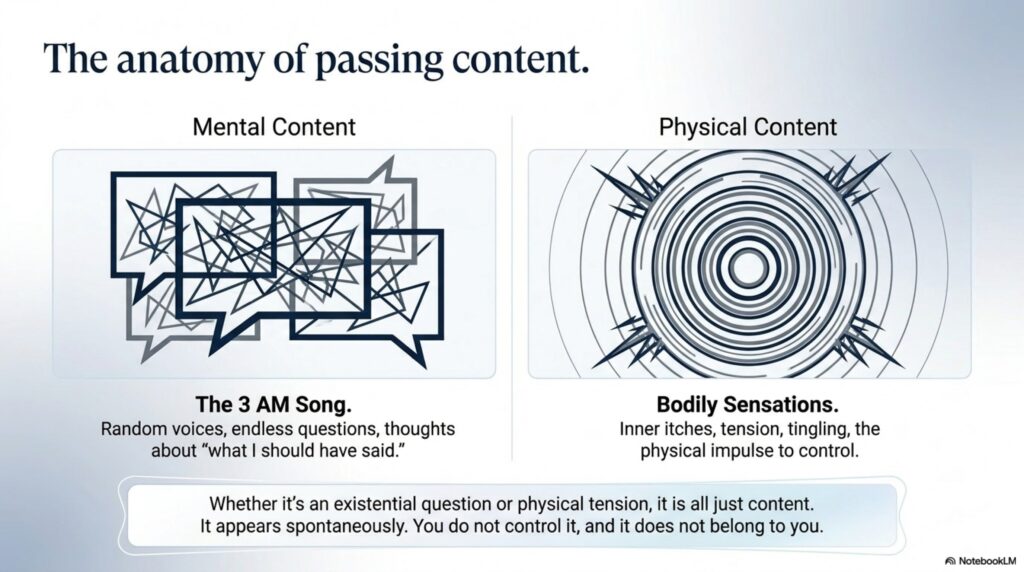
Yeah, I wanted to say that in my case, there are like these bodily sensations that come. It’s like—it seems like there is no even thought, but it’s like, “I need to control. I need to understand it.” It’s like in the body. Can you say something about it?
So can you describe those sensations without interpretation?
Well, some of it is like tension. Where is it?
In different parts. Here, here. I don’t know. And then there is like an impulse.
So there are these sensations. And then there are thoughts that say, “Well, I shouldn’t feel this.”
Actually, says who?
It seems as if the bodily sensation comes without thoughts. I guess it’s not really that way, but—
Well, why not?
So maybe I put this out afterwards, but it’s easier for me to drop thoughts or to see thoughts just like they are, like passing. But it’s harder with my body for me.
But what we’re talking about is sensations. Tingling, tension, maybe like an inner itch or something. What’s the problem?
I don’t know.
It’s the same, really, with the thoughts, or ideas, or frustrations, or perceptions.
You know, um—anyone have that? When you have like this song in your head, and you know, I wake up like at three a.m., and then the song just keeps going and going. And I don’t even like the song. It just keeps playing in my head.
Yeah, it’s just there. Like the sensations are there. There are thoughts that just appear over and over, and we don’t want them.
I won’t tell you my thoughts.
Yeah, but so why treat—it’s all content. It’s all in the same sense. It’s all things that appear. Maybe they appear a hundred million times, but they also disappear. Yeah. And all of that is known.
And this is only about knowing that knowing.
If we can know the knowing deeply enough, then all the appearances and disappearances, the content, it takes care of itself. We see that it moves spontaneously.
So we can stop worrying about it. We can stop worrying about the sensations. We can stop worrying about the thoughts, because we have no control. They’re not even ours.
It doesn’t mean we have to like them, or we have to feel every horrible sensation. Or I don’t know, do something else with them. Maybe that will happen. Maybe not.
But what we do here is again and again: know the knowing of that.
And that knowing is the peace. That’s the freedom.
But we only discover that if we can keep knowing it.
Yes.
Okay.
Yeah. Thank you.
For me, when you talk about dropping concepts, one of the biggest concepts is, you know, what the hell is a thought?
We talk about thoughts all the time. And like, there’s this random voice that sounds like my voice that appears out of nowhere and spews all this random bullshit. Spews it into this space. Like, where is a thought?
You know, there’s just—there’s nothing but mystery behind it. You know, we say thoughts occur in the mind. But then, you know, what the hell is the mind?
You follow every chain of questioning and it ends in this black box of unknowing that can’t be explained.
So we can even drop that.
Yeah, yeah.
I seriously think eventually we’re going to end up just being silent here.
I know it’s coming someday. We’re not there yet. But it’ll come. We’ll just sit here, all peaceful, not knowing anything, totally blissed out.
It’s just funny. We all ask questions, you know? We sit on these calls and we ask questions, and those questions are just these thoughts, you know? Everything’s just a thought. And you know, where do those come from? And who’s thinking them? And who’s hearing them?
Yeah. And if we can keep each other awake to the fact—awake to the knowing of whatever is going on—that’s how we do this. That’s what these meetings are for.
What could be added to what Jeff just said, or what is just being talked about, is questions about—and implying that what isn’t enough. There should be something different. There should be no thoughts, or we shouldn’t talk about it.
Or I think the ultimate—like, again, that’s another concept—but the expectation that what is isn’t enough and there is something else that can be obtained if we just got the answer or the technique or practiced enough or whatever.
And just the idea that there is only this—I know this is jargon, and I can’t use it with any of my friends because they immediately shoot me down for using jargon. But if there is only this, then that kind of answers my question.
Whatever works. And the thoughts—don’t need to go away, because, looking at the thoughts and asking those questions, you know, “What is it? Where is it?” All of that is fascinating.
So the thoughts pop up, and there’s some mechanism in this body-mind that got triggered at some point that just starts to question the nature of the thought. And it’s like, that’s pretty weird.
So yeah, there’s no feeling like the thoughts need to go away, because it’s just this endless fascination with, “What the hell is that thing?”
It’s being said that do not believe your thoughts. And that may be helpful, to realize that those thoughts are just thoughts, and not to log on to them and attach to them and try to figure it out. Just realize their thoughts—they’re just thoughts. They come and go.
Yeah. And to take that a step further is: yeah, they’re just thoughts. But what the hell is a thought?
Looking at the very nature of the one itself.
Yeah. That’s what they are, you know? You probably say they’re what you don’t know.
All right, they are whatever they are.
All right, enough of that bullshit.
Yeah.
Can I ask a question?
Yeah.
How do you know the knowing?
Oh, excellent question.
It’s the words that make that question appear.
The knowing knows itself, but that’s inexpressible in language. So “knowing” is an attempt to express it. It’s another way of saying—this, as Peter just called it—”you know, this presence, being.”
It is. So right now, okay, you are present to this conversation. You are experiencing, yes?
Another way to say that is that this experience is known to you. Whatever “you” is—forget about that. Okay? But it is obviously known, because later you can go tell someone what happened here.
Yes. There is experience, and that experience is known. Another way to say that is there is awareness of the experience. There is presence to the experience.
And that, that knowing or that awareness—it’s alive. It registers things.
These are all just ways of speaking, trying to point to something. But right now, there’s a sense of—it’s going on, right? It’s vibrating. It’s pulsating. It’s not dead.
That is another way of saying that the knowing is known.
Life living itself. Awareness aware of itself. Consciousness conscious to itself. Knowing itself.
And these are all just very poor attempts of something that you can feel right now. You’re here. Experiencing. That’s all it’s pointing to.
So how do you keep knowing the knowing?
That’s already happening. The knowing knows it. Already knows.
Okay.
Right now, you can’t. You can’t make the knowing not know. Presence is present.
Forget about that. Just knowing. It’s a—yeah. The reason that it’s helpful to say that is because it’s not the body or mind that is knowing.
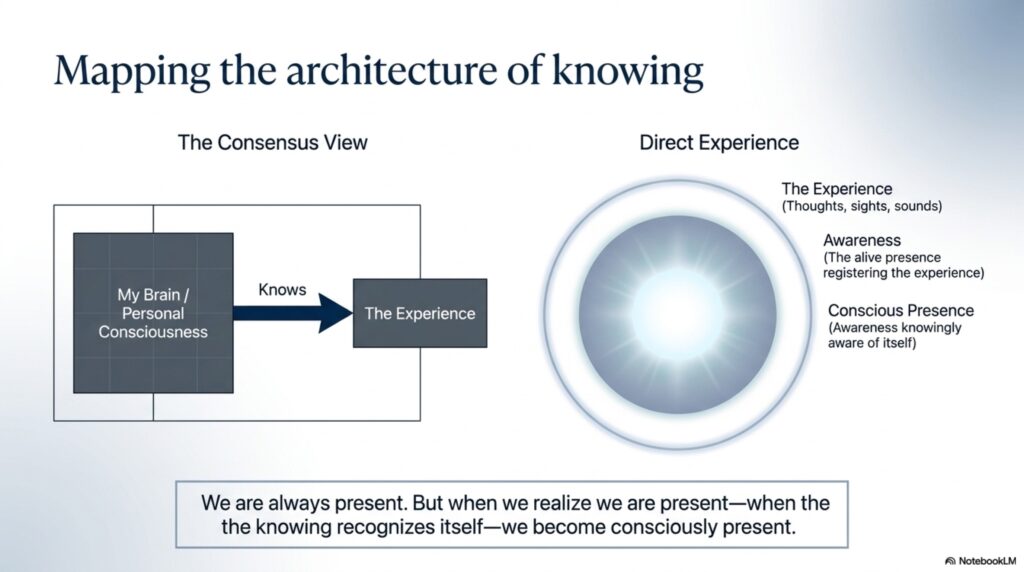
It’s to make a distinction between how we usually believe that this works—which is that my brain, the consciousness in my brain, knows this experience. That I—this body-mind—and the experiencer and—what?
When we say “knowing knows knowing,” the knowing that is—that which experiences experiencing itself. It’s to make a distinction between that which is the mystery we were talking about earlier, in contrast to our normal consensus view of speaking about this—of understanding how life works, which is that my personal consciousness in my brain knows experience.
Awareness works better for me.
So just staying aware of everything that’s going on—is that being aware?
Awareness, yeah. So it’s not awareness is already aware. What is aware is knowingly aware.
So right now, that which is experiencing, whatever that is—let’s leave aside what that—we don’t know what it is, okay?
Some consciousness, some experiencing is happening knowingly. That’s it.
And stay on it as much as you can. Now, realize that that is going on all the time, okay? So whenever it occurs to you, you can notice that there is something. That something is aware.
And then a further description of that is that awareness is aware of itself. But forget about that. Just aware. Just being experiencing.
When you taste that—when that is tasted—that’s aware of itself.
So another example: if you take a baby, how we imagine a baby experiences the world, the baby—there is awareness, but it’s not consciously aware. It’s not knowing, knowing itself. It’s just knowing.
Now forget all of that and just be.
Because as soon as you realize that you’re just being, you’re now consciously being.
We’re always present, but as soon as we realize that we are present, we’re consciously present.
Is that what we want—consciously present or always—way, no. That’s just a recognition.
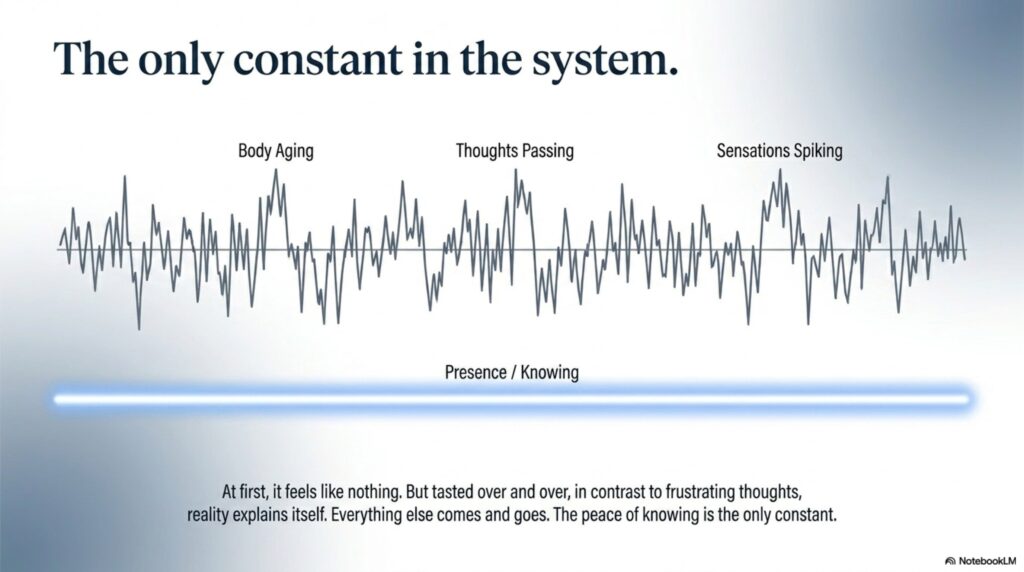
And the more we recognize that is going on, that’s what starts to show us that is more real, more permanent, more what we are than all the things we thought we were.
Like the body, which ages and dies. The thoughts, which come and go. The sensations, which pop out of nowhere and go away again.
So everything else. The only constant that we have is presence, knowing, aware.
And the more we are conscious of that—so the more knowing knows itself, being recognizes itself, all these different ways of saying that—the more it is realized that is the constant.
And so it must be what we truly are, because everything else comes and goes.
And that’s that’s really—
Go ahead. Go ahead. Sorry.
Okay, so when you said, “When you realized you are aware,” that’s that’s knowing itself. I don’t know if I interpret that correctly. But my question is, so when I realize I’m aware, who realizes?
Yeah, that’s a question. Yeah. Question mark.
So this is something to inquire into. But the answer—the correct non-dual answer is: awareness is aware.
Oh, but this doesn’t help us very much.
Okay. So I sometimes use these expressions, yeah, in an attempt, because that’s what the body-mind does, I guess. We try to explain.
And over and over we have to realize: so this is super—this is super. Both Rosalind and now you, we are reminding each other how this is inexplicable, right?
Because no matter how much we try to do the direct non-dual pointing—and it’s right, it’s good to ask these questions—even if we, if awareness becomes aware of itself, what the hell does that help us with, right?
To me, it helps a lot.
To be, okay.
Yeah. I keep doing it. But my mind-boggling is, “Who is becoming aware that I’m aware?”
Yeah. But see that there’s no answer to that.
Complication. Yeah. Yeah. But so, again, right now.
Here we go again. Excellent. This is known. Just forget all the concepts, everything I just stupidly repeated about awareness and all that. Forget all of it. Don’t even give it a word. Don’t give it a name.
Drop all thoughts that come up. All of them.
Drop all the questions.
Just don’t even drop them.
Just ignore them.
And then notice what is left when all of that mind stuff is just ignored.
All of it. Even that thought right now.
And that one.
We’re still here, right?
Still experiencing.
And so our attention has just been put on that experiencing itself.
And the more that happens, the clearer it becomes. It doesn’t become any more understandable or explicable, but it becomes clearer and clearer and clearer.
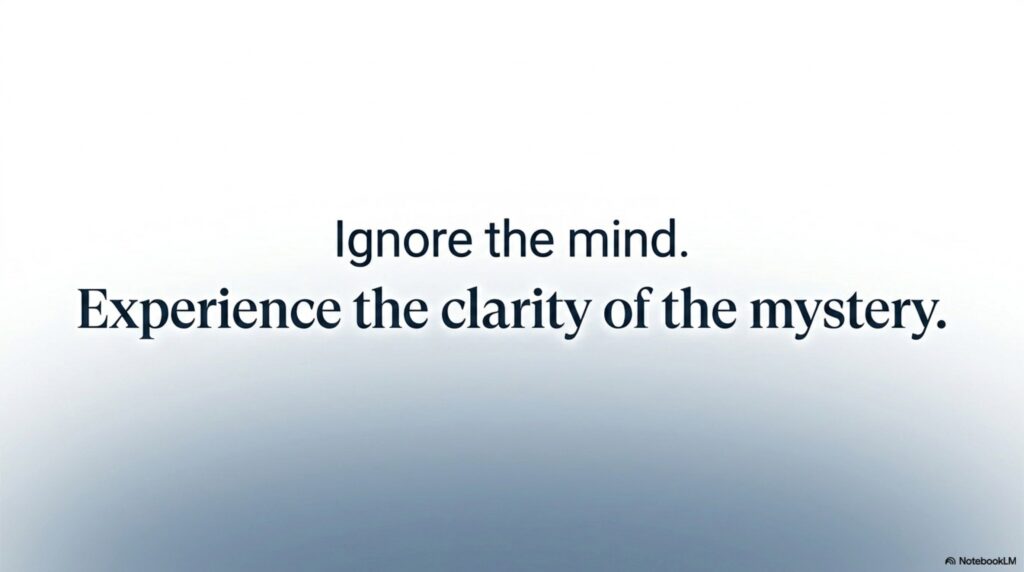
So that’s your job. The job is: ignore the mind, look at this. Ignore the mind, experience this. That’s it. That’s three million non-dual books in one sentence.
So could it just be described as as simple as giving up all thoughts?
Is that enough?
Even that is too much, actually. Because we don’t have to give them up. Just ignore. Even ignore. Even all words are too much.
Let it be. Okay. Ignoring. Yeah. Whatever word works for you, whatever word makes you stop listening to your thoughts, use that one.
It’s a non-doing. It’s a being.
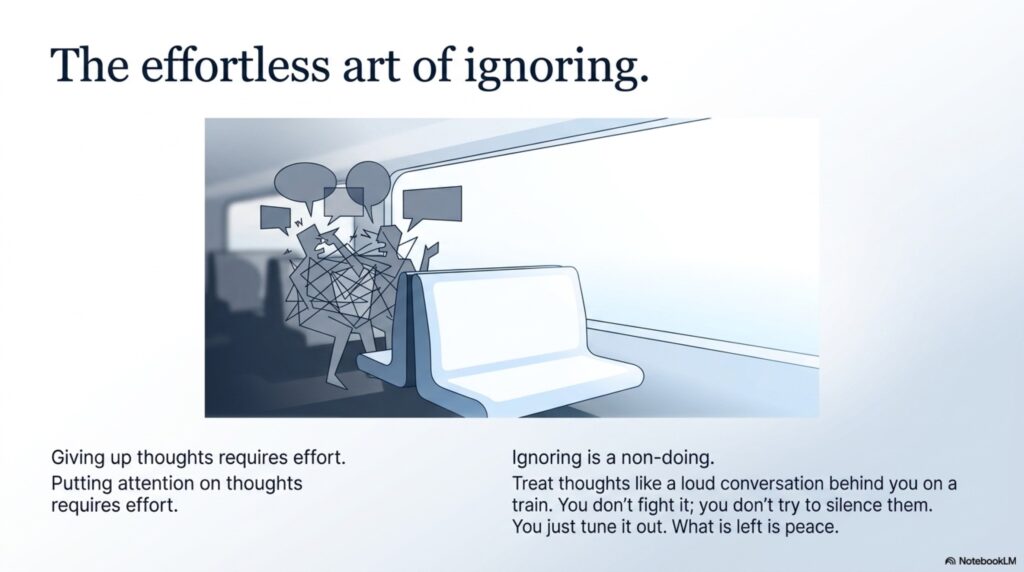
Yeah. See? It actually takes effort to put attention on thoughts. Yes.
It doesn’t feel that way to us, because we’re so trained to listen to thoughts. But it’s actually more effortless to not listen to them.
And it’s, again, the analogy of—you know, the annoying conversation you’re in on the train, and the people behind you are having. And you just ignore it. You just tune it out.
And what is left is peace.
You said, “What is left is peace.” You want to fight about that?
No, I just—what if I have a toothache? And what is left is the toothache?
Yes. And am I okay with that, or do I need peace, because peace is another ideal that I have to strive for?
What do I do wrong? What do I need to do to get peace?
I have to be—I don’t have to. But ideally, to be with what is and not wanting something else to be. Including that. They’re all just concepts. They’re all words.
Peace just is another attempt to describe what is left, what this is.
Yeah. And everything can be heard as a goal. Everything.
And Maxine—what you can notice, in the peace, again it’s just words, right?
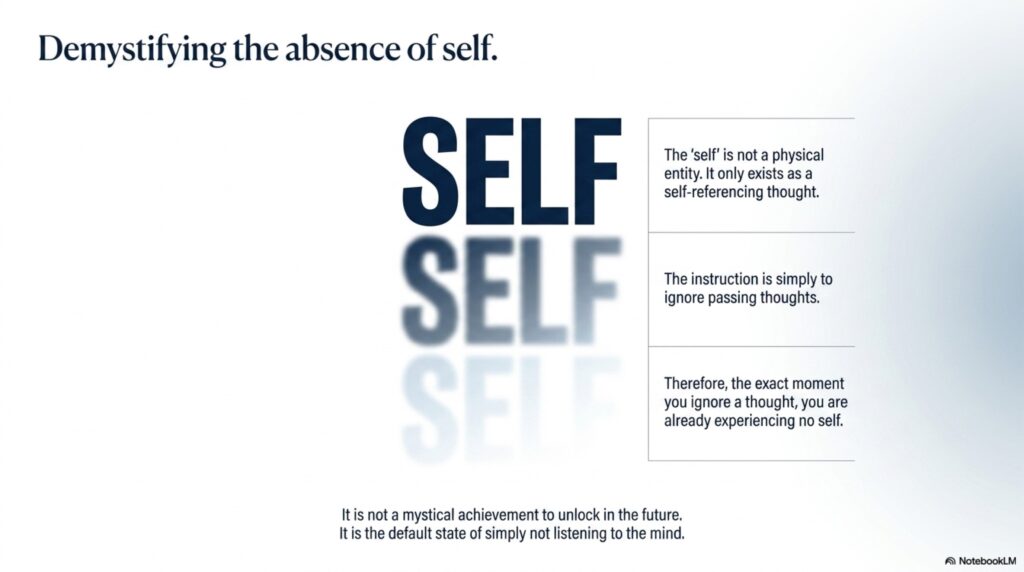
But if there’s ignoring, not listening to thoughts, there is also no self.
So self is another word for those thoughts.
So as soon as you are in that—in this as it is—ignoring the thoughts, you are in no self.
See? Already the case. Already seeing no self.
Just by not listening to the thought. Yes.
Okay.
The self only exists in thought.
Okay. And what about perceptions, because when thoughts are like ignored, then there are all the perceptions. But that’s still the mind, right?
Yeah, yes. Ultimately, that’s also—it depends on what you mean by mind. And we can go into all the explanations again. But perceptions are there. Yes. Thoughts are also still there.
So it’s like: what notices?
Notices perceptions. Yes. All of it. Yeah.
See, perceptions—we usually don’t. It’s our thoughts about the perceptions that usually create the issue, okay? Or the thoughts about the sensations.
The sensations, the perceptions, even the pure thoughts that come and go are not the issue. It’s making them mine.
So even to say “ignore thought”—it’s a generalization. Ultimately, the only thoughts we need to ignore are the ones that reference the self.
But it’s much easier, because then we’re trying to think about it again, right?
They’re like, “Oh, which thought thinks?” You know?
So ignore thought. Taste this. And not for all of time, yeah. Not forever and ever. Just for moments.
Just because that will show—it shows. Reality explains itself to us.
So it will become obvious that some thoughts are not problematic.
If I’m thinking about how much I need to water the plants in the garden, you know, this doesn’t—it doesn’t cause constriction, stress, conflict, suffering.
But to recognize what I am, I need to have moments of ignoring everything, because otherwise I just never consciously know.
And it was very important. But you said that about—it’s not perceptions or sensations, but the thought about it that makes the problem.
Yeah, the issue is—okay, yeah. And again, it’s much more powerful if you discover this directly.
Yeah. I know, because it’s all an attempt to say something about something else. And I’ve said this many, many times.
But the reason—the only thing we can do here is hopefully give each other the motivation and the interest to look directly, to experience, to do the tasting ourselves.
I can’t make you do that. No one can. But that is what teaches. That’s where you find it.
Thank you.
Disclaimer: The following content has been generated by ai, but is a little off at times, in part due to the transcript not discerning the different speakers.
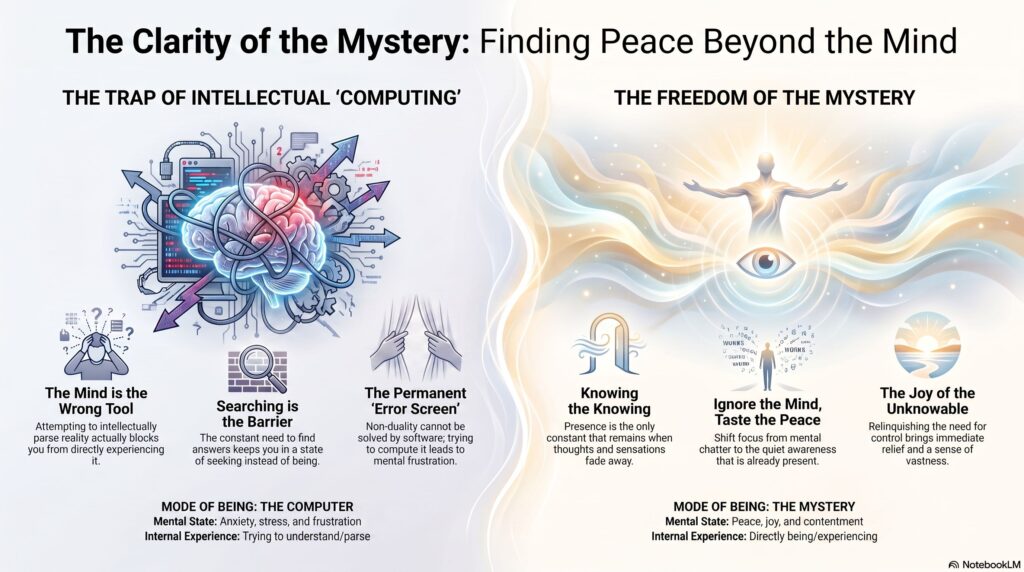
The Clarity of the Mystery: Finding Peace in the Inexplicable
1. The Cognitive Gridlock: Why Understanding is a Barrier
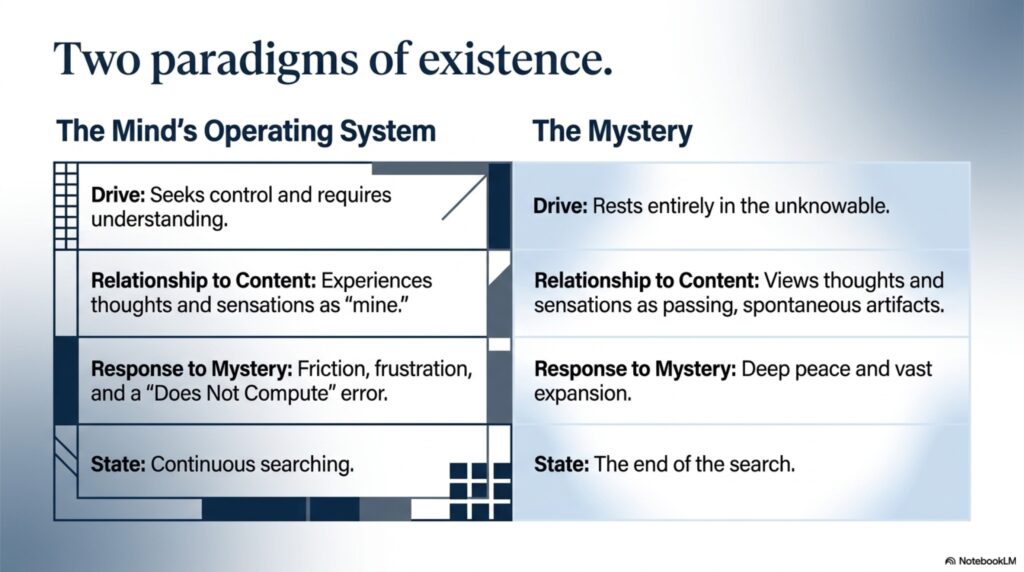
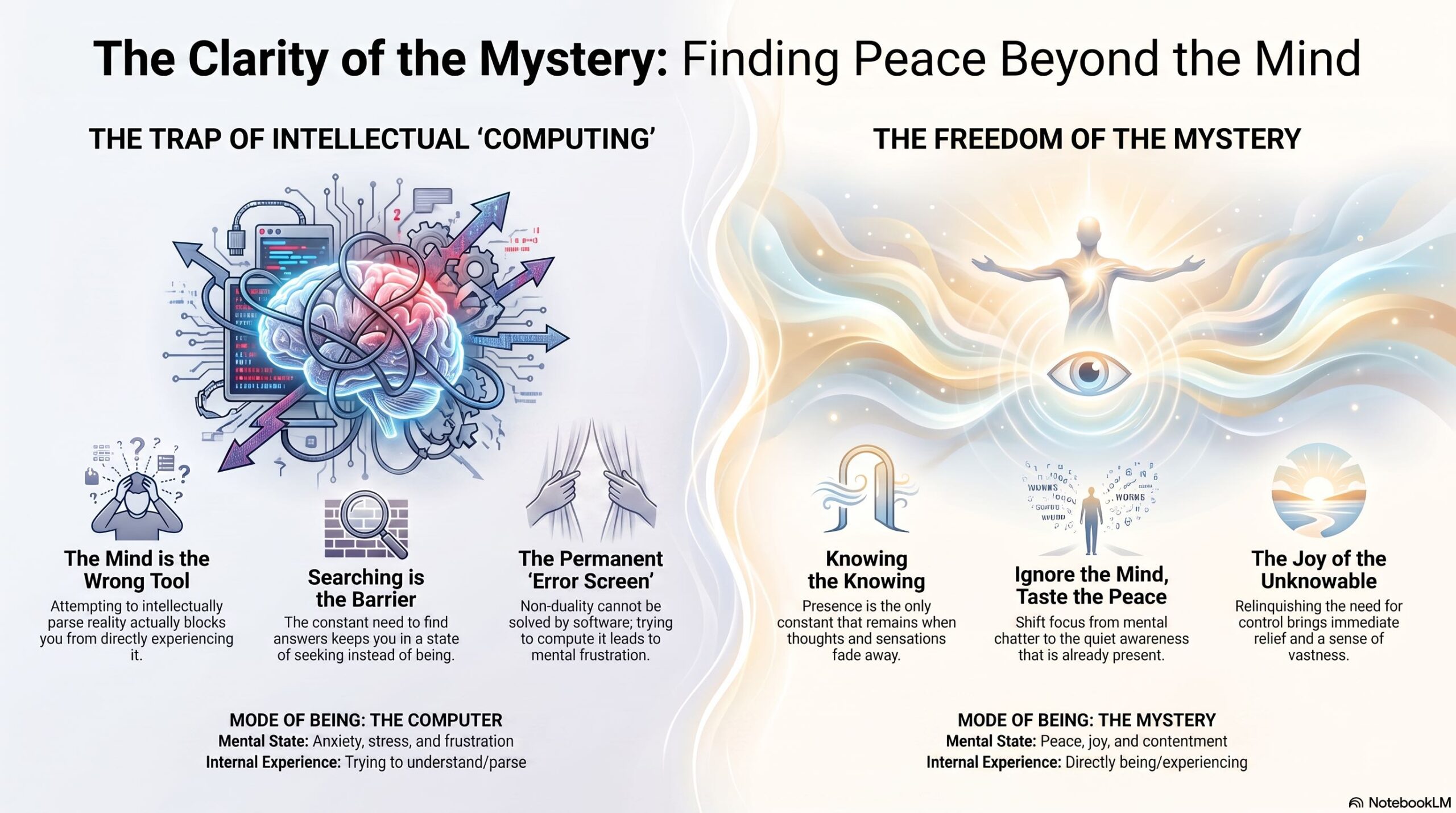
The human mind operates as a sophisticated calculation engine, perpetually attempting to compute, parse, and categorize every facet of existence. We are conditioned to believe that peace is the byproduct of a solved equation—that once we “understand” our lives or the nature of reality, the friction of being will finally dissipate. However, this compulsive need to intellectually grasp our experience is the primary obstacle to experiencing it. When the mind attempts to parse the vastness of the present moment, it inevitably encounters a “permanent error screen.” The software of the intellect begins a loop of “does not compute,” signaling not a failure of intelligence, but the presence of the ungraspable.
Functionally, the search for understanding is identical to “the search” itself. To seek an intellectual resolution is to stay trapped in a cycle of seeking, looking past the immediate reality for a conceptual key that cannot exist. This shift toward the inexplicable often triggers a predictable mental program: the “bullshit alert” or “esoteric alert.” We must recognize this skepticism for what it is—a protective mechanism designed to maintain the ego’s illusion of control. By laying aside the demand for a belief system or a perfect computation, we transition from the exhaustion of the “mental screen” to the profound relief found in the mystery.
2. Redefining the Mystery: The End of the Search
Strategically, we must rescue the word “mystery” from its esoteric baggage. It is not a distant goal to be reached through decades of study; it is a synonym for the inexplicable nature of “this”—life as it is currently appearing. When the need to understand is dropped, the search ends. We are no longer trying to solve reality; we are simply looking at it.
Our culture provides various “ready answers” that act as barriers to this direct inquiry, filling the void of the unknown with conceptual filler:
- Religion: Provides structural explanations and moral frameworks to define the mystery.
- Science: Offers empirical data and materialist theories to solve the mystery.
- Philosophy: Uses logic and linguistic parsing to categorize the mystery.
- Psychology: Offers narratives of “self-improvement” and behavioral causes to explain the mystery.
Direct inquiry requires “wading through” these pre-packaged beliefs—even non-dual concepts—to reach the question directly. This cessation of mental labor is a functional definition of peace. Once the anxiety of needing to compute dissipates, the unknown ceases to be a threat. This transition from the labor of “trying to solve” to the ease of “letting it be” reveals the mechanics of what remains when the mind stops its work.
3. The Mechanics of “Knowing the Knowing”
To find stability in the inexplicable, we must distinguish between the content of experience and the awareness in which that content appears. A common misconception is that “knowing” is a biological function—a product of the personal consciousness in the brain. However, inquiry reveals that “Knowing” is a prior, alive, pulsating presence that registers the brain’s activities.
The knowing knows itself. This is not an intellectual achievement of the brain, but an alive, pulsating presence. It is the register of experience that remains even when the specific details of that experience change. It is the “knowing” that is aware of a question appearing and aware of that same question disappearing.
The following table distinguishes between the transient variables of our lives and the enduring presence that constitutes our true ground:
| The Changing Content (Variables) | The Constant (The Only Constant We Have) |
| Physical Sensations: A toothache, tension, or an inner itch. | Awareness: The capacity to register the sensation. |
| Mental States: Frustration, joy, or “does not compute” errors. | Presence: The “space” in which emotions arise. |
| The Body: The aging process and biological shifts. | Being: The undeniable sense of “I am-ness.” |
| Narrative: Thoughts about the past or the “self.” | Knowing: The alive presence that doesn’t age or change. |
Recognizing the constant is the key to realization. While a sensation like a toothache may be painful, the “knowing” of that sensation remains untouched and peaceful. Because this presence is the only thing that does not come and go, it is fundamentally what we truly are. This recognition is not a new achievement, but a “non-doing”—a shift in attention away from the noise toward the silence that registers it.
4. The Practice of Strategic Ignorance
Entering the mystery does not require a violent struggle against the mind. Instead, it involves “strategic ignorance”—an effortless tuning out of the mental narrative. This is comparable to overhearing an annoying conversation on a train. You do not need to make the passengers stop talking to find peace; you simply stop parsing their words and allow the sound to recede into the background.
The centerpiece of this practice is the radical realization that the “self” only exists in thought. The “Maxine” or the “I” that needs to be improved or understood is a linguistic construct—a cycle of programming. When the narrative is untethered from attention, the self-referential “me” dissolves.
To “taste the peace” of the mystery, follow this protocol of non-engagement:
- Acknowledge the thought: Notice the appearance of a thought without judgment (e.g., “I should have spoken up”).
- Identify the “Self” reference: Recognize that the thought is trying to define, judge, or “fix” a personal self.
- Withdraw attention: Stop listening to the content. Instead of engaging, return to the fact that the thought is known.
- Ignore the Mind: If you ignore the thoughts that reference a “self,” you find that the self-construct vanishes. What remains is a silent, inexplicable presence.
This is the ultimate “non-doing.” It actually takes more effort to maintain attention on the frustrating loops of the mind than it does to let them be. By refusing to pay attention to self-referential programming, the undercurrent of peace becomes obvious. Reality does not require a translator or an intellectual solution; it explains itself to us with absolute clarity the moment the mind stops trying to parse it.
Leave a Reply