
Detailed Summary (getrecall.ai)
Introduction to Awareness and Its Controversies
- The book Awareness was written by Anthony de Mello, an Indian Jesuit priest, and has become a significant work for modern mystics, spiritual seekers, and various thinkers, including Eckhart Tolle, Naval Ravikant, and Tim Ferriss. (00:00:00)
- In 1998, the Vatican issued a formal notification declaring that the teachings of Anthony de Mello were incompatible with the Catholic faith. (00:00:11)
The Nature of Human Sleep and Conditioning
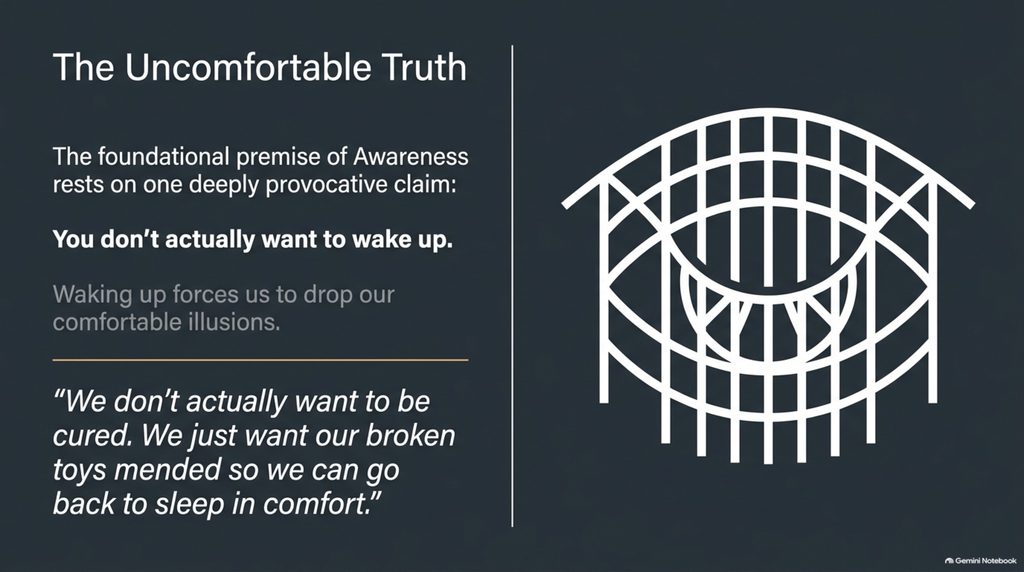
- The central premise of the book is that individuals do not truly want to be happy or awakened because waking up requires abandoning the stories they tell themselves and dropping their illusions. (00:01:04)
- Suffering is attributed not to the difficulty of life itself, but to a lack of awareness regarding one’s internal state. (00:01:18)
- Much of human life is spent in a state of sleep, characterized by automatic reactions, the pursuit of approval, and an attachment to people and ideas. (00:01:26)
- Human behavior is often driven by conditioning rather than free choice, and individuals frequently project their own fears, desires, expectations, and beliefs onto reality. (00:01:41)
- Most emotional distress arises from internal narratives rather than actual events. (00:01:56)
Defining Awareness and Mechanical Existence
- Awareness is defined as the act of seeing reality clearly without immediate judgment, resistance, or attempts to change it, which leads to personal freedom. (00:02:03)
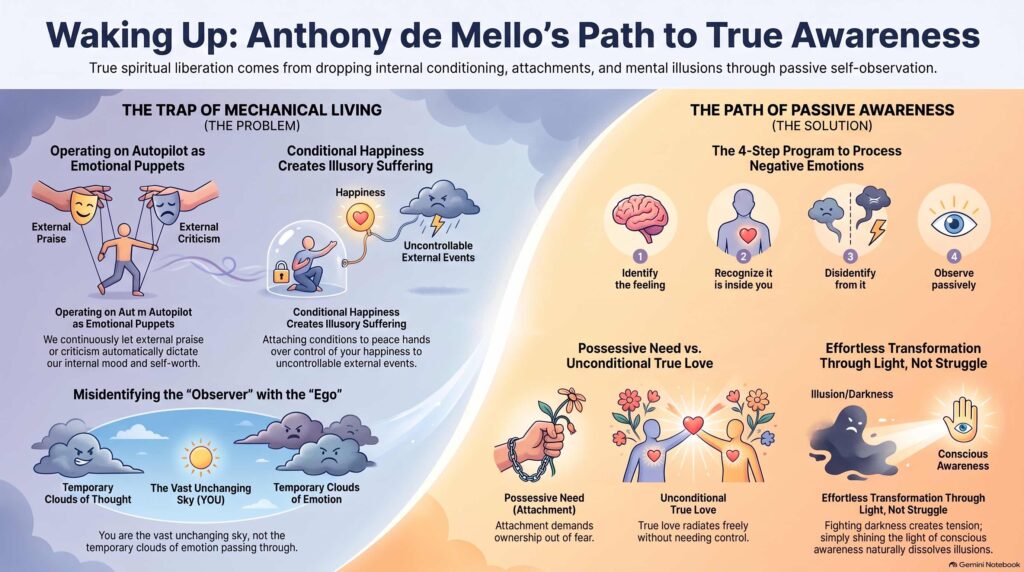
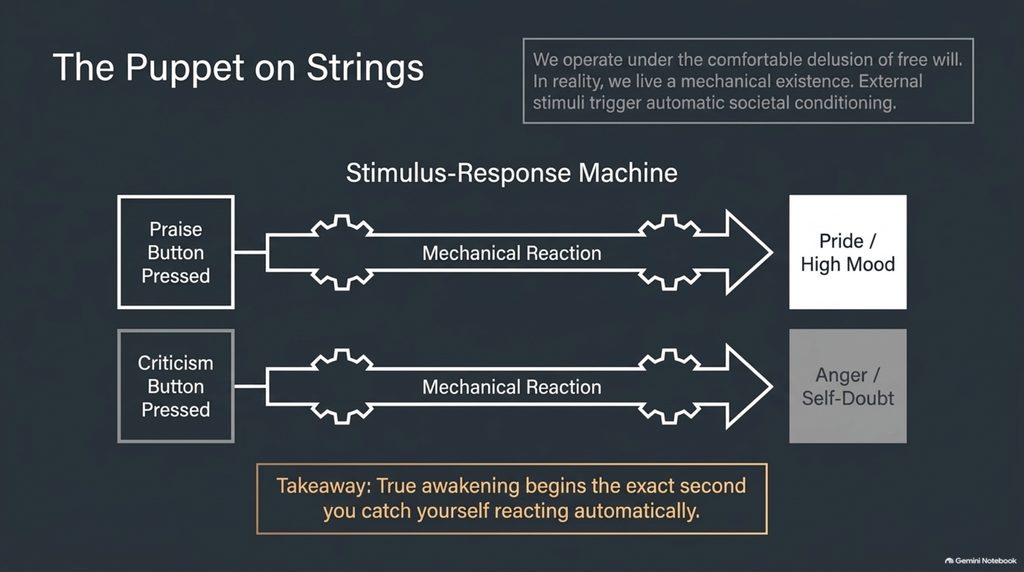
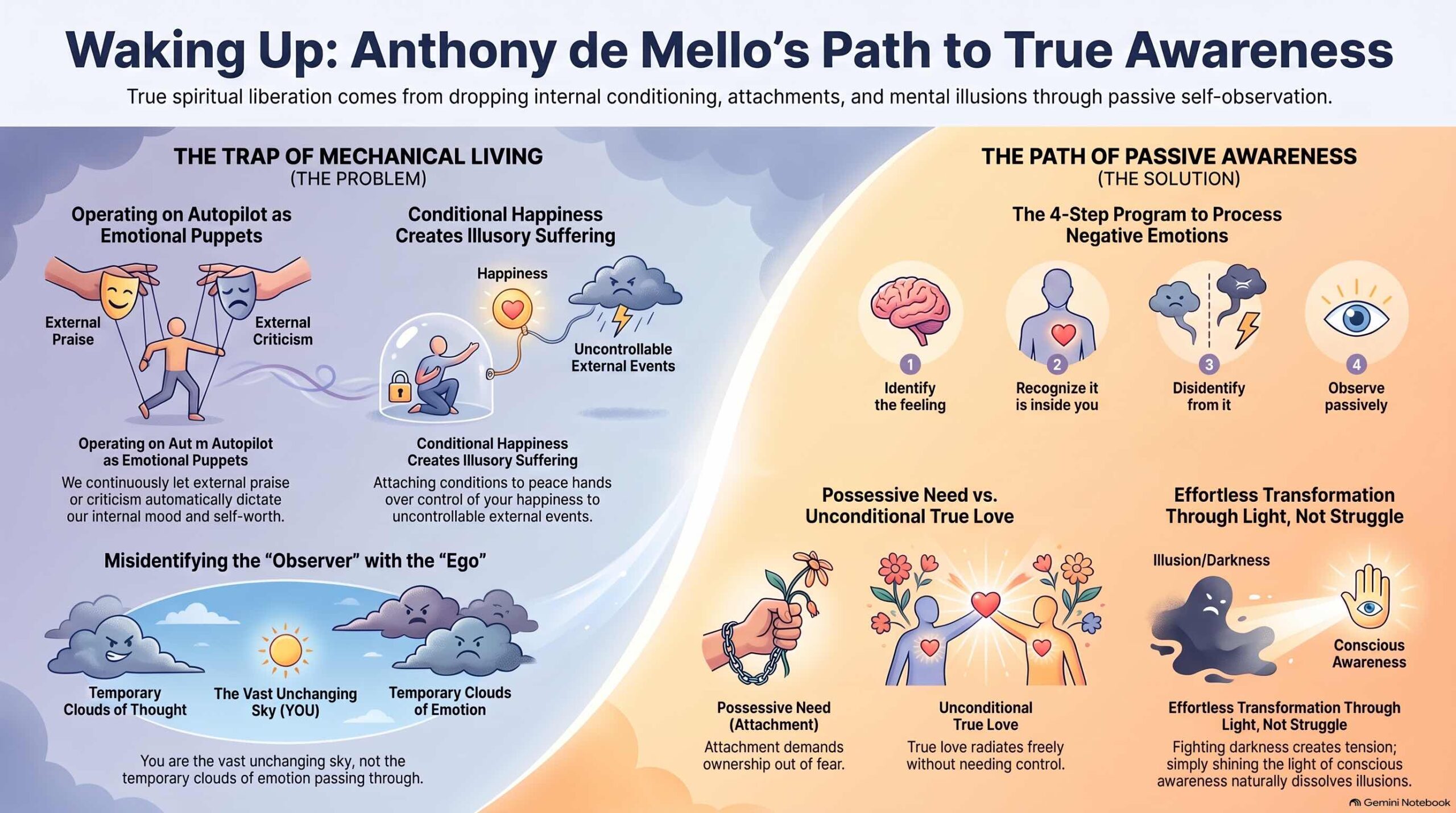
- Anthony de Mello argues that most people live a mechanical existence on autopilot, operating under the delusion that they are conscious and in control. (00:02:39)
- Human reactions are often manipulated by external stimuli, such as praise or criticism, which trigger automatic emotional responses based on societal conditioning. (00:03:01)
- True awakening begins when an individual catches themselves reacting automatically and recognizes that external events are dictating their state of mind. (00:03:40)
Conditional Happiness and External Demands
- People generally seek relief rather than a true cure when pursuing spirituality or therapy, as a genuine cure requires the discomfort of facing reality and abandoning conditioning. (00:03:56)
- The desire for relief manifests as a demand for external circumstances to be rearranged so that individuals can remain in a state of comfortable sleep, a concept Anthony de Mello refers to as conditional happiness. (00:04:20)
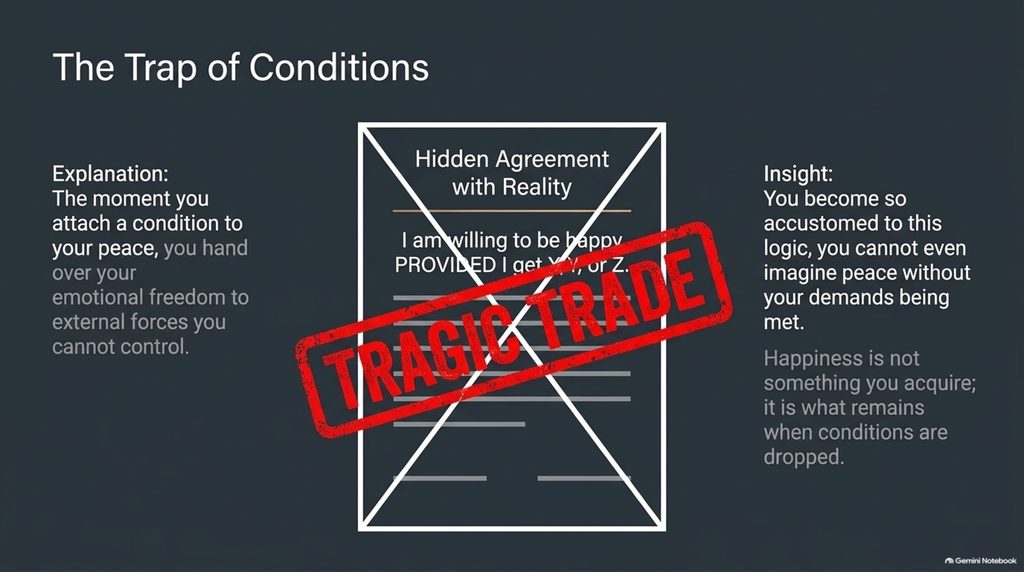
- Individuals frequently establish hidden agreements with reality, making their happiness conditional upon specific external outcomes, career milestones, or the behavior of others (00:05:00).
- Attaching conditions to peace results in a loss of emotional freedom, as it grants control over one’s internal state to external factors that are inherently uncontrollable (00:05:08).
- Conditional logic becomes so ingrained that many people struggle to conceive of peace without the satisfaction of their specific demands (00:05:31).
Unlearning Programming and Finding Peace
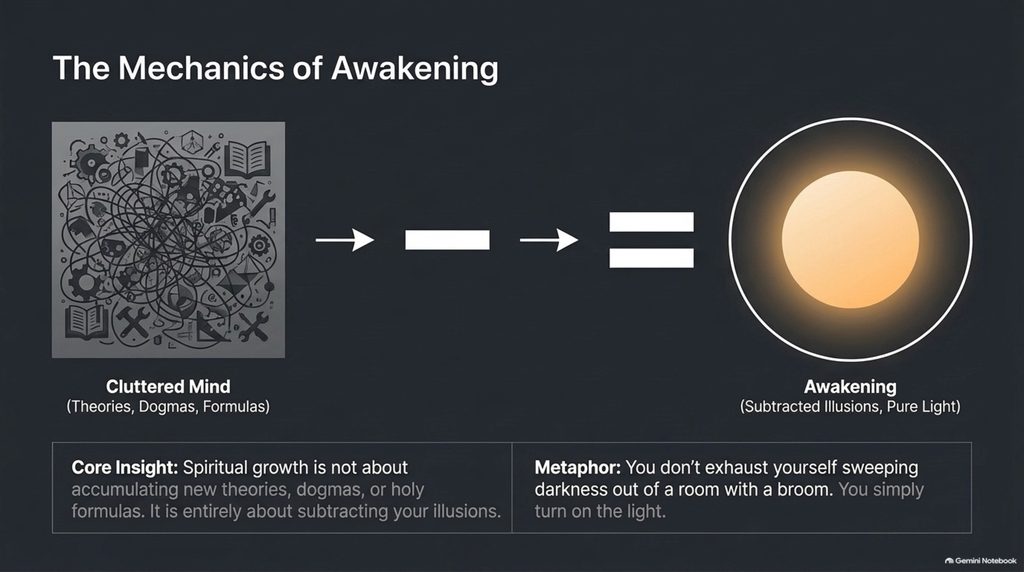
- Spirituality, as defined by Anthony de Mello, is a practical process of unlearning false programming rather than the adoption of rigid dogmas or complex theories (00:05:46).
- Happiness and peace are described as a natural state that is obscured by the insistence on maintaining conditions and illusions (00:06:08).
- True peace is what remains once an individual stops demanding that reality conform to personal desires (00:06:28).
Distinguishing the Observing Self from the Ego
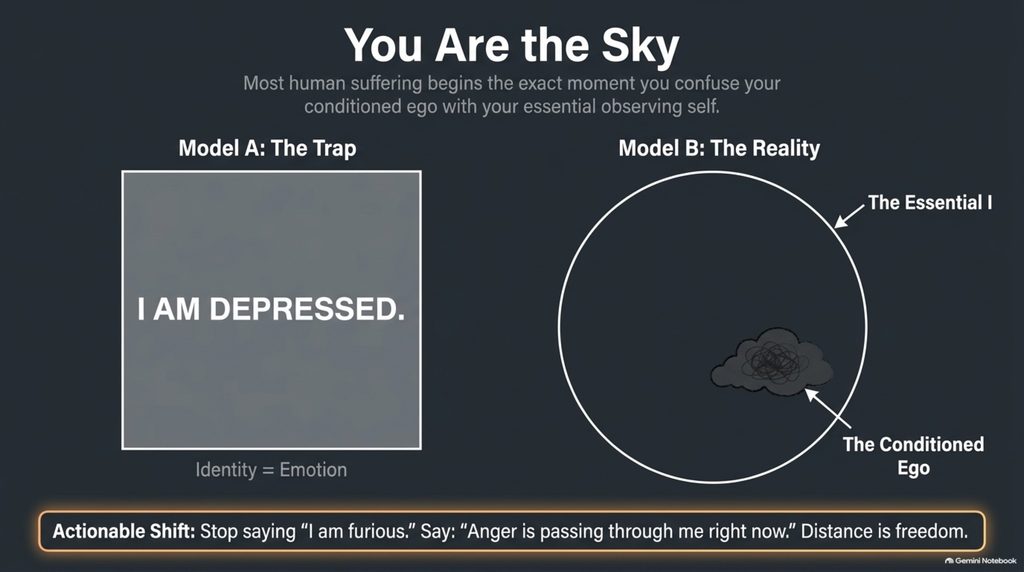
- A core insight involves distinguishing between the “observing self” (the essential “I”) and the “conditioned ego” (the “me”) (00:06:34).
- Human suffering often arises from the mistake of identifying one’s fundamental self with temporary experiences or emotional states (00:06:49).
- Language contributes to this illusion when individuals equate themselves with emotions by saying “I am depressed” or “I am angry” (00:06:58).
- Reframing emotional experiences by noting that an emotion is “passing through” creates psychological distance between the observer and the observed (00:07:27).
- The relationship between the self and emotions is compared to the sky and clouds; the sky remains untouched by the passing, temporary nature of the clouds (00:07:42).
The Dangers of Labeling and Social Roles
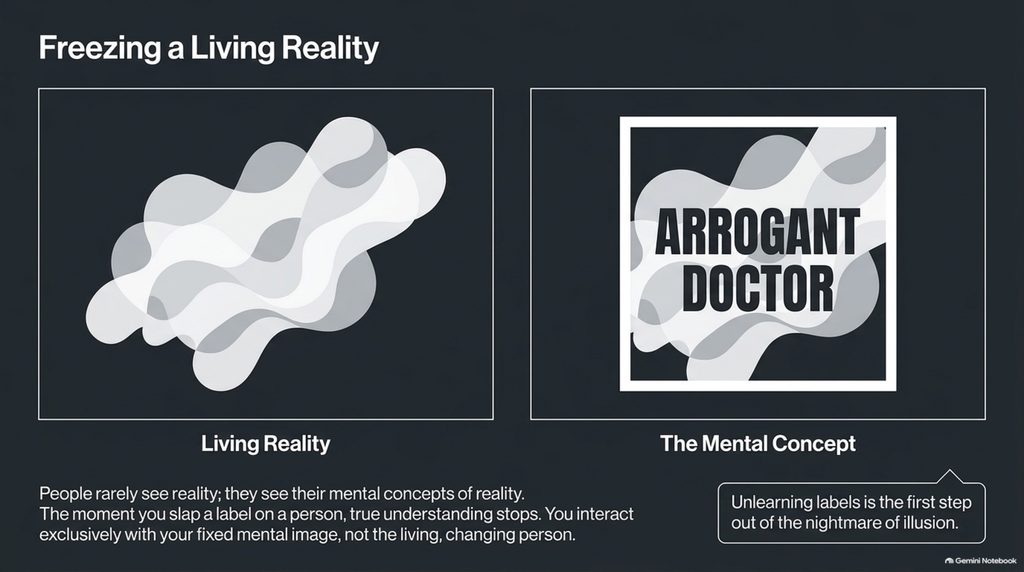
- Conflict often stems from the tendency to interact with fixed mental images or labels assigned to others rather than the actual, changing person (00:08:06).
- When individuals label others as “arrogant” or “a failure,” they cease to understand the person and instead react only to their own mental projections (00:08:22).
- Heartbreak and disappointment often occur because individuals trust their own judgments and concepts of others rather than the people themselves (00:08:45).
- Defining oneself through social roles, titles, or careers creates anxiety, as the individual fears that the loss of these labels would mean the end of their essential self (00:09:01).
- Waking up requires the unlearning of labeling habits and the practice of observing the “me” with total detachment to achieve spiritual freedom (00:09:27).
Silence and the Limitations of Conceptual Knowledge
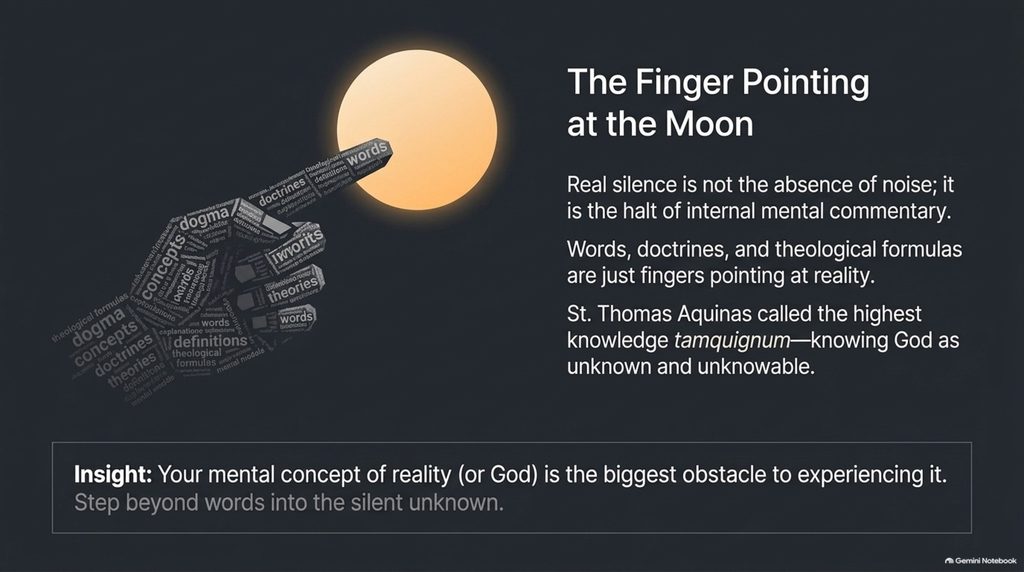
- Real silence is defined as an inner state where the mind ceases its continuous stream of internal commentary, analysis, and mental chatter. (00:09:55)
- Dlo proposes that silence itself serves as a greater revelation than written texts, doctrines, or theological formulas, which are described as fingers pointing at the moon rather than the reality they indicate. (00:10:09)
- Direct, unmediated contact with reality occurs only when an individual stops the constant process of naming, evaluating, and commenting on their surroundings. (00:10:38)
- A central thesis is that a fixed mental concept of God acts as a significant obstacle to experiencing the divine, as such concepts are merely personal mental creations rather than the reality of God. (00:10:47)
- People often fail to perceive the divine presence surrounding them because they operate under the assumption that they already possess knowledge about it. (00:11:11)
Moving Beyond Theological Formulas
- St. Thomas Aquinas is cited for his belief that the highest human knowledge of God is to know God as unknown and unknowable, a realization that led him to stop writing toward the end of his life. (00:11:19)
- True spirituality involves the honesty to move beyond words and theories into the silent unknown rather than accumulating more conceptual formulas. (00:11:41)
- Practical contemplation involves physical stillness and passive self-observation, such as focusing on breath, body sensations, and sounds without applying labels or judgments. (00:11:57)
- By eliminating mental noise, an individual can stop searching for God as an idea and instead rest in the living presence that exists beneath the chatter. (00:12:19)
Internal Interpretation Versus External Reality
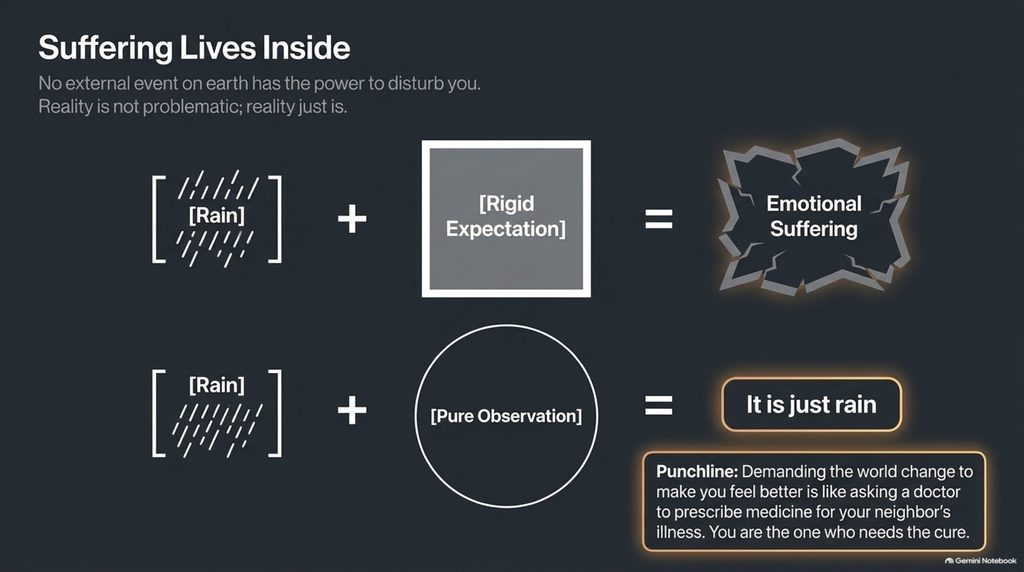
- A persistent human illusion is the belief that external events have the power to cause unhappiness, when in fact suffering originates from internal interpretation rather than the outside world. (00:12:29)
- Using the example of rain ruining a picnic, it is noted that the rain itself is neutral, and any negative emotion experienced is a result of an internal reaction rather than the event itself. (00:12:51)
- Dlo asserts that no external event has the power to disturb or hurt an individual, as reality is neutral and problems only arise when rigid expectations clash with what actually occurs. (00:13:22)
- Emotional suffering is caused by the mind’s interpretation of events, yet people frequently blame external circumstances while ignoring their own internal processing. (00:13:49)
- Demanding that the external world change to achieve personal happiness is compared to a patient asking a doctor to prescribe medicine for someone else, as the individual in pain is the one who requires internal change. (00:13:56)
- Even if external circumstances or people change to suit an individual’s desires, that person remains vulnerable and dependent if they do not address their own internal state. (00:14:18)
Managing External Opinions and Negative Emotions
- This internal mechanism also applies to how individuals process the opinions of others, such as being called a failure, which presents a choice in how to respond. (00:14:27)
- External opinions regarding one’s character should be viewed as reflections of the other person’s mental conditioning rather than as objective truths about one’s own identity (00:14:42).
- Dlo suggests questioning why one feels a need for external validation, as granting others power over one’s peace allows their criticism or praise to dictate self-worth (00:14:50).
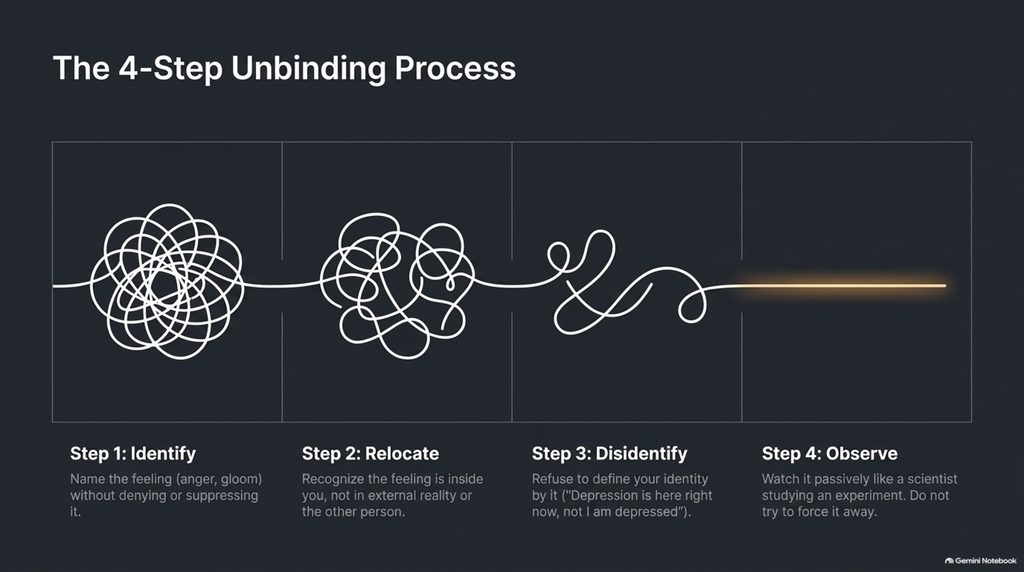
- A four-step program is proposed to manage negative emotions: first, identify the feeling without denial; second, recognize the feeling exists internally rather than in external reality; third, avoid defining one’s identity by the emotion; and fourth, observe the feeling passively like a scientist (00:15:19).
- Taking responsibility for one’s internal state reveals that peace is not lost, but rather obscured by personal interpretations (00:16:03).
Attachment and the Nature of True Love
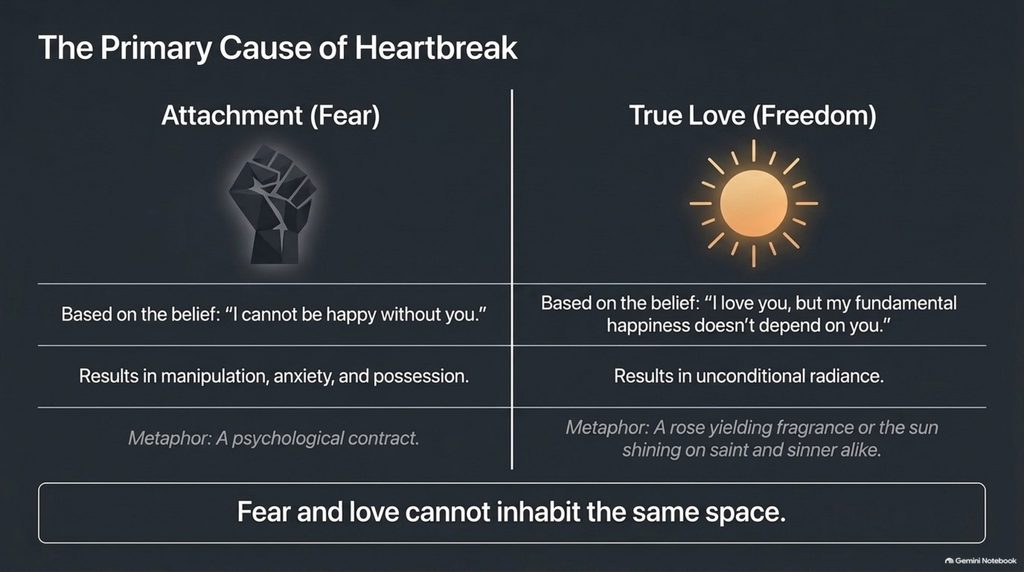
- Attachment is defined as a state of clinging based on the false belief that happiness is impossible without a specific person, object, or outcome (00:16:27).
- Subconscious “conditional contracts” are formed through attachment, where individuals trade their happiness for external factors they cannot control, leading to emotional instability (00:16:43).
- Psychological need is distinguished from true love; stating “I cannot live without you” is characterized as an expression of possession, manipulation, and fear rather than love (00:17:29).
- Because fear and love cannot coexist, needing someone for emotional survival prevents the ability to truly love them, as the relationship becomes a mechanism for ego satisfaction (00:18:12).
- True love is described as unconditional, similar to the sun or a rose that radiates warmth or fragrance without demanding anything in return (00:18:37).
Releasing Attachments and Possessiveness
- Releasing attachments does not result in being cold or heartless, but rather enables a person to enjoy relationships more deeply because they no longer feel the need to possess or cling to others (00:19:15).
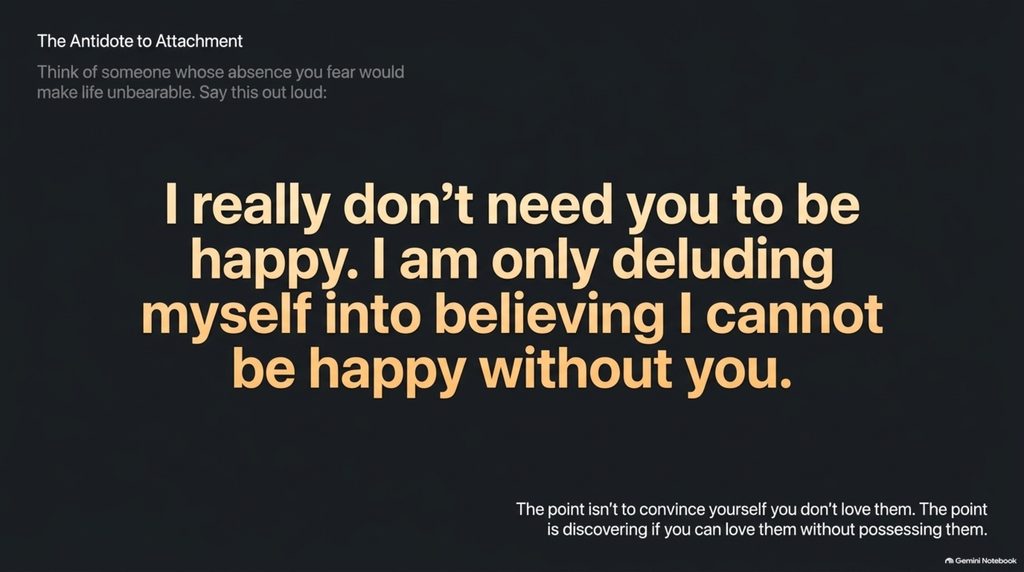
- To overcome the spell of attachment, one can practice an exercise involving the verbal acknowledgment that one does not need a specific person to be happy and that the belief otherwise is a delusion (00:19:36).
- This practice is intended to help individuals discover how to love others without the need to possess, control, or manipulate them, ultimately allowing for authentic love (00:20:06).
Passive Observation Versus Internal Struggle
- Fighting negative emotions like anxiety, fear, or anger by suppressing, rationalizing, or forcing positivity is described as a significant spiritual trap (00:20:35).
- Engaging in an internal struggle against negative emotions provides them with energy and attention, which binds the individual to those emotions and creates further tension and conflict (00:20:57).
- Instead of fighting, the recommended approach is pure passive self-observation, where one examines emotions with curious interest rather than labeling them as bad or attempting to fix them (00:21:27).
- Self-observation involves identifying where tension is felt in the body, noting racing thoughts, and understanding the specific fears underlying the emotion (00:21:44).
Techniques for Conscious Awareness
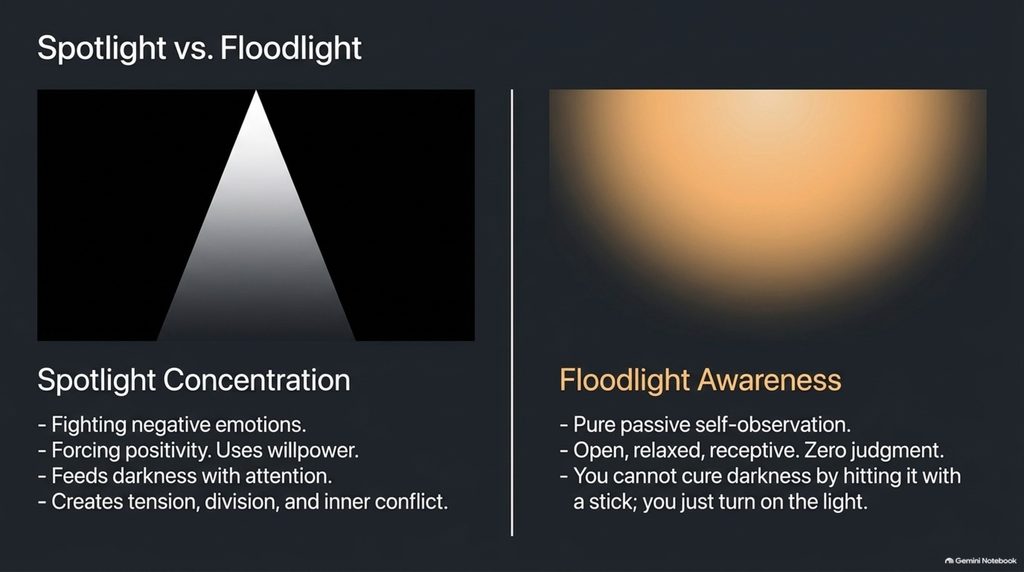
- A distinction is made between “spotlight concentration,” which is narrow and exclusionary, and “flood light awareness,” which is open, relaxed, and receptive to all internal and external experiences (00:22:00).
- True observation requires absolute detachment and the absence of judgment; judging a feeling causes an individual to stop observing and return to automatic, reactive behavior (00:22:31).
- Conscious awareness acts like a light in a dark room, causing illusions, fears, attachments, and false beliefs to dissolve naturally without the need for active struggle (00:23:04).
Spiritual Freedom and the Illusion of Need
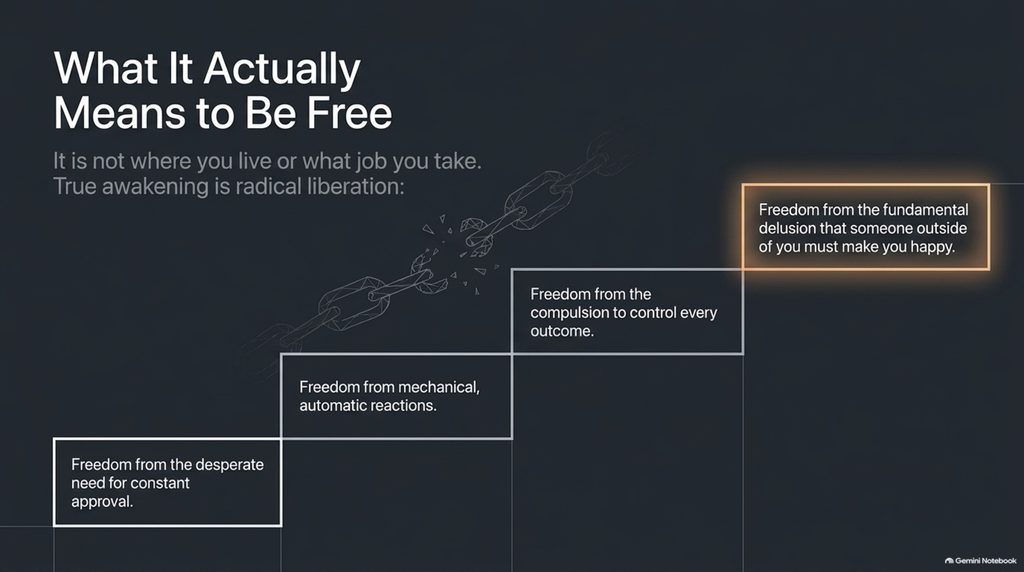
- Spiritual freedom is defined as radical liberation from the need for constant approval, the fear of rejection, mechanical reactions, the compulsion to control outcomes, and the burden of living by others’ expectations (00:23:52).
- True freedom involves releasing the fundamental delusion that external people or things are responsible for one’s happiness (00:24:36).
- While many fear that abandoning attachments will lead to coldness or indifference, the opposite occurs because attachment prevents people from seeing others clearly (00:24:43).
- Living in attachment causes individuals to view others only in terms of how they serve the ego or threaten personal security, leading to constant calculation, manipulation, and fear of loss (00:24:52).
- Once an individual stops relying on others for validation, they become capable of genuine love and can live with greater clarity and lightness, free from fear or coercion (00:25:08).
The Process of Unlearning and Seeing Reality
- Spiritual growth is defined as a process of unlearning and subtracting illusions rather than accumulating new theories, dogmas, or intellectual formulas (00:25:31).
- Concepts and labels act as static boxes that obscure living reality, such as when a child stops observing a bird to focus solely on the mental label assigned to it (00:25:46).
- Awakening requires dropping rigid labels to perceive reality with the fresh, unclouded wonder of a child, as ultimate reality cannot be captured by human concepts (00:26:01).
- Awakening is not a distant goal requiring decades of effort or asceticism, but is available in the present moment through self-observation (00:26:25).
- Peace, freedom, and unconditional joy are inherent qualities that have always been present within the individual, waiting to be discovered (00:26:47).
The Final Realization of Reality
- The goal of this perspective is not to provide bliss or higher vibrations, but to reveal reality, which is defined as what remains when one stops lying to oneself (00:27:05).
- There is no requirement to fix one’s life, change one’s personality, or become a better person, as awareness is simply the act of seeing clearly without effort (00:27:12).
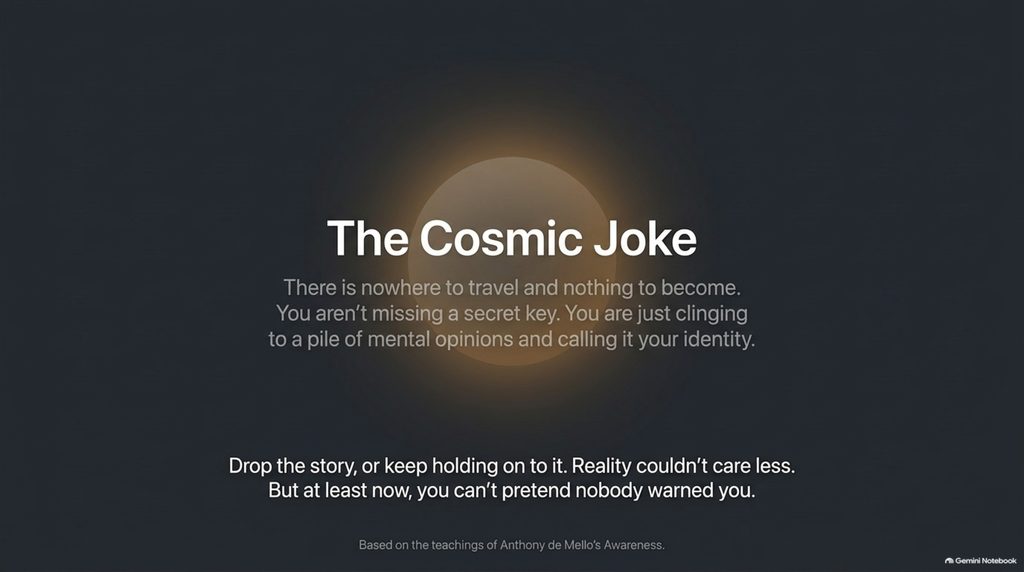
- The human struggle is characterized as a “cosmic joke” where individuals mistakenly believe they need to travel or become something else, while actually just clinging to mental opinions that they mistake for their identity (00:27:21).
- Individuals have the choice to continue holding onto their personal stories or to drop them, noting that reality remains indifferent to either choice (00:27:38).
Leave a Reply