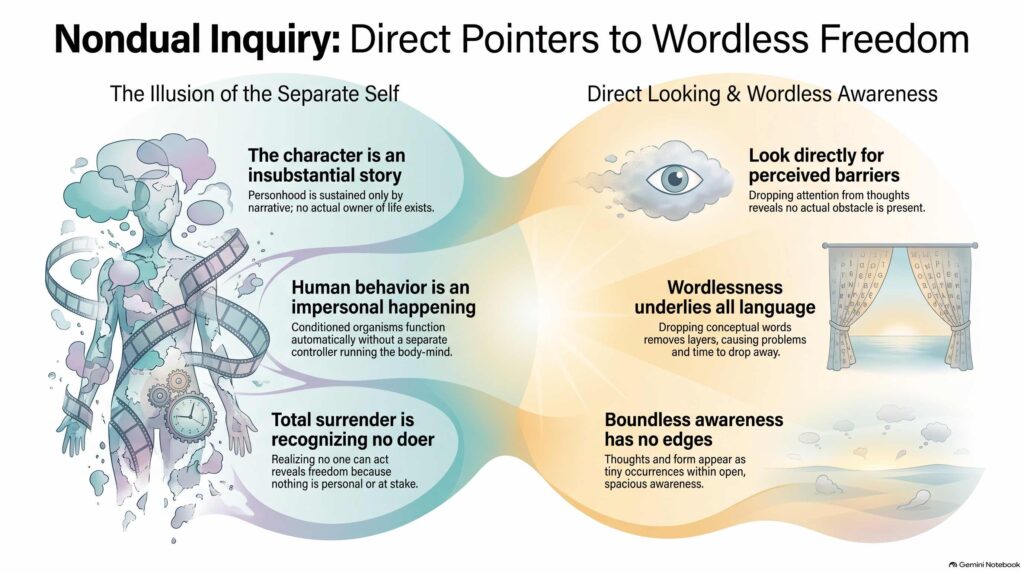
Nondual Inquiry Session
Summary via Memo AI App:
Key Points
- No better life for me
- Nothing is in the way
- Wordless knowing is free
- No separate self exists
Overview
| Concept | Detail |
|---|---|
| Better life | Not available to the me |
| Character | Insubstantial story |
| Barrier | Nothing found directly |
| Presence | Not a thing |
| Wordlessness | Underlies language |
| Time | Falls with language |
| Separate self | Not found anywhere |
| Surrender | Same as inquiry |
[[2026-10-15]] This session explores nonduality through dialogue, inquiry, and direct pointers away from the personal self.
No better life
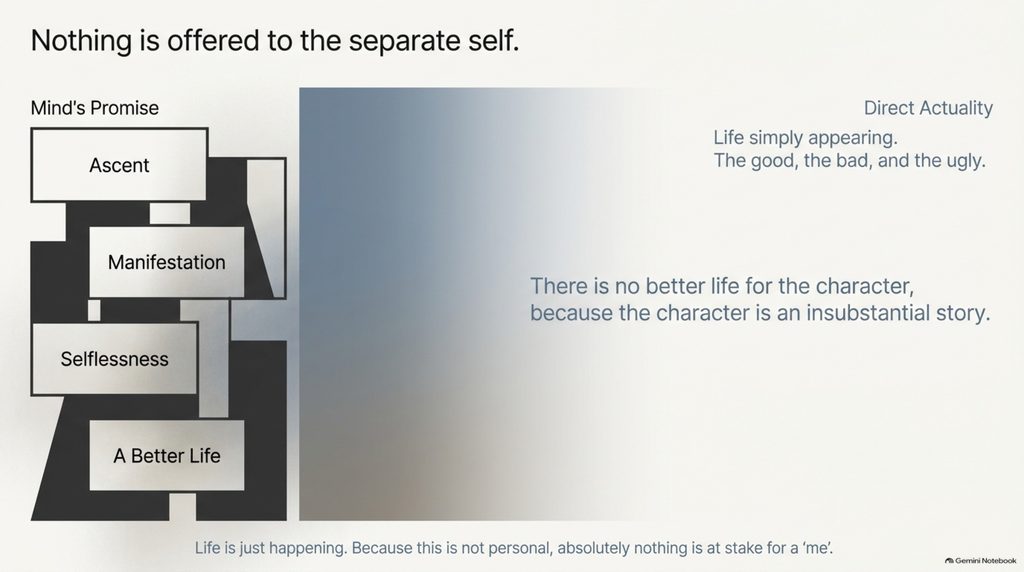
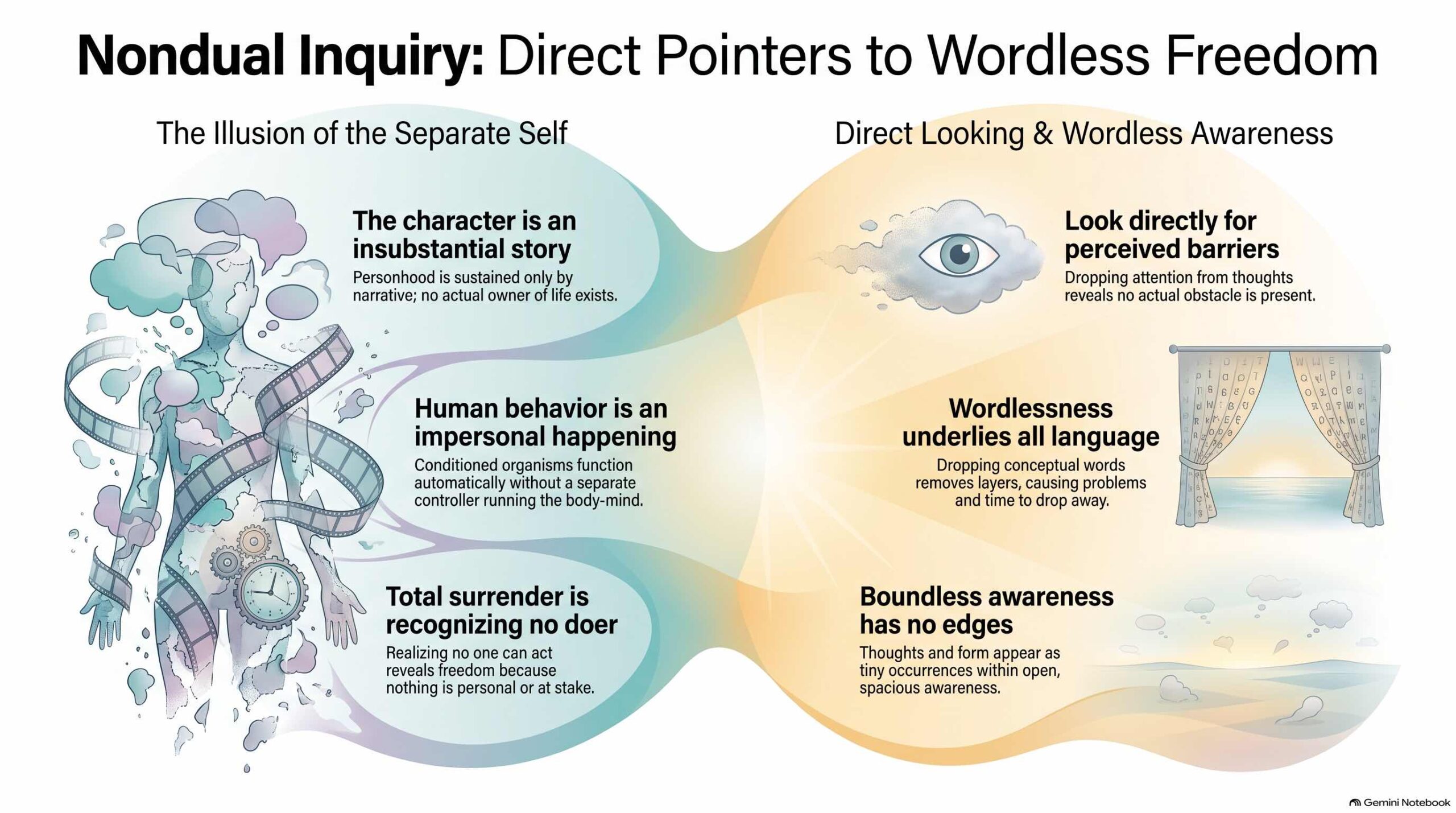
The core point is stark: this message offers nothing to the separate self. Life simply appears, and the personal owner of it cannot be found.
There is no better life for the character.
- The character is insubstantial, a story.
- Life is just happening, including the good, bad, and ugly.
- This is not personal, so nothing is at stake for a me.
Stories of service, selflessness, ascent, and manifestation still promise a new life for the me. That promise is not what this message offers, even if such things may still happen.
Resonance
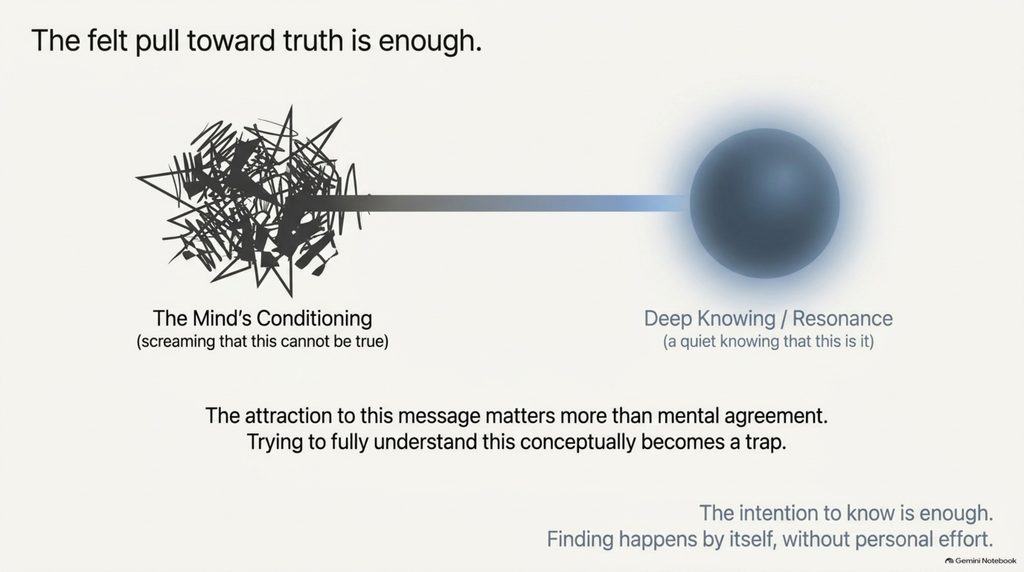
The attraction to this message matters more than mental agreement. The mind resists it, but there can still be a deeper knowing that it is true.
Resonance: Attraction to this points to what is already the case, even when the mind argues against it.
A felt pull toward truth is enough. The intention to know is enough, and the finding happens by itself rather than through personal effort.
- Conditioning can scream that this cannot be true.
- At the same time, there can be a quiet knowing that this is it.
- Trying to fully understand it conceptually becomes a trap.
Inquiry
Several exchanges turn from explanation to direct looking. The emphasis stays on what is actually present rather than on concepts about consciousness, mind, or progress.
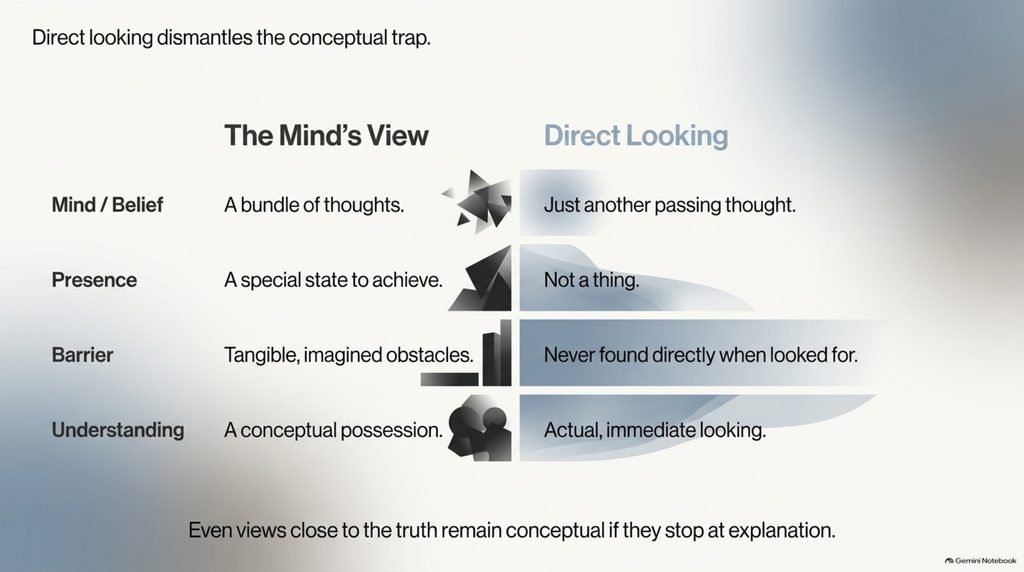
| Mind | a bundle of thoughts |
|---|---|
| Presence | not a thing |
| Belief | another thought |
| Barrier | not found directly |
| Understanding the teaching as a concept is treated as trouble because the mind turns it into another possession. Even views that are closer to truth still remain conceptual if they stop at explanation. |
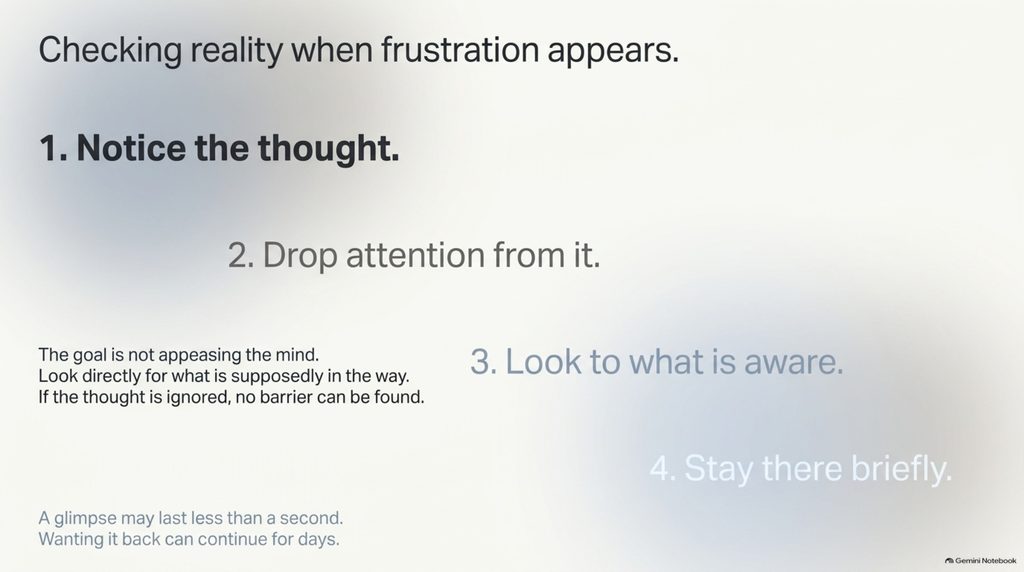
- A glimpse can happen for less than a second.
- Wanting it back can then continue for days.
- The question is not how to appease the mind.
- Look directly for what is supposedly in the way.
- If the thought is ignored, no barrier can be found.
When frustration appears, the pointer returns to immediate presence rather than to analysis. The key move is simple:
- If the thought is ignored, no barrier can be found.
- Notice the thought
- Drop attention from it
- Look to what is aware
- Stay there briefly
Spaciousness
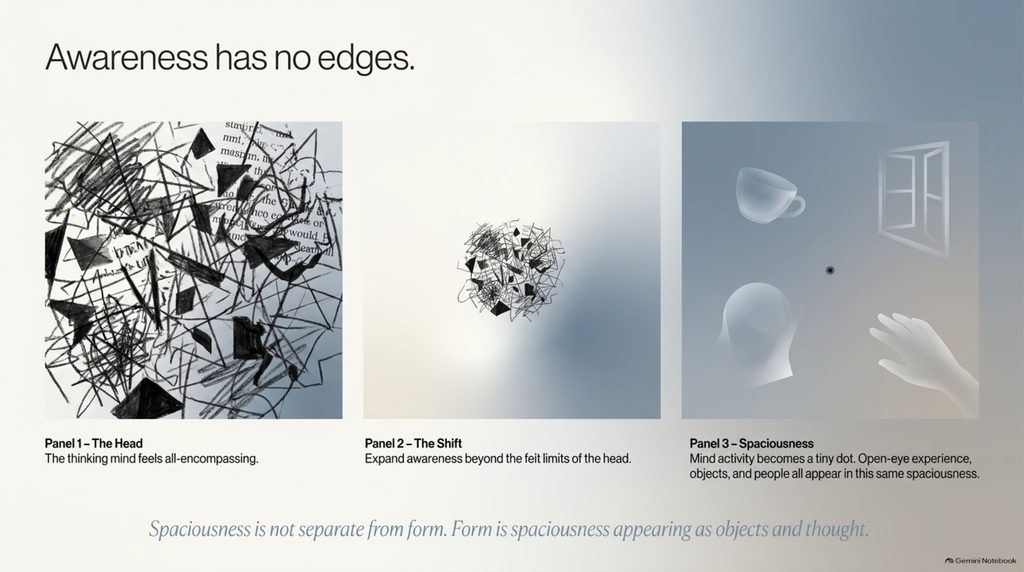
One guided exercise reframes mind activity by widening perspective beyond the felt limits of the head. Thoughts and emotions shrink into a tiny appearance within boundless awareness.
The exercise moves from imagined expansion to ordinary perception. Everything seen, including people and objects, appears in the same spaciousness, and even words of the mind count as just another appearance.
- Expand awareness beyond the thinking mind.
- No edge to awareness can be found.
- From that view, mind activity becomes a tiny dot.
- Open-eye experience also appears in that same spaciousness.
This spaciousness is not separate from form. Form is that same spaciousness appearing as objects, people, and thought.
Wordlessness
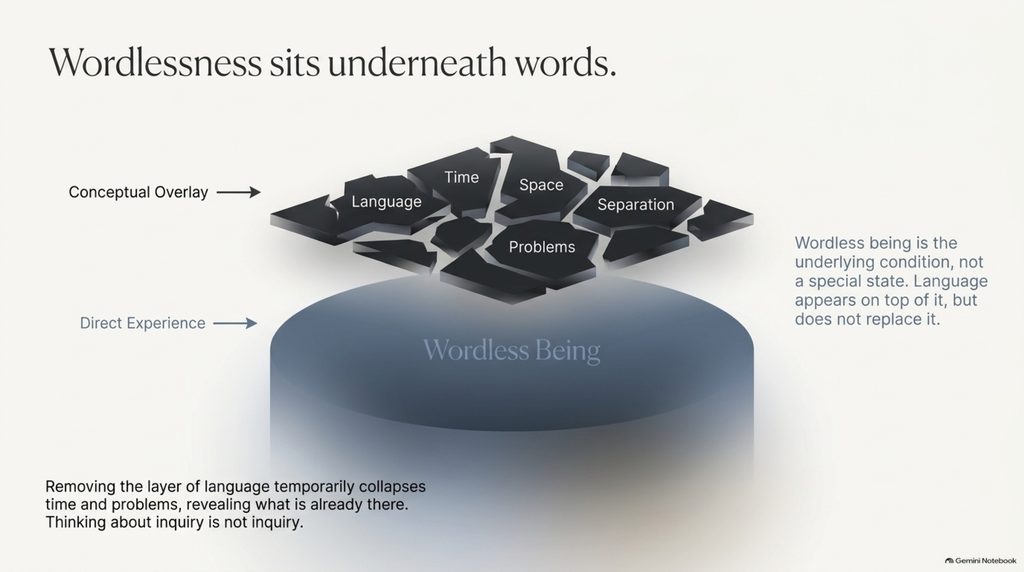
Wordless being is presented as the underlying condition rather than a special state. Language appears on top of it, but does not replace it.
A simple exercise helped by dropping words and meeting experience freshly, as if new to the world. Without words, problems are absent; without language, time also drops away.
- Wordlessness sits underneath words.
- The exercise only removes a layer to reveal what is already there.
- Time, space, and separation are easier to examine without conceptual overlay.
Thinking about inquiry is different from doing inquiry. The mind can imagine the exercise in words and miss the direct looking entirely.
No separate self
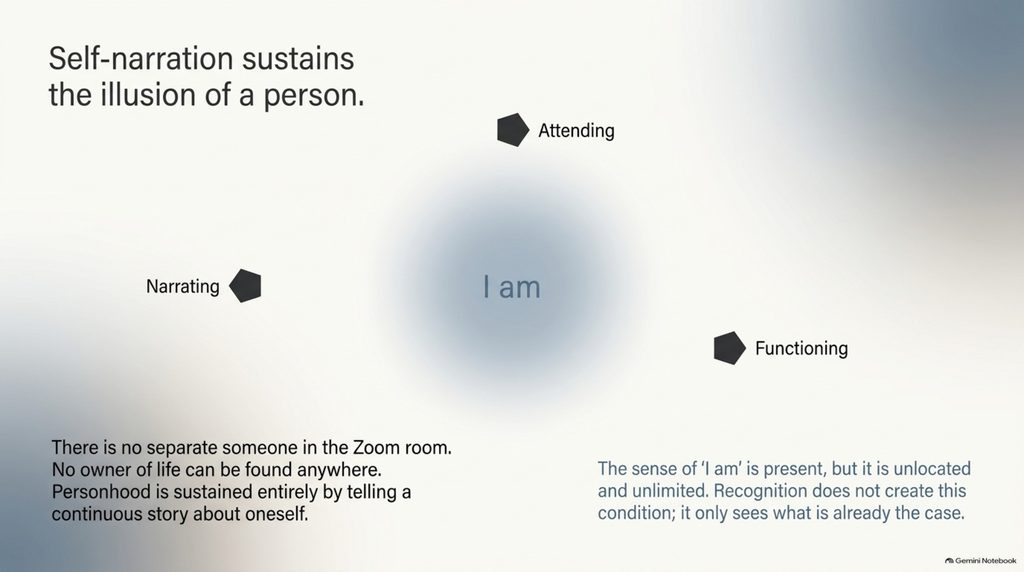
The session repeatedly returns to the absence of any actual person behind experience. Selfing continues through narration, but no owner of life can be found.
Direct seeing: There is no separate someone in the room; only self-narration keeps the illusion active.
- No self exists anywhere in the Zoom room.
- Personhood is sustained by telling a story about oneself.
- The sense of “I am” is present, but not located or limited.
Recognition does not create this condition. It only sees what is already the case.
Impersonal freedom
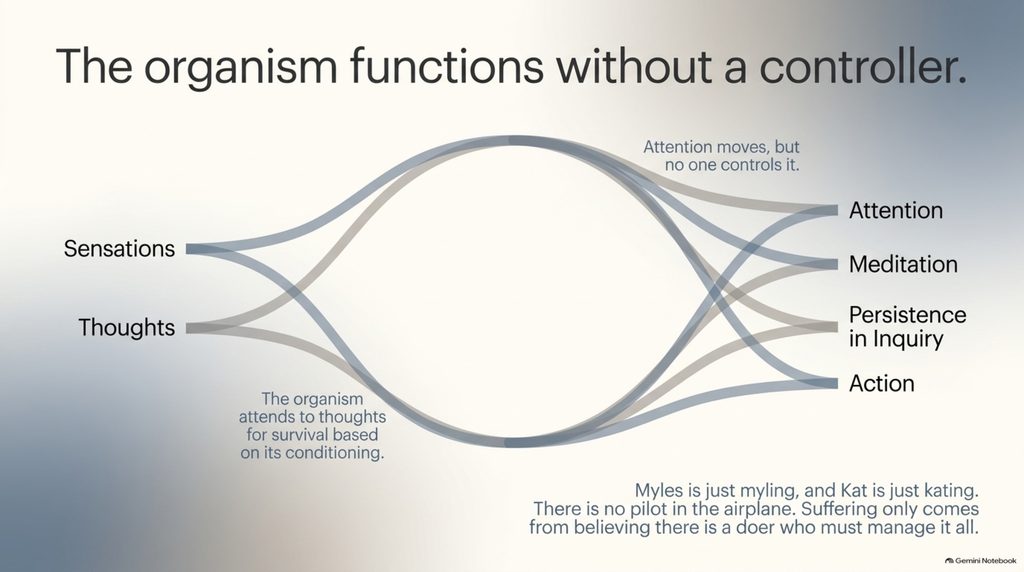
Human behavior, conditioning, and attention are treated as impersonal happenings. The organism functions as it was conditioned to function, and suffering comes from believing there is a doer who must manage it.
- Attention moves, but no one controls it.
- Meditation may happen, but not through a separate controller.
- The organism attends to thoughts and sensations for survival.
- Persistence in inquiry also happens without a personal author.
Myles is just myling, and Kat is just kating. There is no one getting inquiry right or wrong, no pilot in the airplane, and no owner of the body-mind.
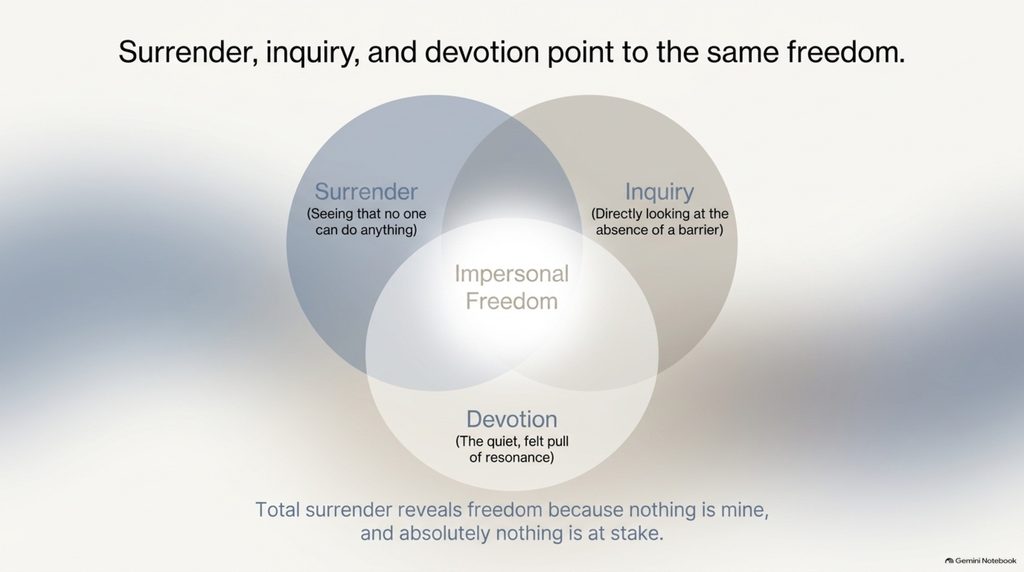
Surrender, inquiry, and devotion point to the same thing. Seeing that no one can do anything is total surrender, and that surrender reveals freedom because nothing is mine and nothing is at stake.
Leave a Reply