GetRecall.Ai Detailed Summary
Introduction: Why Everyone Misreads the Upanishads (00:00:00)
- Many readers approach the Upanishads as a single, unified religious textbook, which is an inaccurate perception of the material. (00:00:23)
- The Upanishads consist of a collection of over 200 ancient texts authored by dozens of anonymous individuals over a period exceeding 1,000 years. (00:00:32)
- Rather than being written to establish a religion, the Upanishads were created to dismantle an existing one. (00:00:39)
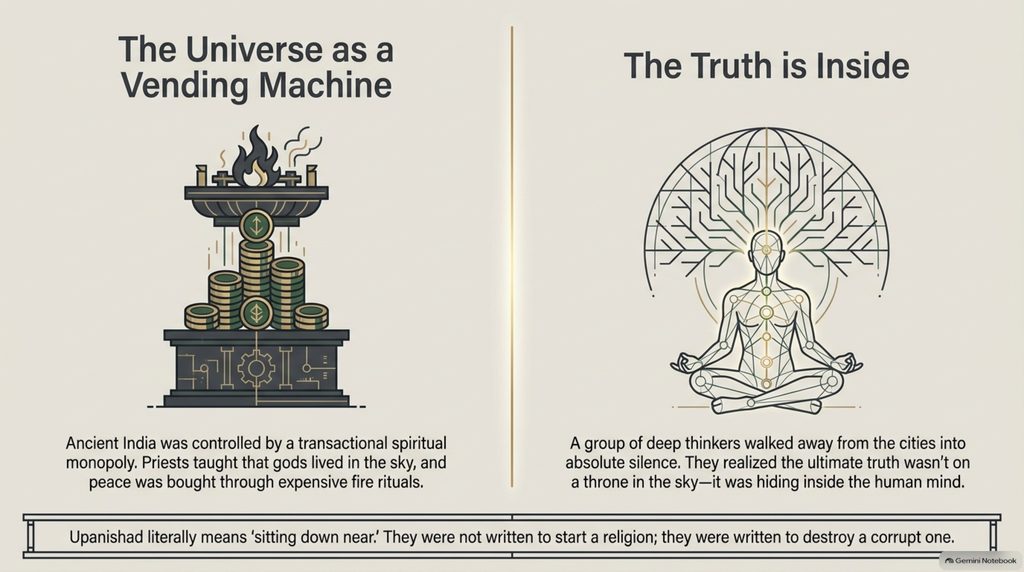
- Approximately 3,000 years ago, ancient India was governed by a transactional religious system where priests maintained a monopoly on spiritual power. (00:00:46)
- Under this system, individuals were taught that they had to pay priests to perform expensive, complex fire rituals to secure health, wealth, or safety from gods residing in the sky. (00:00:55)
- Around 800 BC, a group of thinkers began a rebellion against this system, rejecting the cities, temples, and priests. (00:01:20)
- These individuals retreated to the forests to practice silence, concluding that ritualistic fire offerings were ineffective. (00:01:28)
- The core realization of these thinkers was that the ultimate truth of the universe is located within the human mind rather than in a divine throne in the sky. (00:01:34)
- The term “Upanishad” translates to “sitting down near,” describing a student sitting at the feet of a master in the forest to receive secret teachings. (00:01:48)
- Historians recognize 13 of the discovered texts as the major Upanishads. (00:02:03)
The Grand Design: 13 Texts, One Chronological Argument (00:02:05)
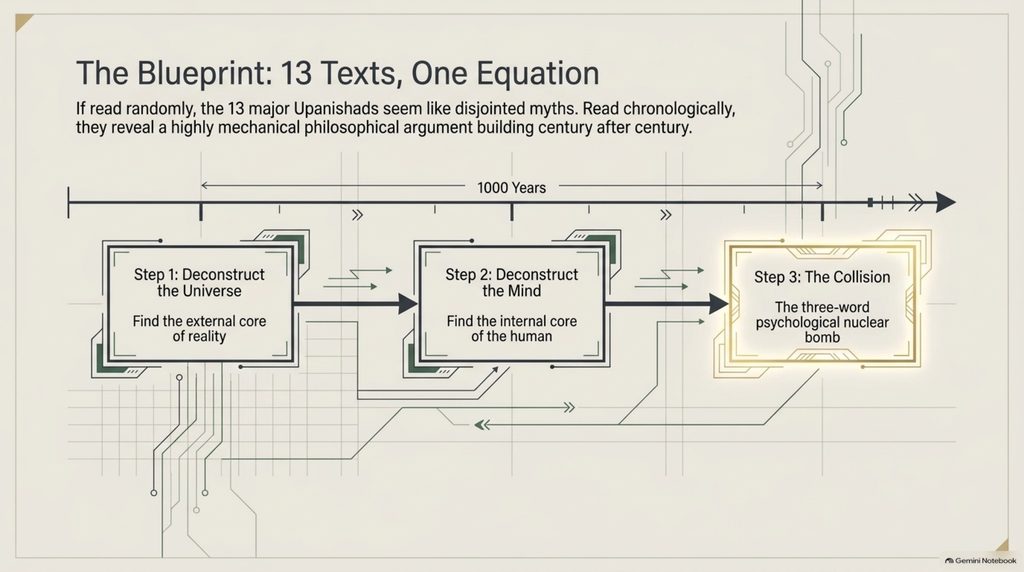
- The 13 major Upanishads appear as chaotic poetry when read in a random order (00:02:05).
- Reading these texts in their exact chronological order reveals a structured, mechanical philosophical argument that develops over several centuries (00:02:13).
- This chronological progression leads toward a single, significant realization (00:02:20).
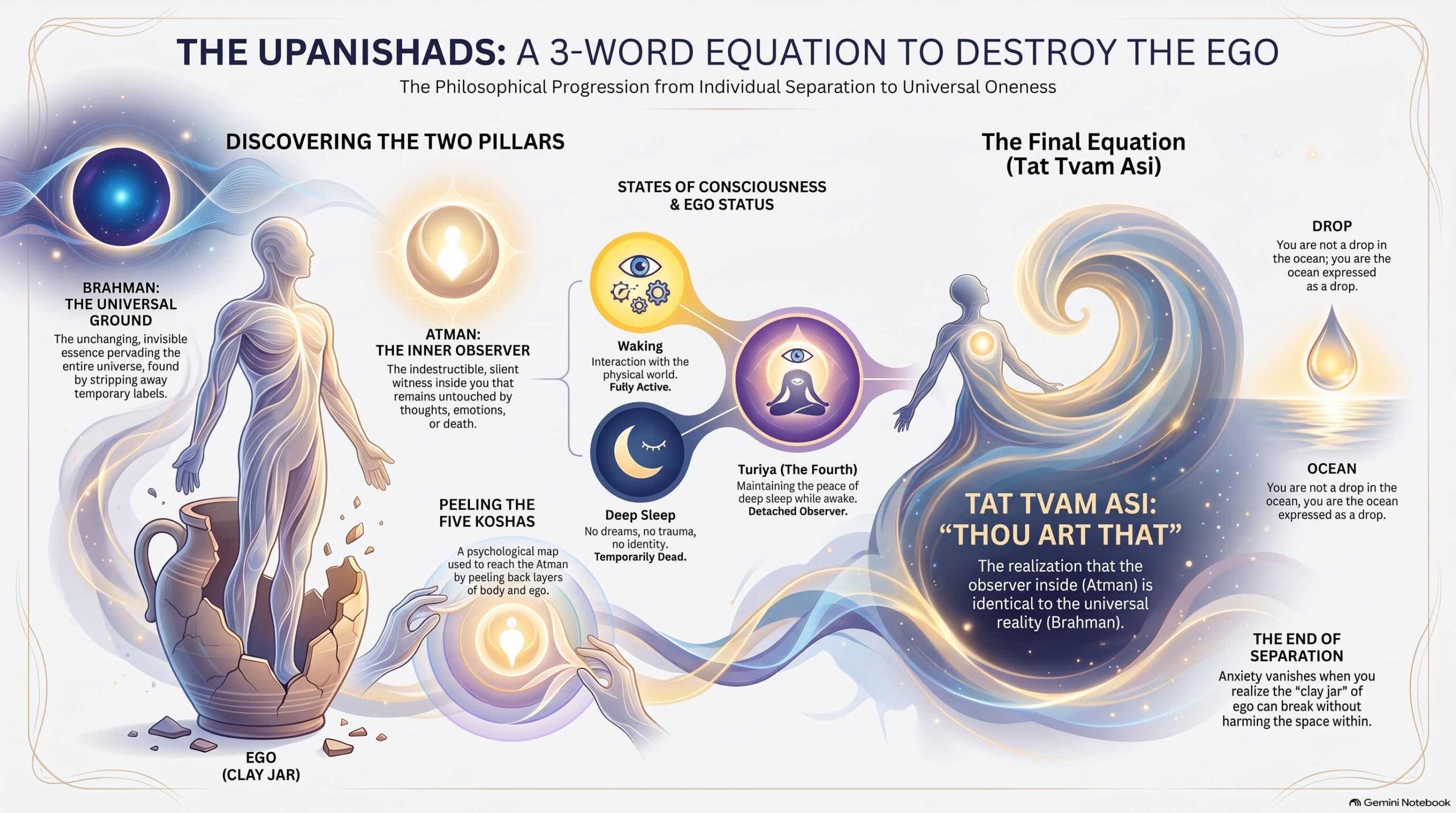
- The progression of these texts culminates in a three-word psychological equation developed by forest sages (00:02:42).
- This psychological equation is intended to eliminate the ego and provide a permanent cure for anxiety (00:02:49).
- The chronological timeline of the Upanishads commences around the 8th century BC with the two oldest and largest texts in the collection (00:02:56).
Brihadaranyaka & the Birth of Brahman (Neti Neti) (00:02:58)
- The Brihadaranyaka Upanishad, which translates to the “great forest book,” documents the efforts of forest sages to identify the core of the physical universe (00:02:58).
- The sages identified a fundamental limitation in human language, noting that defining the infinite reality of the universe with words inherently restricts and labels it (00:03:13).
- By applying labels to reality or identity, individuals trap themselves within limited and restrictive definitions (00:03:44).
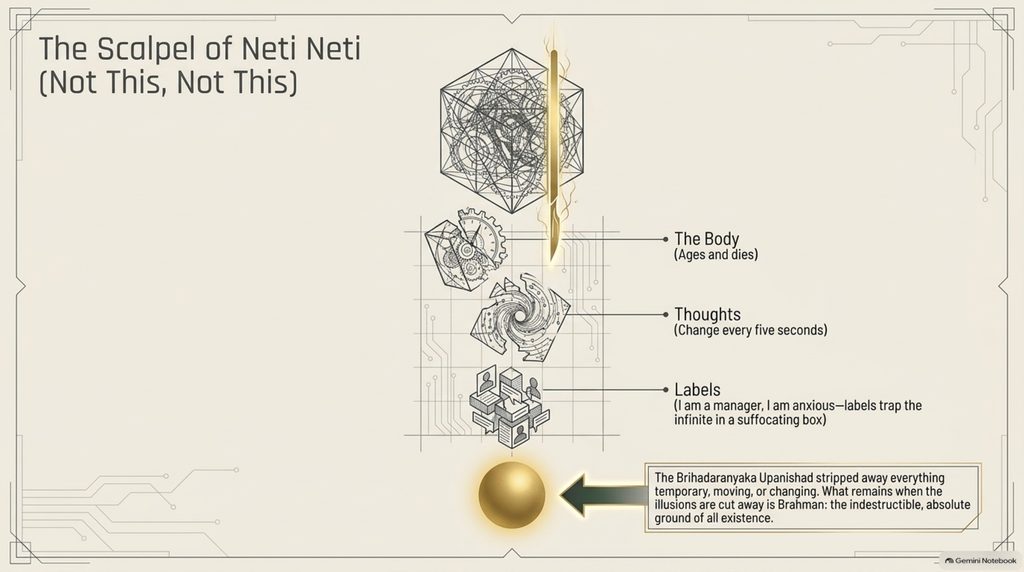
- To dismantle these labels, the authors of the Brihadaranyaka Upanishad developed a psychological tool known as “neti neti,” which translates to “not this, not this” (00:03:59).
- The sages applied the neti neti process to the physical body, concluding it is not the ultimate truth because it ages and dies (00:04:08).
- The process was also applied to human thoughts and emotions, which were rejected as the ultimate truth because they are constantly changing (00:04:16).
- By using neti neti as a tool to strip away everything that is temporary, moving, or changing, the sages sought to uncover an indestructible, formless reality (00:04:31).
- This ultimate, unchanging, and infinite ground of existence is identified as Brahman (00:04:46).
- Brahman is described not as a deity with a physical form, but as the canvas upon which the entire universe is painted (00:04:54).
Chandogya: The Seed and the Salt — Proving the Invisible Essence (00:05:08)
- The Chandogya Upanishad explores the concept of the invisible Brahman, which is the ultimate reality of the universe (00:05:08).
- Svetketu, a young student, returns home after 12 years of rigorous study having memorized religious texts and rituals, but he possesses an arrogant demeanor (00:05:15).
- His father, a forest sage named Udalaka, challenges Svetketu by asking if he has received instruction on how to hear the unhearable, perceive the unperceivable, and know the unknown (00:05:43).
- Realizing that his academic knowledge lacks an understanding of the essence of things, Svetketu asks his father to teach him about the invisible reality of Brahman (00:06:05).
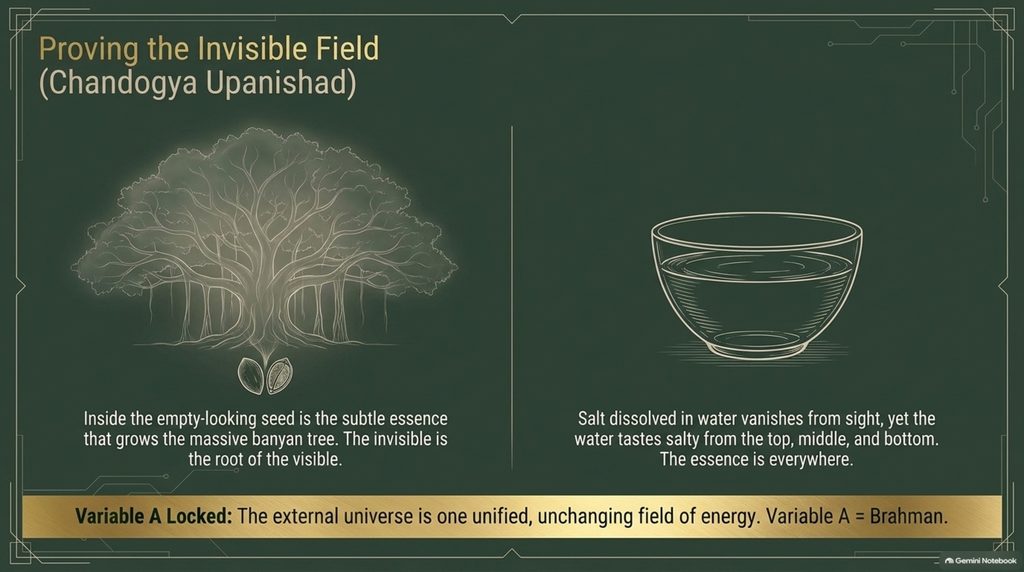
- To demonstrate this concept, Udalaka asks Svetketu to break open a tiny seed from a banyan tree, which appears empty to the naked eye (00:06:22).
- Udalaka explains that the massive banyan tree exists because of the subtle, invisible essence contained within that seed (00:06:40).
- In a second demonstration, the father instructs Svetketu to place a lump of salt into a bowl of water overnight (00:06:56).
- Although the salt dissolves and becomes invisible, the water tastes salty when sampled from the surface, middle, and bottom (00:07:11).
- Udalaka uses the salt experiment to illustrate that Brahman is an invisible essence present everywhere in the universe, just as the salt is present throughout the water (00:07:34).
- Through these teachings, the forest sages established that the external universe is a unified, invisible field of energy (00:07:56).
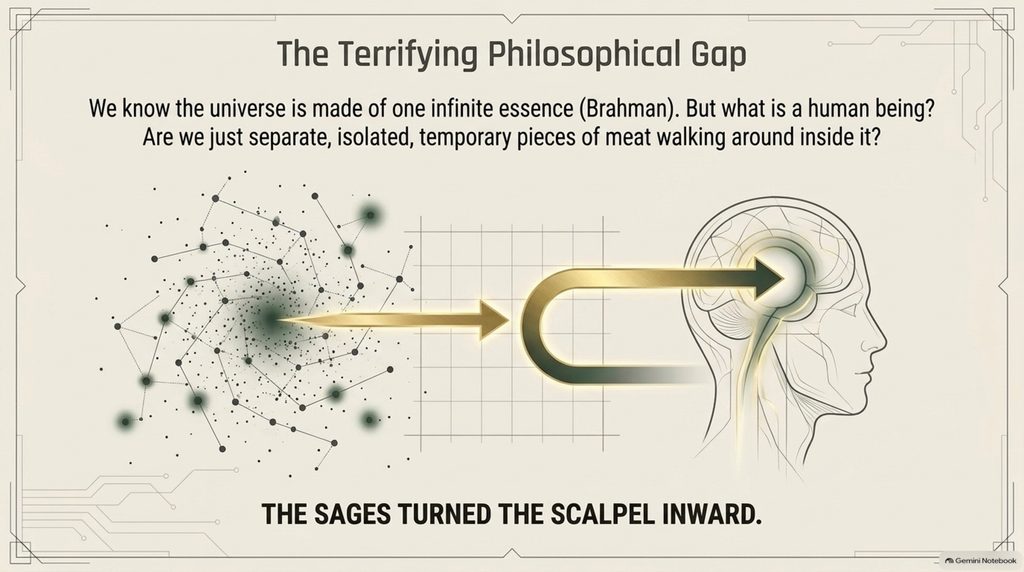
- This conclusion creates a philosophical question regarding the nature of human identity and whether individuals are separate from this infinite, unchanging field of reality (00:08:11).
Katha: Nachiketa, Death, and the Discovery of the Atman (00:08:28)
- The Katha Upanishad was composed by forest sages to shift the focus of inquiry from the nature of the universe to the nature of the human mind and the essence of human life (00:08:28).
- The text centers on a young boy named Nachiketa, who is sent to the underworld to the house of Yama, the lord of death, following a dispute with his father (00:08:57).
- Upon arriving at the house of death, Nachiketa waits for three days without food or water because Yama is away (00:09:11).
- Recognizing that he has kept a guest waiting, Yama offers Nachiketa three wishes as a cultural obligation (00:09:20).
- Nachiketa uses his first two wishes to secure peace for his father and to learn a sacred fire ritual (00:09:27).
- For his third wish, Nachiketa asks Yama to reveal the truth of what happens to a person after death, noting that there is doubt regarding whether a person continues to exist or not (00:09:35).
- Yama attempts to dissuade Nachiketa from this question by offering him wealth, beautiful women, massive empires, and a lifespan of hundreds of years (00:10:00).
- Nachiketa rejects these bribes, arguing that such pleasures are temporary, wear out the senses, and will eventually be taken away by death (00:10:18).
- Impressed by the boy’s resolve, Yama accepts Nachiketa as a student and provides a psychological revelation regarding the nature of the self (00:10:41).
- Yama explains that individuals who identify solely with their physical bodies experience terror, whereas the wise recognize the body as merely a shell (00:10:54).
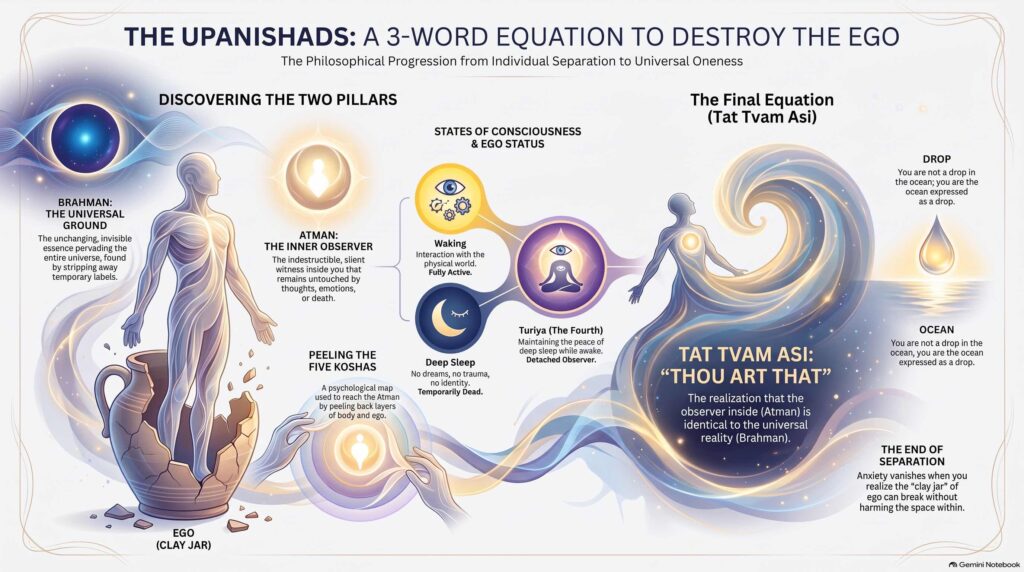
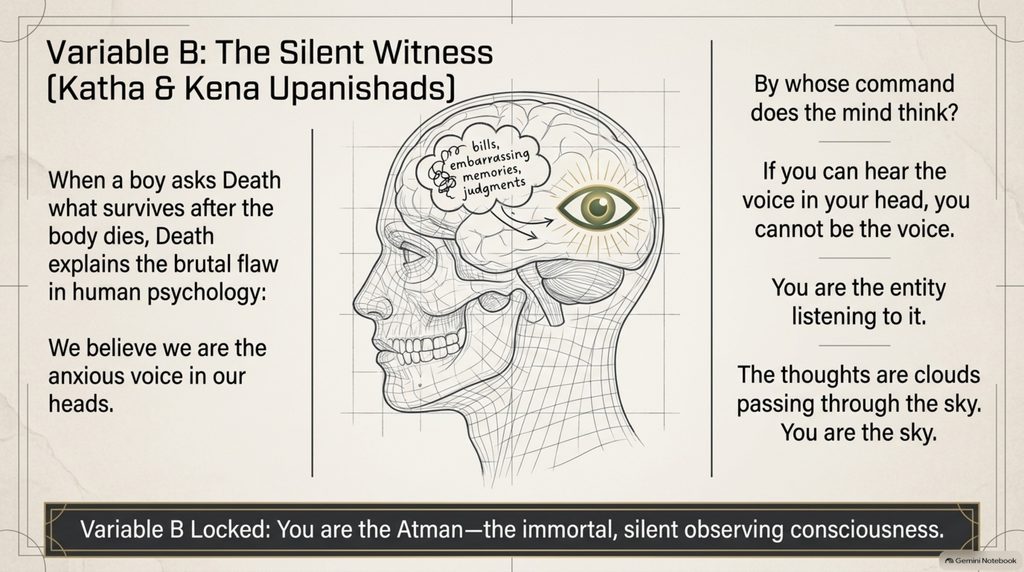
- Behind the body, mind, and ego lies an eternal, indestructible essence known as the Atman, or the true self (00:11:10).
- The Atman is described as never being born and never dying, remaining unaffected by weapons, fire, or water (00:11:17).
- The Atman is characterized as the silent, observing consciousness located at the center of a human being (00:11:25).
Kena: The Silent Witness Behind the Voice in Your Head (00:11:43)
- The Kena Upanishad begins with a student questioning the source of human perception and cognition, specifically asking what commands the mind to think and the eyes to see (00:11:43).
- The teacher responds to these inquiries by defining the ultimate source as the “ear of the ear,” the “mind of the mind,” and the “eye of the eye” (00:12:01).
- Western perspectives often equate an individual’s identity with the internal voice that worries, judges, and replays memories (00:12:09).
- The Upanishads identify a logical flaw in this assumption by noting that if an individual can hear the internal voice, there must be a separate entity listening to it (00:12:23).
- The ability to observe one’s own anxiety or thoughts proves that the individual is the observer rather than the anxiety or thoughts themselves (00:12:31).
- Thoughts, emotions, and the ego are compared to clouds passing through the sky, while the individual is identified as the sky itself (00:12:40).
- This true self is referred to as the Atman, or the silent witness (00:12:49).
- Realizing the nature of the Atman changes an individual’s relationship with their mind, allowing them to observe anxiety without fighting it, under the knowledge that it cannot touch them (00:12:58).
- The sages recognized that human beings cannot simply sit in this state of realization without further guidance (00:13:02).
Isha: How to Live in the World Without Being Trapped by It (00:13:07)
- The Isha Upanishad was written to address the necessity of living, working, and eating within the physical world, rather than spending one’s life in a forest focused solely on consciousness (00:13:07).
- As one of the shortest and most beautiful texts in the collection, the Isha Upanishad begins with the paradox of rejoicing in the world through renunciation (00:13:22).
- The text instructs individuals not to covet the wealth of others and provides guidance on how to exist as the atman while inhabiting a physical body (00:13:30).
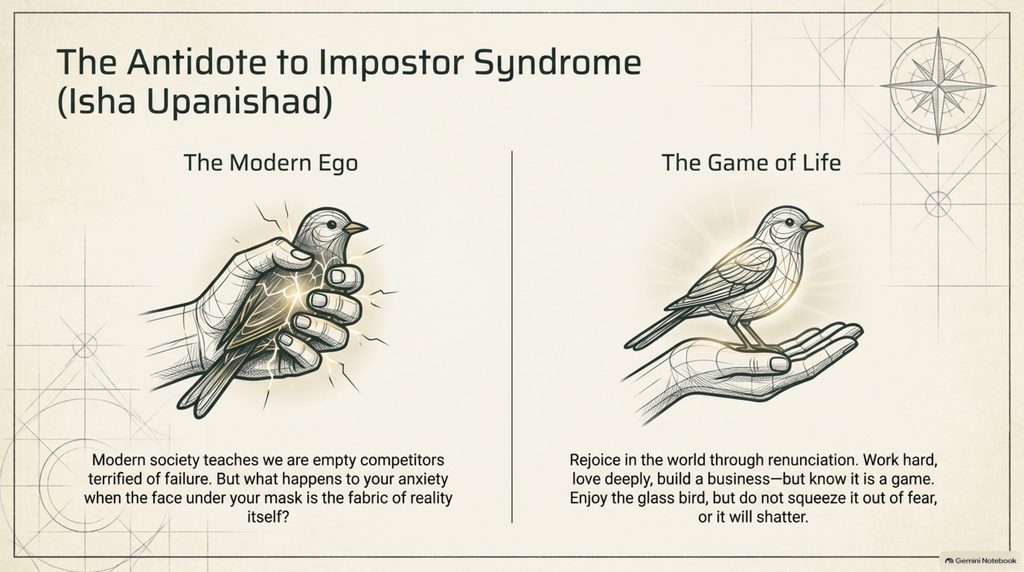
- It is possible to experience pleasure, work hard, and have a family while simultaneously renouncing attachment to these worldly experiences (00:13:37).
- Life should be approached with the understanding that it is a game; one can enjoy the “glass bird” of life, but must not grip it out of fear, as doing so will cause it to shatter (00:13:44).
- The forest sages established two primary pillars of Eastern philosophy: Brahman, which is the infinite and unchanging reality of the universe, and atman, the immortal and silent observer residing within the individual (00:13:59).
- While Brahman and atman are presented as two separate concepts representing the universe and the self, the sages prepared to make a significant and controversial philosophical advancement (00:14:14).
Taittiriya: The Five Koshas and the Map of the Self (00:14:31)
- Forest sages sought to locate the silent observer, or atman, within the human body to reconcile the relationship between the universe and the self (00:14:31).
- The Taittiriya Upanishad addresses why individuals experience sensations like anxiety, hunger, and stress rather than the atman by providing a psychological map of human existence (00:14:46).
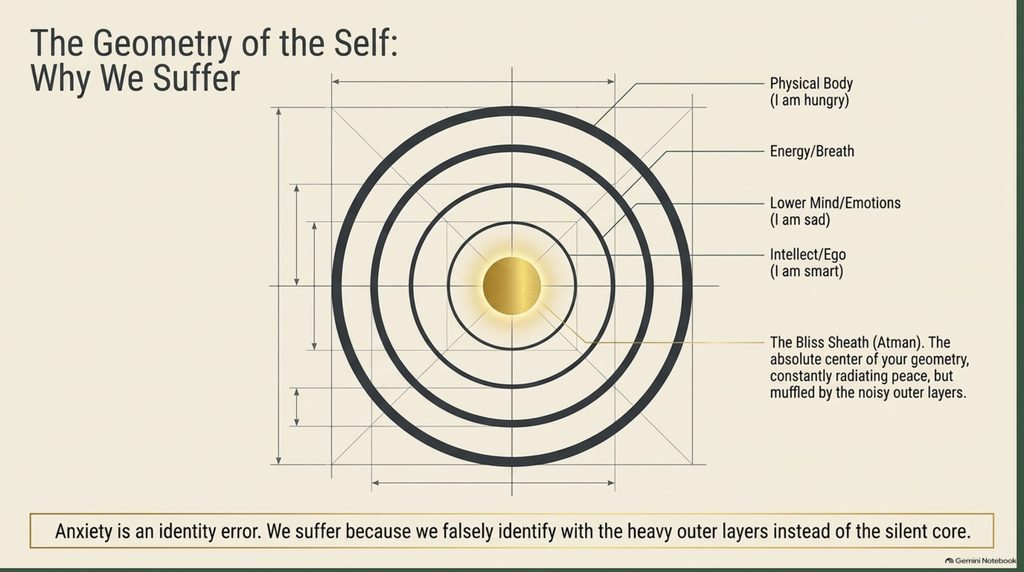
- Human beings are described as being composed of five distinct layers or sheets known as koshas, which function similarly to a Russian nesting doll (00:15:02).
- Suffering is attributed to the tendency of individuals to falsely identify themselves with the outer layers of these koshas (00:15:08).
- The outermost layer is identified as the physical body (00:15:16).
- The second layer consists of energy or breath (00:15:16).
- The third layer is the lower mind, which encompasses raw emotions and reactions (00:15:23).
- The fourth layer is the intellect, which contains logic and the ego (00:15:23).
- Most people remain trapped within the outer four layers throughout their lives, leading them to equate their identity with physical hunger, emotional sadness, or intellectual intelligence (00:15:30).
- The Taittiriya Upanishad posits that by quieting the body, slowing the breath, and stopping thoughts, one can peel back the outer layers to reach the fifth and final layer (00:15:47).
- The fifth layer is defined as the bliss sheath, or the atman, which serves as the absolute center of human geometry (00:15:55).
- While the atman constantly radiates peace, its presence is muffled by the noisy, heavy layers of the ego that surround it (00:16:03).
- The text transitions from establishing the existence of this center to explaining the mechanics of how one can actually experience it (00:16:10).
Mandukya: The Four States of Consciousness (00:16:19)
- The Mandukya Upanishad is a 12-verse text considered the shortest and most powerful work in the Upanishadic collection, with an ancient proverb suggesting it is the only text one needs to read in a lifetime. (00:16:19)
- The text categorizes human consciousness into four distinct states to map the human mind. (00:16:41)
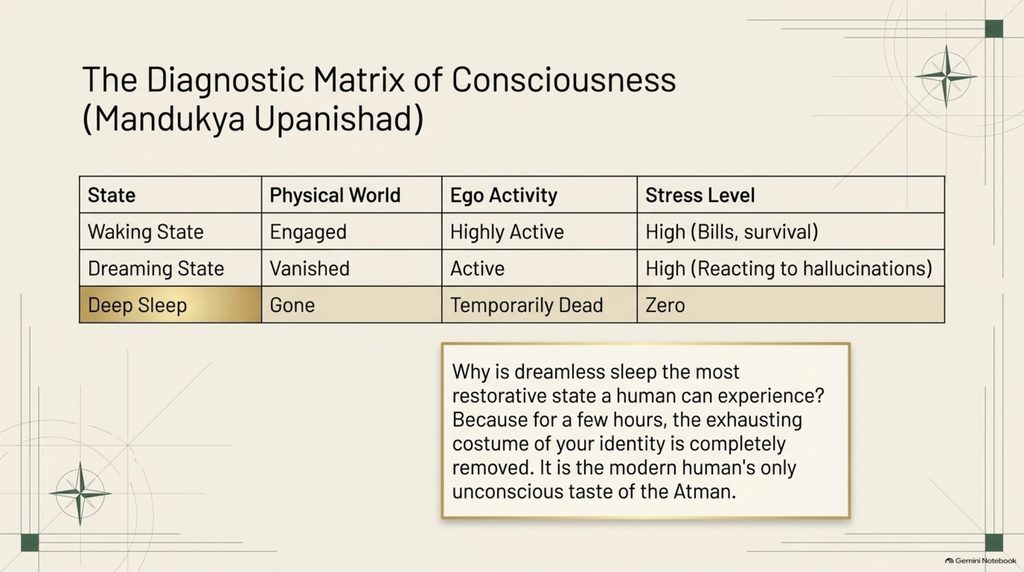
- The first state is the waking state, characterized by open eyes and engagement with the physical world, where the ego is most active and concerns such as stress, finances, and relationships reside. (00:16:48)
- The second state is the dreaming state, where the physical world is absent but the mind remains active, creating a reality based on memories and fears that can trigger physical reactions like sweating or terror. (00:17:10)
- In the dreaming state, the ego continues to function by reacting to internal hallucinations. (00:17:23)
- The third state is deep dreamless sleep, a condition devoid of the physical world, dreams, anxiety, trauma, identity, or ego. (00:17:30)
- Despite the temporary absence of the ego during deep sleep, individuals retain a sense of continuity upon waking, often reporting a feeling of being rested. (00:17:57)
- Deep sleep is considered the most restorative state because it allows for a temporary removal of the “costume of identity,” providing a glimpse of pure, unbothered awareness or the atman. (00:18:14)
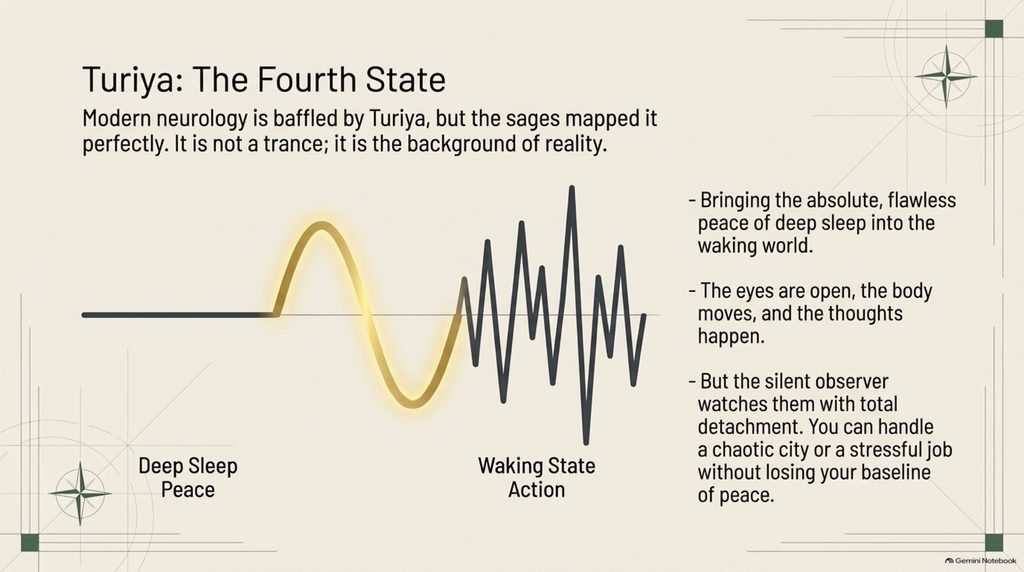
- Because deep sleep is an unconscious experience, the Mandukya Upanishad introduces a fourth state known as Turiya. (00:18:36)
- Turiya is described not as a state, but as the background of reality, representing the integration of the peace found in deep sleep into the waking world. (00:18:51)
- Achieving Turiya involves maintaining the silent, egoless detachment of dreamless sleep while remaining awake and active in the physical world. (00:19:06)
- A person in the state of Turiya can navigate chaos, stress, and tragedy while remaining untouched and maintaining a baseline of absolute peace. (00:19:28)
- After identifying this silent observer within the mind, the sages sought to connect this observer to the universe. (00:19:42)
The Great Collision: Tat Tvam Asi — Thou Art That (00:19:54)
- Ancient forest sages utilized the physical world to establish the existence of Brahman, defined as the infinite and unchanging reality of the universe (00:19:54).
- The sages mapped human consciousness to identify Atman, described as the immortal, silent observer residing within the individual (00:20:09).
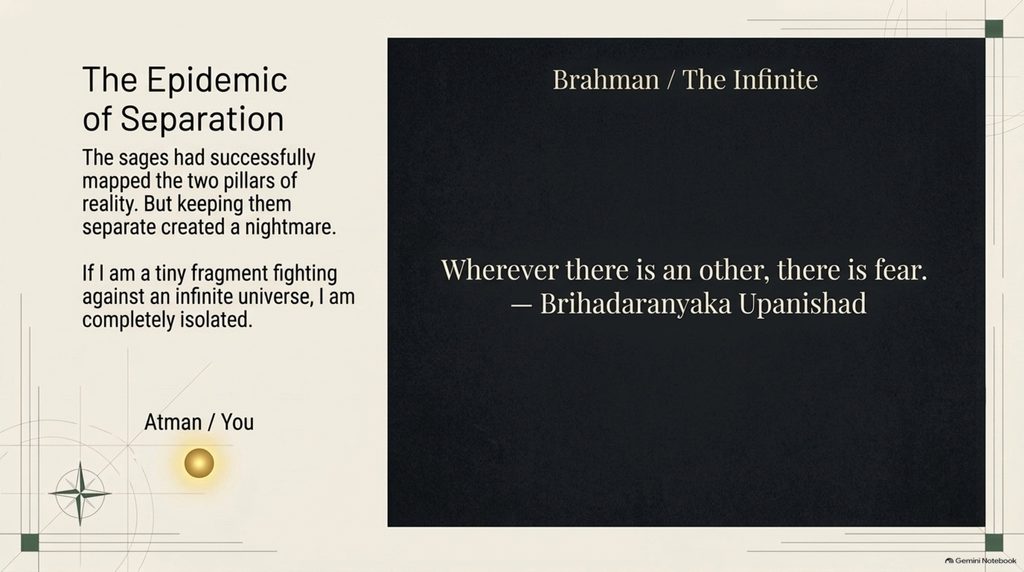
- Maintaining a conceptual separation between Brahman and Atman leads to human isolation, as the individual perceives themselves as a small fragment in conflict with an infinite universe (00:20:27).
- According to the Brihadaranyaka Upanishad, the root of all human terror is separation, summarized by the psychological law that wherever there is an “other,” there is fear (00:20:41).
- In the Chandogya Upanishad, the father Udalaka instructs his son Svetaketu by demonstrating that an invisible essence exists within seeds and salt water (00:21:05).
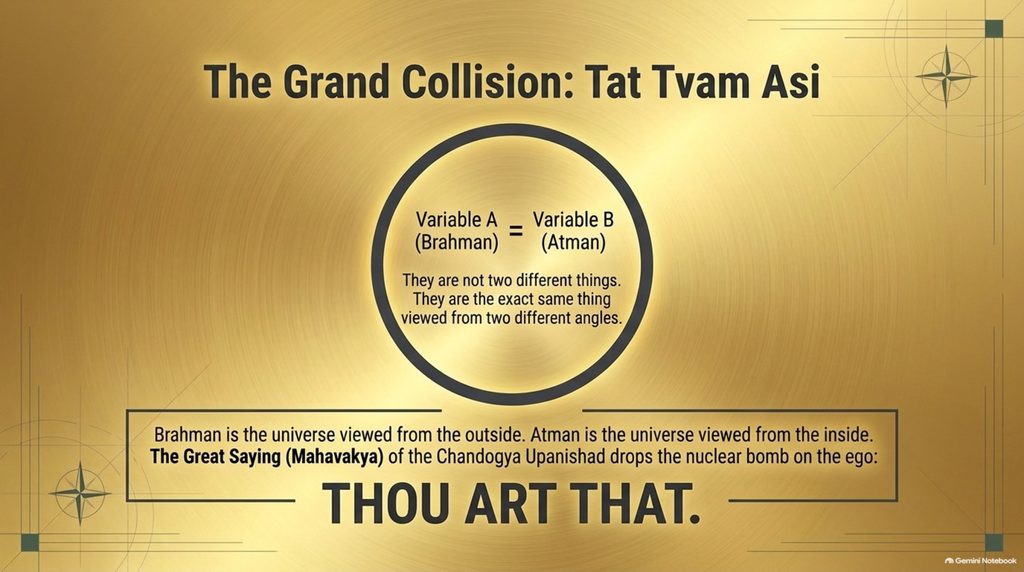
- Udalaka delivers the “mahavakya” or great saying, “Tat Tvam Asi,” which translates to “Thou art that,” identifying the subtle truth pervading the universe as the Atman (00:21:25).
- This realization posits that Brahman and Atman are not distinct entities but the same reality viewed from different perspectives: Brahman from the outside and Atman from the inside (00:21:53).
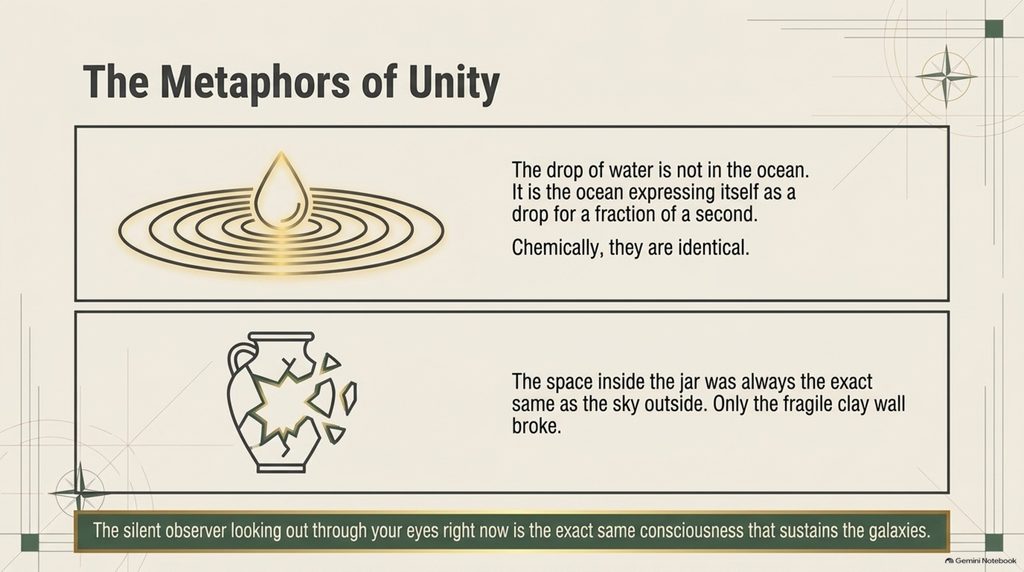
- The relationship between the individual and the universe is compared to a drop of water in the ocean, which is chemically identical to the sea despite its perceived separation (00:22:16).
- Another analogy involves the space inside a clay jar, which is identical to the sky outside; the breaking of the jar represents the removal of the barrier that creates the illusion of separation (00:22:43).
- The Upanishads assert that the consciousness observing through an individual’s eyes is the same consciousness that sustains the galaxies (00:23:05).
- Individuals are not isolated egos trapped in physical bodies, but rather the universe experiencing itself through a specific human perspective (00:23:12).
The Modern Cure: Ending the Epidemic of Separation (00:23:25)
- Applying the teachings of the Upanishads to daily life, such as during a stressful commute, is significantly more challenging than simply appreciating the texts as poetry (00:23:25).
- Modern society is structured around the illusion of the ego, which promotes the belief that individuals are isolated, disconnected, and in constant competition with others (00:23:38).
- The prevailing cultural narrative suggests that humans are born empty and must spend their lives attempting to fill an internal void through the acquisition of material goods, external validation, and the curation of online personas (00:23:52).
- Identifying exclusively with a fragile body and an anxious mind leads to a paralyzing fear of death and a deep-seated terror of failure (00:24:06).
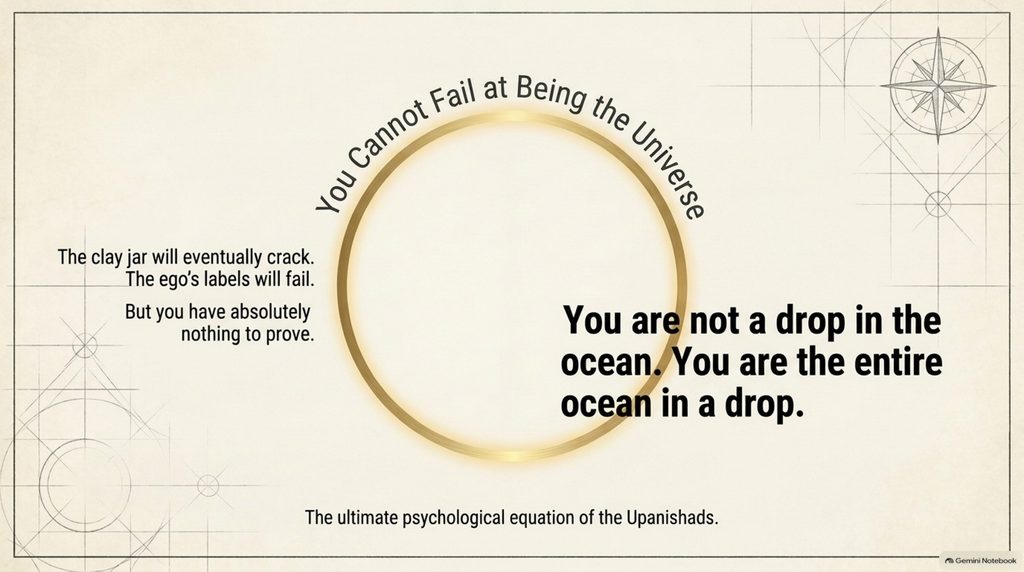
- Realizing that the ego is merely a mask and that the true self is the fabric of reality eliminates the need to prove one’s worth, as it is impossible to fail at being the universe (00:24:26).
- While the ego experiences agony when external circumstances like job loss or reputational damage occur, the Atman—the silent observer—remains unharmed, much like the space inside a clay jar remains intact even if the jar cracks (00:24:39).
- Anchoring oneself in the silent witness rather than the temporary layers of the ego transforms one’s relationship with others, shifting the perception of people from competitors or threats to reflections of the same consciousness (00:25:02).
- The collapse of the illusion of separation reveals that individuals are not, and have never been, truly alone (00:25:25).
- Approximately 3,000 years ago, individuals retreated into the forest to systematically dismantle the illusion of human isolation through inward reflection, without the need for temples or financial gain (00:25:32).
Leave a Reply