Thinking and Being Inquiry
Key Points
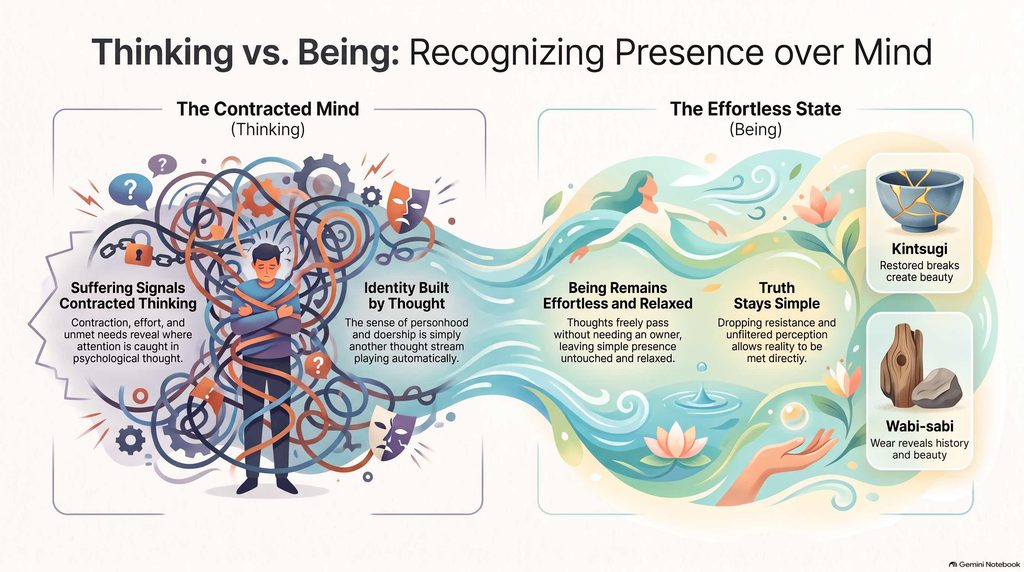
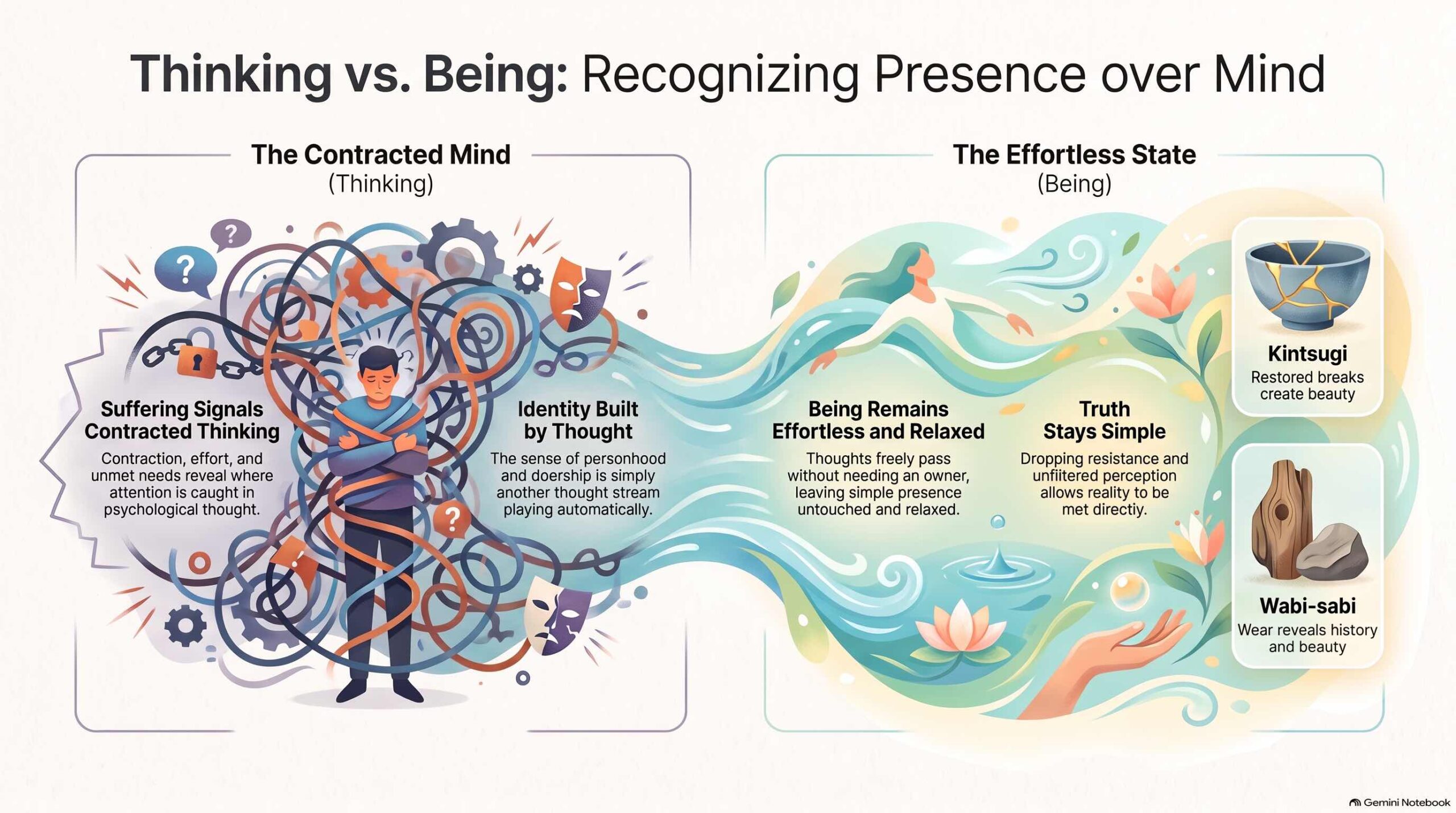
- Suffering signals contracted thinking
- Thoughts can pass without ownership
- Identity can appear as thought
- Truth stays simple
Overview …
| Topic | Detail |
|---|---|
| Thinking and being | Being feels more relaxed |
| Suffering | Contraction signals identification |
| Identity | Personhood can appear as thought |
| Presence | Stay with simple I am |
| Creativity | Timing versus regular practice |
| Art perception | Draw what is there |
| Repair | Wear can deepen beauty |
| Relationships | Agreement is not always needed |
[[2026-10-19]] This conversation explores how to tell thinking from being, how suffering and identity relate to thought, and how the same themes show up in creativity, relationships, and daily life.
Thinking and being
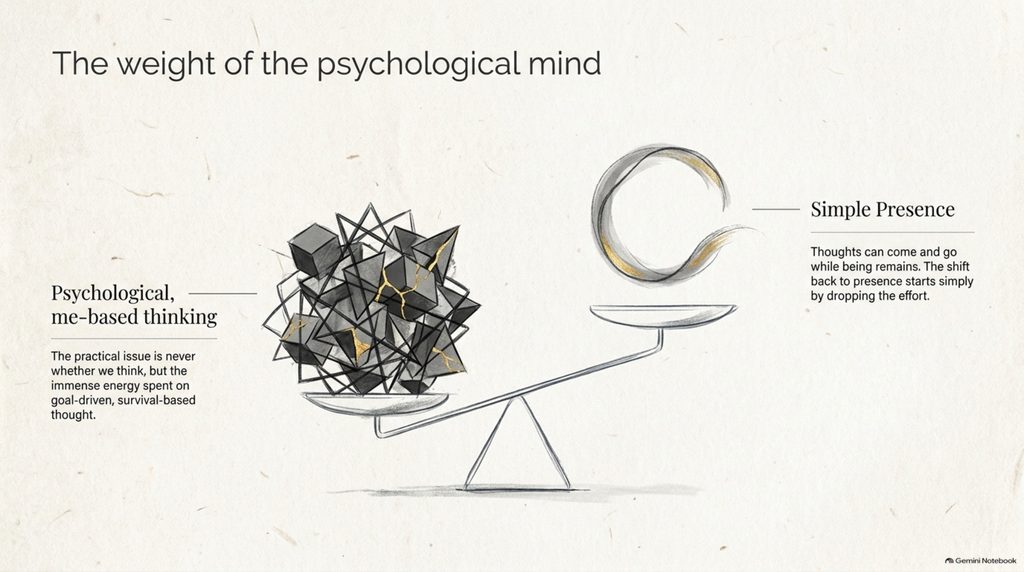
The core question is whether it matters to detect the difference between thinking and being. The practical issue is the amount of energy spent in psychological, me-based thinking.
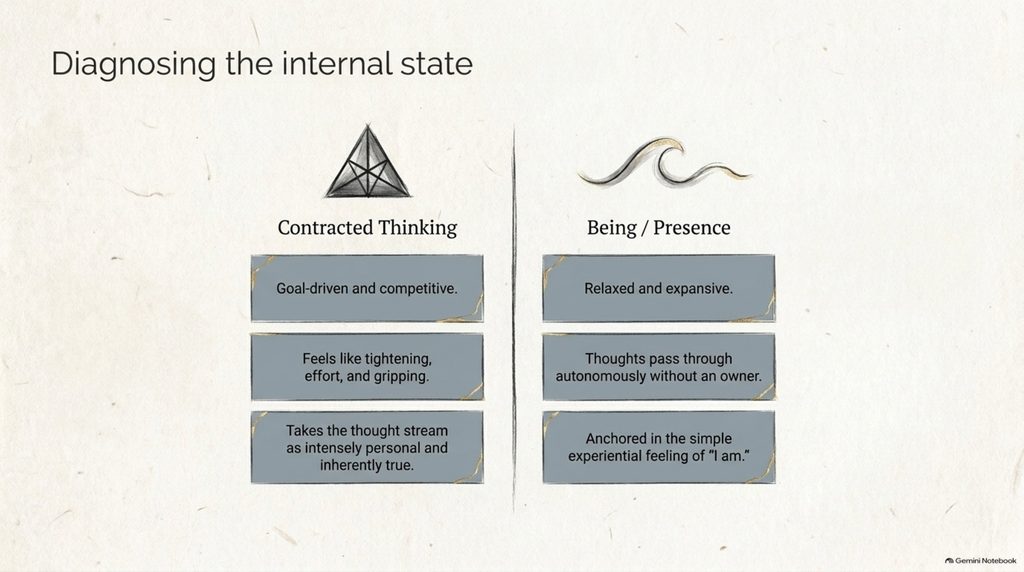
- Being feels more relaxed.
- Thoughts can come and go while being remains.
- The problem is not thought itself.
- The sticking point is taking thoughts as true or personal.
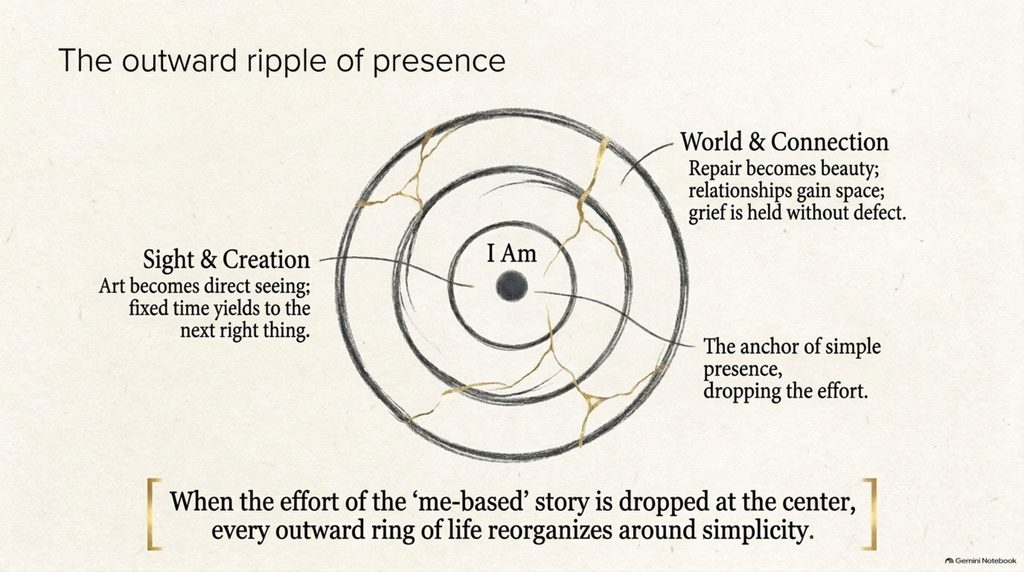
- A shift back to presence often starts with relaxing and dropping the effort.
The useful distinction is experiential rather than conceptual. Goal-driven, survival-based, competitive thought feels different from simple presence.
The thought of being a person can be just another thought.
Suffering
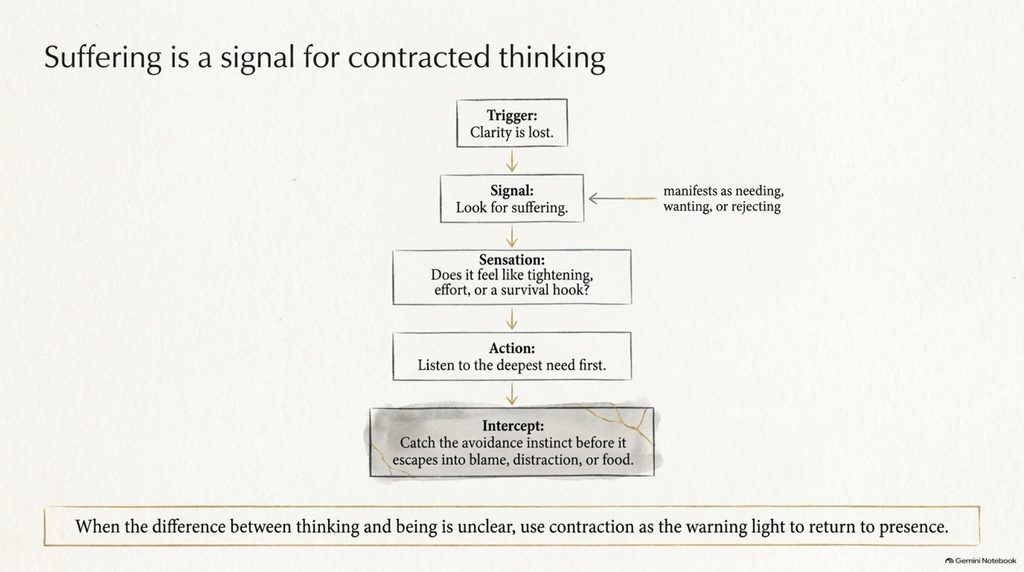
Suffering came up as the clearest signal for contracted thinking. When clarity is not immediate, suffering shows where attention is caught.
Practical test: If the difference is unclear, look for suffering, contraction, effort, and unmet need.
- Contracted thinking feels like effort or tightening.
- It hooks around survival, getting somewhere, or competing.
- Suffering can be framed as needing, wanting, or rejecting.
- A sense of need invites checking whether the need is true at the deepest level.
The suggested response is to listen first instead of escaping into blame, distraction, food, or other avoidance. Even if avoidance still happens, listening comes first.
Identity
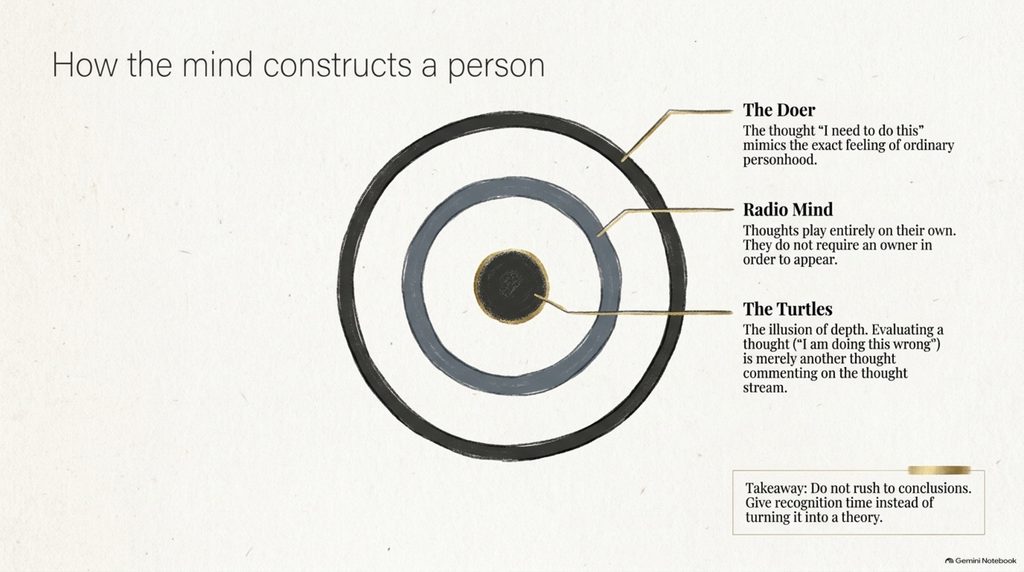
Several reflections focused on how identity gets constructed by thought. One guided inquiry brought a direct recognition that the thought “I need to do this” had the same feel as the ordinary sense of being a person.
| Doer-thought | Feels like personhood |
|---|---|
| Radio mind | Thoughts play on their own |
| Turtles image | Thoughts comment on thoughts |
- Evaluating a thought is also another thought.
- The sense of “I am doing this wrong” is itself part of the same thought stream.
- Thoughts do not need to belong to anyone in order to appear.
The conversation returns to simplicity here: do not rush to conclusions, stay with “I am,” and give recognition time instead of turning it into a theory.
Living and creating
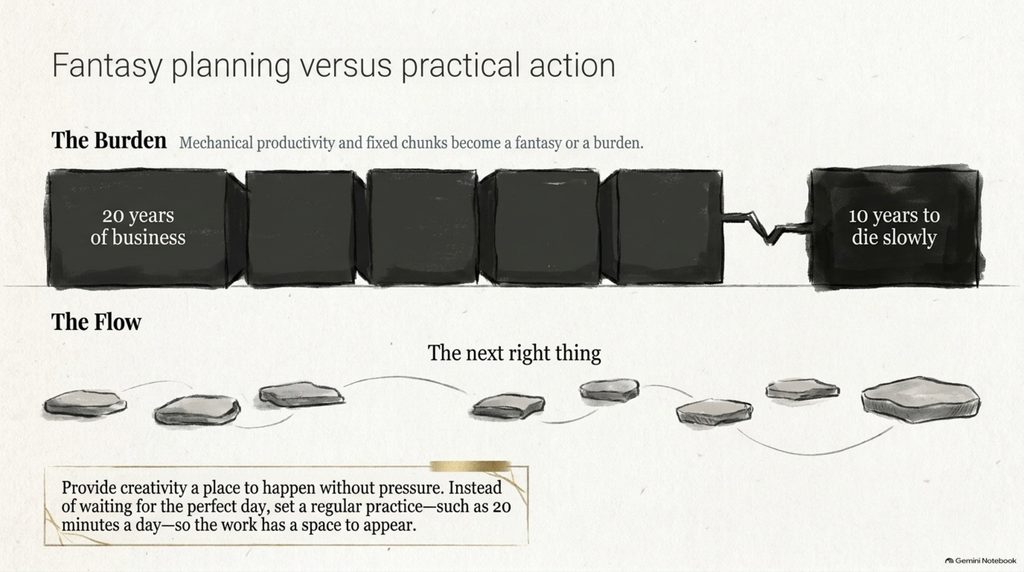
Questions about the future and productivity stayed connected to the same inquiry. Planning a life in fixed chunks can become fantasy or burden, while practical action still happens.
- A possible future frame appeared as 20 more years for business and 10 years to die slowly.
- The work in mind was consulting, computers, and mechanical productivity.
- The alternative approach was the next right thing rather than pressure.
Creativity was used as an example of timing. One view waits for the right day; another sets regular practice, such as 20 minutes a day, so the work has a place to happen.
Art and seeing
Art examples showed the difference between direct perception and mental shorthand.
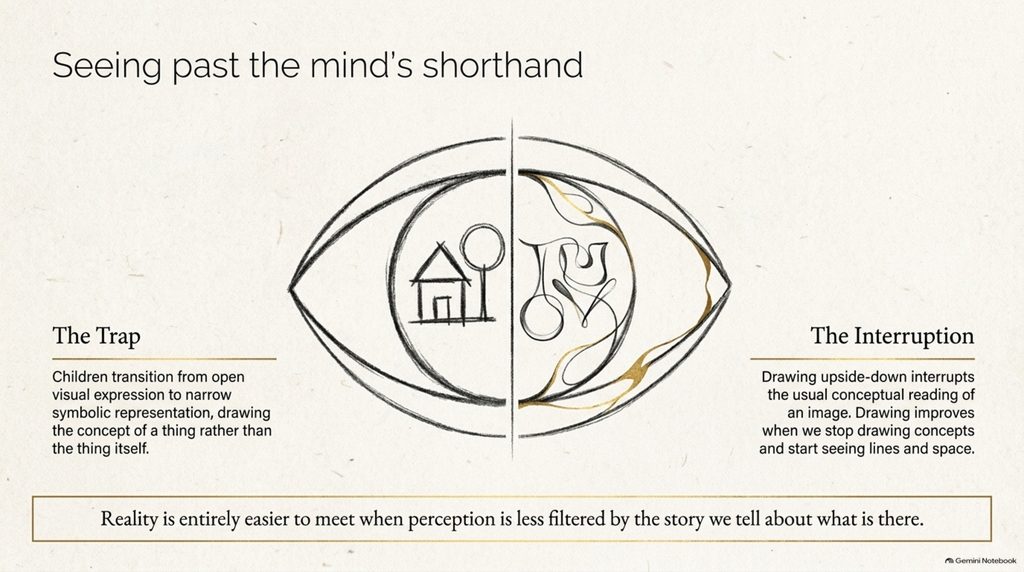
- Drawing improves when seeing lines, curves, and space instead of drawing concepts.
- Upside-down drawing interrupts the usual conceptual reading of an image.
- Children often start with open expression, then narrow into symbolic representation.
This linked back to nondual inquiry: reality is easier to meet when perception is less filtered by the story about what is there.
Repair
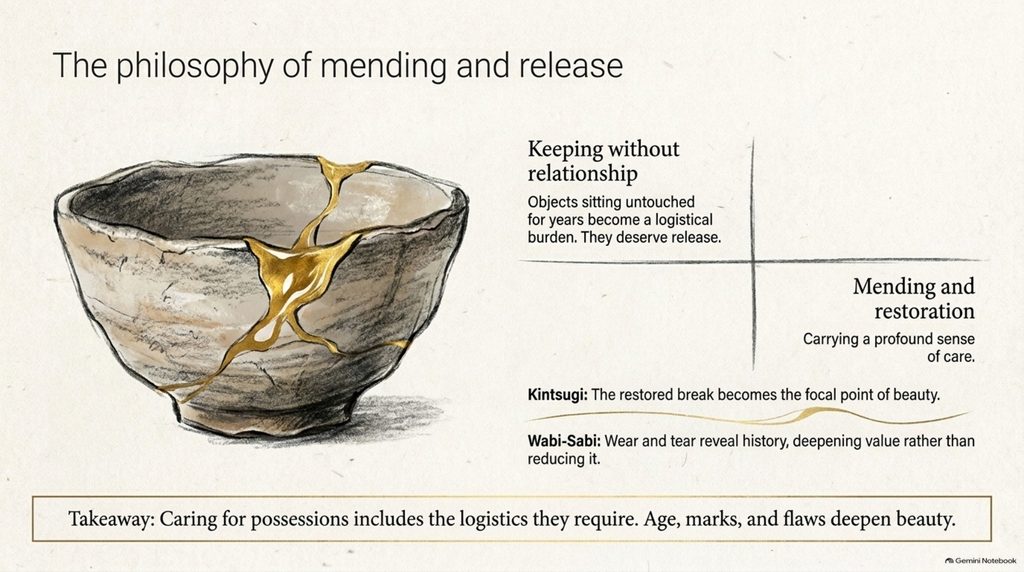
A later theme turned to mending, keeping, and letting go. Repair can feel creative and nourishing, but keeping things without relationship becomes a burden.
- Mending clothes or objects can carry a sense of care and restoration.
- Some things deserve release when they sit untouched for years.
- Caring for possessions includes the logistics they require.
Japanese ideas helped frame this. Kintsugi Restored break becomes beauty Wabi-sabi Wear reveals history and beauty The broader point is that age, marks, and flaws can deepen value rather than reduce it.
Relationship patterns
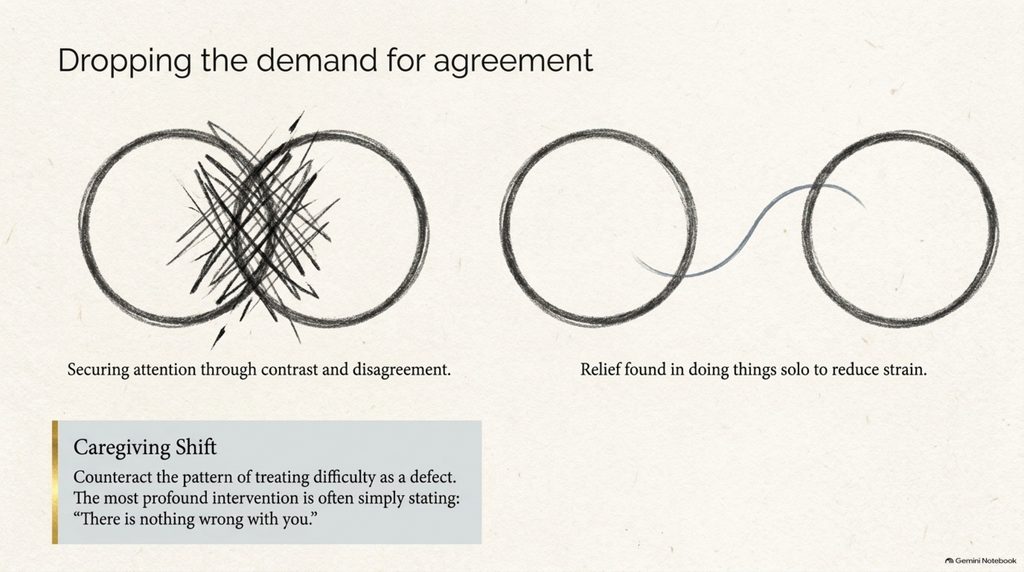
Relationship discussion focused on contrast, disagreement, and the wish for agreement. Disagreement can become familiar enough that agreement feels strange.
- Some people seem to secure attention through contrast.
- Relief comes from dropping the demand for agreement.
- Doing some things solo reduces friction and strain.
Another thread was caregiving language. Telling a child “there is nothing wrong with you” counteracts the pattern of treating difficulty as defect.
Grief
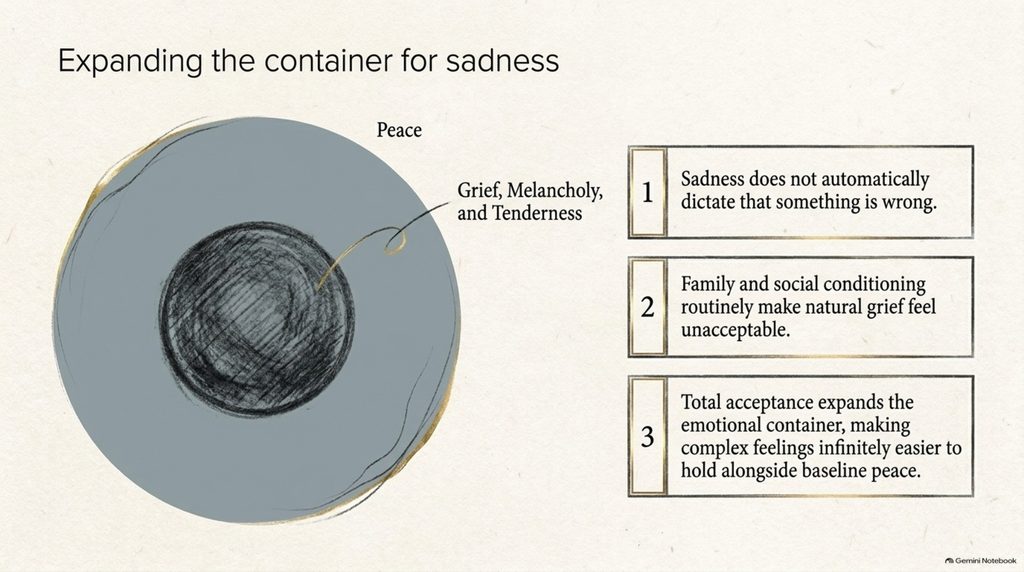
The closing theme made room for sadness without pathologizing it. Grief, melancholy, and tenderness can sit alongside peace.
- Sadness does not automatically mean something is wrong.
- Family conditioning can make grief feel unacceptable.
- Acceptance makes feelings easier to hold.
A shared conclusion ran through this section and the whole conversation: truth is simple, while mind multiplies complexity through interpretation and resistance.
Leave a Reply