Salvadore Poe – Holidays 038-145 (ai summary)
Transcript (via getrecall.it)
(00:00:00) Welcome to the deep dive everybody. I’m your host and uh today we are getting into something pretty wild. (00:00:05) Hey everyone. Yeah, I’m thrilled to be here as the expert for this one because this topic flips a lot of what we think (00:00:11) we know totally upside down. It really does. So I want you the listener to just imagine realizing that (00:00:19) um the single most exhausting job you have is completely unnecessary. Yeah. The job that’s taking up like 90% (00:00:27) of your daily energy. Exactly. the one keeping you up at night. For centuries, almost every (00:00:33) spiritual and self-help tradition has basically framed our inner life as a battlefield. (00:00:37) Right? The message is always that we have to, you know, conquer the selves. We’re told we have to kill the ego. Like (00:00:42) we need to destroy this selfish chattering part of ourselves if we ever actually want to find lasting peace, (00:00:47) which frames human existence as this, well, this lifelong struggle against our own minds. We end up treating our inner (00:00:54)
landscape like a permanent war zone. Just constantly scanning for uh unauthorized thoughts or bad habits to (00:01:00) eradicate, which is just incredibly draining. Oh, totally exhausting. (00:01:03) But today’s deep dive challenges that entire paradigm. We’ve been pouring over this massive stack of transcripts from (00:01:09) live spiritual retreats, specifically lectures by Salvador Poe from his liberation is talks. (00:01:15) Yes, the liberation is talks. And the core mission of this deep dive today is to unpack why the ego absolutely does (00:01:23) not need to be destroyed. We are going to explore how what we call the self is actually just a temporary um (00:01:30) sort of fancy movement of our true nature. Okay, let’s unpack this. Before we can (00:01:34) even begin to understand why fighting the ego is a trap, we have to like establish a baseline, (00:01:40) right? Because if we are supposed to stop managing this self, we really need to know who or what is actually sitting (00:01:46)
in the driver’s seat. Yeah. Like what happens when all that mental noise actually quiets down? (00:01:50) Establishing that baseline is crucial because without it, dropping the ego just feels like staring into a void. (00:01:56) And nobody wants that. No, not at all. So in these retreat recordings, Po introduces this very (00:02:02) practical concept. He calls it taking a holiday. And just to be clear, he isn’t talking (00:02:06) about uh booking a flight to the beach, right? No, a holiday in this framework is taking a deliberate break from the (00:02:15) roundthe-clock energetic upkeep of maintaining the story of you because maintaining that story is (00:02:21) essentially a full-time gig. I mean, think about a typical Tuesday. Oh, it’s non-stop. (00:02:25) We spend hours just silently rehearsing arguments in the shower or justifying our past decisions (00:02:32) or worrying about how our tone was perceived in that one work email. Yes. updating the internal resume of our (00:02:38) grievances. We are just constantly curating a persona and the sheer caloric and mental output (00:02:44)
required to keep that persona intact is staggering. It’s massive. (00:02:48) But when you take a holiday from that curation, what remains is something the sources refer to as pure aware being or (00:02:56) the unborn state. The unborn state. That’s an interesting phrase. (00:02:59) Yeah. And the defining characteristic of this baseline state is that it has zero attributes. None. like it has no name, (00:03:06) no historical baggage, no political affiliations, no preferences. Exactly. It simply is the space in which (00:03:11) everything else happens. See, that sounds incredibly peaceful, but also um a little abstract for (00:03:17) someone listening to this while commuting or folding laundry. How do they actually tangibly recognize an (00:03:24) attributeless state? Well, the talks offer this brilliant and very universal analogy to ground this (00:03:30) deep sleep. Oh, interesting. Yeah. Every single person loves the (00:03:34) profound relief of a deep dreamless sleep. We actively crave it. (00:03:39)
We really do. And the reason we love it isn’t just the physical rest. It’s because in deep (00:03:43) sleep, the narrative of I is entirely absent. Oh wow. Yeah. The boss you hate doesn’t (00:03:49) exist. Your financial anxieties don’t exist. The whole weight of your identity just (00:03:52) vanishes. Yeah. So taking a holiday is essentially importing the profound piece of deep (00:03:57) sleep directly into your waking life. So you were walking around making coffee, talking to people, but that heavy anchor (00:04:03) of a personal narrative just isn’t dragging behind you. Exactly. Another way the sources (00:04:07) visualize this is by looking at the sun. Okay. Pure aware being operates just like the (00:04:13) radiant sun. It outshines everything. The passing clouds of thoughts, the stormy emotions, the physical (00:04:18) sensations, but it doesn’t deny any of them. Crucially, no. It doesn’t deny them. The (00:04:24) sun never goes to war with a raincloud. It just shines right through it. Okay, let me play devil’s advocate for a (00:04:29)
moment here. Go for it. If I intentionally drop my personal (00:04:34) story, my opinions, my history, my immediate fear is that I am just zoning out, right? (00:04:40) It sounds dangerously close to dissociation. I mean, I don’t want to become a passive zombie who just checks (00:04:46) out of reality because it’s easier. Yeah. And that is actually the most common push back you hear in these (00:04:52) retreat transcripts. But the mechanics of a holiday work in the exact opposite direction. (00:04:56) Really? How so? Well, dissociation is a numbing out. It’s a retreat from reality. Taking a (00:05:02) holiday is stepping into hyperresence. Oh, I see. Consider what happens when we are caught (00:05:08) up in our personal stories. We’re actually walking around in a hypnotic trance. (00:05:13) Right. Interacting with our thoughts about reality rather than reality itself. (00:05:17) Exactly. By stepping out of the endless chatter, you aren’t checking out. You are finally waking up to the raw data of (00:05:23)
the present moment without the heavy distorted filter of your personal agenda. I want you, the (00:05:28) listener, to just consider the sheer volume of mental real estate currently occupied by defending your identity. (00:05:36) It’s a lot. Just imagine how much lighter you would feel if you could simply clock out of (00:05:41) that job for just 10 minutes today. No defending, no managing, no performing. Just being the space where things (00:05:48) happen, it reclaims a massive amount of cognitive and emotional bandwidth. Okay, so if our natural baseline is this (00:05:55) radiant peaceful sun, the obvious next question is about causality, right? (00:06:00) Like where does all the anxiety, the noise, and the deep sense of isolation actually come from? (00:06:05) Because the peace seems to get lost so quickly, right? We need to dissect the mechanics (00:06:09) of how this noisy ego actually forms in the first place. Yeah. So, the lectures break this down (00:06:14) using two specific terms that describe the anatomy of this illusion. The rising eye and the phantom eye. (00:06:20)
Okay, the rising eye and the phantom eye. They explain this step-by-step process (00:06:23) of how pure awareness gets tangled up in a story. The rising eye is the initial movement into form. It is the exact (00:06:30) moment when pure empty awareness spontaneously attaches an attribute to itself. (00:06:37) Let’s track that in real time. Imagine waking up in the morning. For the first two seconds, there is just light coming (00:06:42) through the window, right? And the feeling of the blankets. Yeah. There is no you yet with a (00:06:47) problem. Yeah. But then the brain boots up. A thought arrives like it’s Monday. Followed immediately by I have that (00:06:54) stressful presentation today. Yes. The pure awareness has just drawn a circle around an anxious thought and (00:06:59) declared this is me. And that innocent movement of identification is the rising eye. Pure (00:07:05) awareness is suddenly claiming I am anxious or I am my past trauma. Right? (00:07:11) Then there’s the second term the phantom eye and this exposes the most vital part of this whole framework (00:07:16)
which is this self that just formed out of thin air (00:07:19) has absolutely no physical or structural substance. It is literally a phantom. It’s an optical illusion generated by (00:07:26) the activity of claiming a thought. Exactly. And what’s fascinating here is that the transcripts push the audience (00:07:32) to test this for themselves. Yeah. They say the phantom I cannot withstand direct scrutiny (00:07:38) because it isn’t an entity. It’s an activity. The sources suggest a physical (00:07:44) experiment you can do right now. Oh, I love this part. If you pause right now and actively scan (00:07:49) the inside of your head or your chest to locate the solid eye, the CEO who is supposedly generating all these (00:07:56) thoughts, it vanishes. You’ll find a tight sensation in your chest. Maybe you’ll find a stray thought (00:08:02) about what you’re having for dinner. But you cannot isolate a permanent solid eye operating the machinery. (00:08:08) I came up with an analogy for this when reading the sources. It auras like a rogue software program running in the (00:08:14)
background of your computer. Oh, that’s good. Yeah. It’s just quietly eating up all (00:08:18) your mental CPU. Your fan is spinning. The battery is draining and your mind is racing. (00:08:23) Right. But the very second you open the task manager to look directly at the program to see what’s causing the drain, (00:08:30) the program instantly closes itself. Yes, the ego only survives when it operates in your peripheral vision. When (00:08:36) you shine the spotlight of awareness directly on it, there’s nothing there to find. (00:08:40) That task manager analogy, well, it really highlights a radical shift in how we understand the nature of thought. (00:08:46) It does. And the sources point out something fascinating about our desire to figure things out. We usually think (00:08:53) that the ego has a need to understand things like it possesses that need (00:08:57) right. But the lectures clarify that the need to understand I as the ego itself trying to maintain its existence. The (00:09:05)
question and the questioner are the exact same movement. So when I start spiraling and saying you (00:09:10) know I really need to figure out my life path there isn’t a solid me inside who possesses a need. The very arising of (00:09:17) that anxious need is what conjures the illusion of a me into existence in that specific moment. (00:09:23) Exactly. The ego is acting as a verb, not a noun. It is just a temporary bubbling up of activity. (00:09:28) Okay. But if the ego is just an activity, just a phantom software program temporarily running our deeply (00:09:35) conditioned human instinct is to immediately try to delete it. Oh, of course we want to slay the dragon. We (00:09:40) want to be permanently enlightened, right? Yet the core message across all these retreats is that going to war with (00:09:47) the phantom is the ultimate trap. Why is it a trap though? I mean, if I know something is causing (00:09:54) me suffering and eating up my mental CPU, trying to shut it down feels like the most logical next step. (00:10:00)
Well, it feels logical until you look at the mechanics of the fight. Okay. (00:10:03) Any attempt to kill the ego fundamentally requires an ego to hold the weapon. (00:10:08) Oh, why? Yeah. The desire to destroy the self is just the self adopting a new strategy to (00:10:14) maintain control. It creates this endless self-reflective loop. It is the equivalent of trying to bite (00:10:20) your own teeth. Exactly. You’re using the mind to try and escape (00:10:23) the mind, which just creates more mental activity to fully grasp why we don’t need to (00:10:28) fight it. The lectures dive into a non-dual perspective. They use the relationship between the ocean and a (00:10:33) wave. Right? The wave is the ego, the temporary rising form. The ocean is pure being and (00:10:39) the wave is never at any point separate from the ocean. It is entirely made of water. The sources sometimes use ancient (00:10:45) terms like Shiva and Shakti to describe this, right? Which can sound a bit mystical. (00:10:51) It can, but they actually describe a very mechanical relationship. Think of it like physics. (00:10:55)
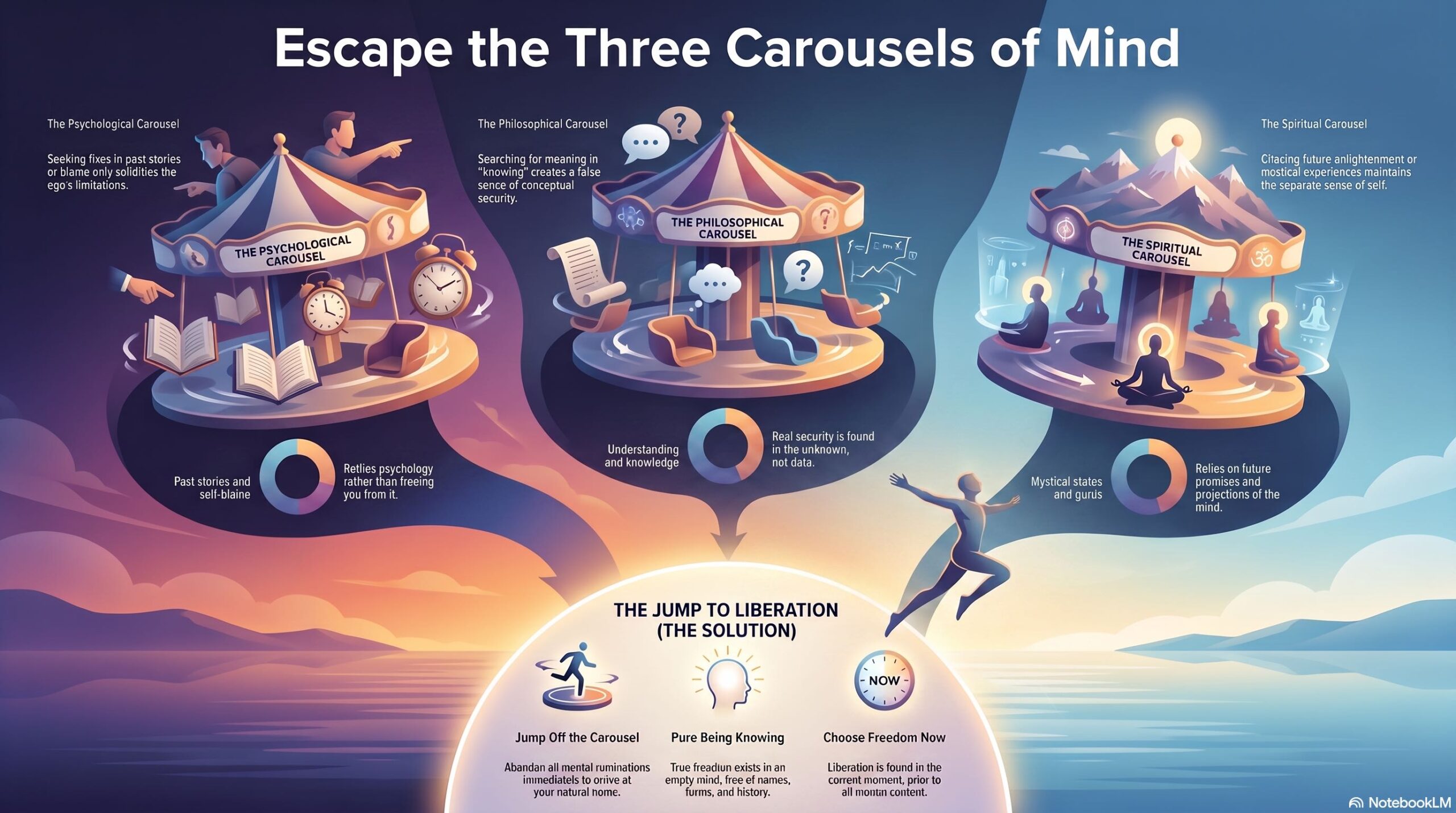
Okay? Shiva represents the unmanifested potential, the vast quiet space of pure (00:11:01) awareness. Shaktdi is the kinetic energy, the movement of that space into form, like a thought or an emotion. (00:11:09) So the wave isn’t an invading force trying to destroy the ocean. It’s just the ocean deciding to wave. (00:11:14) Brilliantly put. And because we failed to recognize that the wave is just water. We panic and we jump onto what (00:11:21) the lectures call the three carousels of mind. Three carousels. Yeah. (00:11:25) These are the psychological, philosophical, and spiritual carousels. So we spend years in therapy trying to (00:11:30) fix our psychological ego. Or we read endless books trying to philosophically figure out the meaning of the ego. (00:11:36) Or we meditate for decades on the spiritual carousel trying to transcend or destroy the ego, (00:11:41) right? But riding those carousels to fix yourself just reinforces the illusion that there is a broken you sitting on (00:11:47) the horse. You keep putting quarters in the machine going round and round (00:11:51)
feeling like you are doing important inner work, but you are actually just keeping the (00:11:57) ego incredibly busy and wellfed. A powerful visual used in the sources to break this cycle is the movie screen (00:12:05) analogy. I love this one. Imagine a massive pristine movie screen. (00:12:11) That screen is your pure aware being, the phantom self. All your thoughts, your history, your anxieties. That is (00:12:19) just the light and shadow projected onto the screen. So the movie is constantly changing, but (00:12:24) the screen is just holding the space. Think about what happens when a movie plays. A scene of a raging destructive (00:12:29) fire does not burn the physical fabric of the screen. Right? (00:12:32) A scene of a devastating heartbreak does not leave a scar on the screen. The shadow literally cannot harm the canvas. (00:12:39) Therefore, there is zero necessity to destroy the shadow. None. The screen remains entirely (00:12:44) untouched before, during, and after the movie plays. Here’s where it gets really interesting. (00:12:48)
I hear that and it makes logical sense, but let me push on the practical implications of this. If I truly (00:12:53) internalize that I am the untouchable screen and I stop trying to fix, manage or conquer my ego, what prevents me from (00:12:59) becoming a terrible selfish person? Don’t we need the ego or at least the constant policing of the ego to keep us (00:13:07) from acting entirely out of greed and harming others? That’s the fear. (00:13:11) But if we connect this to the bigger picture, we assume the ego is the source of our morality. (00:13:16) Yeah. But if we look closer at the mechanics of human behavior, greed, division, and conflict are actually (00:13:23) manufactured by the ego. They are symptoms of it. Oh, I see. (00:13:27) The rising of the ego is the literal birth of separation. Is the exact mechanism that says here is where I end (00:13:34) and you begin and I must protect what is mine at your expense. But pure aware being by definition has (00:13:39) no boundaries. It permeates everything equally. Right? When you drop the story of (00:13:43)
separation and rest in that pure awareness, greed simply loses its structural foundation. (00:13:48) You can’t be greedy if there is no perceived other to take things from. Exactly. When you recognize you are the (00:13:55) screen holding the entire movie, you stop violently competing with the other characters for more screen time. (00:14:01) Because the default state of pure being isn’t chaos. Its default state is completeness and a lack of harm. You (00:14:08) don’t need to enforce morality onto it. Precisely. But let’s bring this down to earth. This is deeply profound. But we (00:14:14) don’t live on a pristine movie screen. No, we don’t. We live in a world where taxes are due, (00:14:19) where people cut us off in traffic, where we receive passive aggressive emails. (00:14:23) Absolutely. We cannot sit in a state of formless bliss all day. How do we actually live (00:14:30) alongside this phantom ego in a messy practical reality? Well, the sources are very clear that the goal is not to (00:14:37)
escape your daily life or maintain a blank mind. Living this takes what Po calls the audacity of freedom. (00:14:44) The audacity of freedom. Yeah. It is the audacity to stop taking the contents of your own head so (00:14:49) incredibly seriously. You don’t live on a holiday 24 hours a day, right? A permanent holiday is just (00:14:54) another spiritual fantasy. The car still has to be driven. The practice is seeing the ego arise, feeling the anxiety (00:15:01) spike, watching the narrative form, and recognizing it as just shadow and light. You let the movie play, but you refuse (00:15:08) to let it dictate your entire reality. Exactly. And the retreat transcripts offer a brilliant sematic analogy for (00:15:16) dealing with trauma or heavy repetitive thought loops. They call it the foot on the gas analogy. (00:15:22) Okay. Walk us through how that works in a stressful situation. Let’s say I get a text message that triggers a deep (00:15:27) insecurity and my mind instantly starts spinning a catastrophic story. In that moment, engaging with those (00:15:34)
heavy thoughts, arguing with them, or desperately trying to fix them is the equivalent of slamming your foot on the (00:15:39) gas pedal while the car is in park. Oh man, you are revving the engine. The RPMs (00:15:44) skyrocket. Your nervous system responds to the mental activity by dumping cortisol into your bloodstream. Because (00:15:50) the sematic experience of trauma and anxiety builds entirely because you are fueling the engine with your attention. (00:15:55) Yes, you are flooring it. So, in that specific panicinducing moment, how do I actually take a (00:16:00) holiday? Taking a holiday is mechanically just taking your foot off the gas. (00:16:05) You don’t have to slam on the brakes. Okay. You don’t have to yell at the engine to (00:16:08) be quiet. You don’t even have to analyze why the car is revving. Yeah. (00:16:13) You just take your foot off the pedal and let the car idle. It won’t go silent immediately, right? (00:16:18) The engine will still vibrate for a minute, sure, but because you have stopped (00:16:22)
actively feeding it fuel, the nervous system naturally begins to downregulate and quiet itself. (00:16:28) But this requires a pattern interrupt. I mean, when the phantom self flares up and the engine is roaring, how do we (00:16:34) actually remember to take our foot off the gas? This is where it gets incredibly (00:16:38) practical. The lectures provide a very specific, almost surgical inquiry for these moments. Wait is it (00:16:44) when you feel that tight anxious eye taking over your chest and demanding that you solve a problem right now you (00:16:50) pause and ask yourself one question okay what am I prior to this (00:16:54) what am I prior to this wow it almost forces the brain to short circuit it acts as a neurological pattern (00:16:59) interrupt but the crucial instruction here is that you are not looking for a verbal or (00:17:06) philosophical answer because your mind will try to answer with I am pure awareness but that’s just (00:17:11) more mind exactly The question itself is the tool. It abruptly shifts your attention away (00:17:17)
from the burning building in the movie and points it backward toward the blank screen. (00:17:22) It breaks the hypnotic trance of the narrative and thrusts you back into the space of pure aware being. (00:17:27) Yes. So you listening right now can test this out today. (00:17:30) Highly recommend it. The next time you feel yourself getting tightly wound up, maybe the inner critic (00:17:35) starts shouting after you make a mistake at work, just notice the RPMs rising. Take your foot off the gas. (00:17:40) Let the engine idle and internally ask, “What am I prior to this?” Feel the gap that opens up in the noise. (00:17:47) You don’t need to conquer the inner critic. Just let the question create a sudden breath of space. (00:17:52) And you are slowly building a new default setting where freedom is the baseline and the ego is just recognized (00:17:59) as passing weather. It might storm, but a sky itself is never damaged. The central revelation we (00:18:04) are pulling from all these retreat talks is really just a massive sigh of relief. You do not need to wage a lifelong (00:18:12)
exhausting war against your own mind. It is a war designed to be unwininnable and liberatingly. It is one you don’t (00:18:19) actually have to fight. the self. All your carefully curated stories, your deep anxieties, your desperate need to (00:18:26) figure everything out is just a temporary flickering shadow on the indestructible screen of your pure aware (00:18:34) being. You can absolutely let the movie play. The drama can unfold. You just don’t (00:18:39) have to forget that you are the screen holding it all. Enjoy the movie, but remember where you (00:18:43) are sitting in the theater. Perfect way to put it. To wrap up today’s deep dive, I want you to (00:18:48) consider this one final mindbending thought as you move through your day. Well, this is a good one. (00:18:53) We explored how the desire to understand and fix the ego is just the ego keeping itself alive. The seeker and the (00:18:59) blockage are the exact same entity. So if the EA that desperately wants to be enlightened is the precise thing (00:19:06)
blocking your peace, what would happen if you simply resign from the job of seeking right this very second?
The audacity of freedom.
What am I prior to this?
Freedom is the baseline.
Leave a Reply