This One Mistake Keeping You Separate from Your True Self
Swami Sarvapriyananda Lecture
Detailed Summary (via getrecall.it)
Detailed summary
The Radiance Beyond All Darkness (00:00:01)
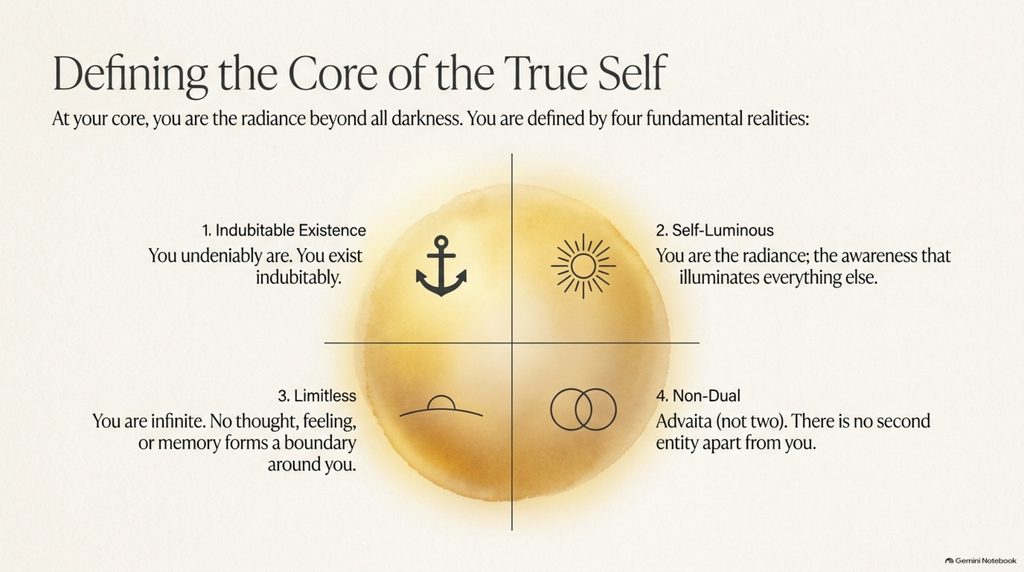
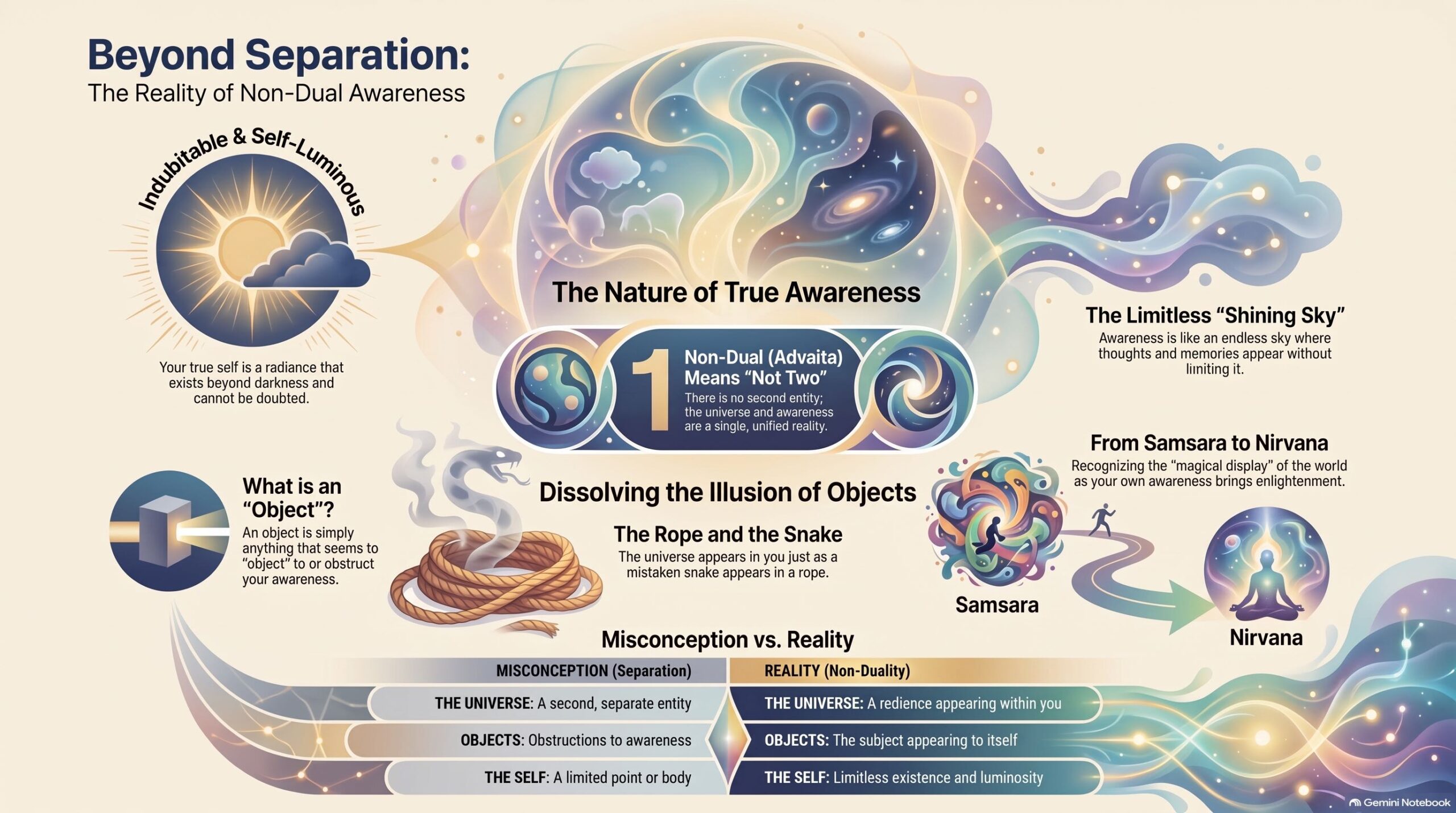
- The true self is described as a radiance beyond all darkness that is both indubitable and self-luminous (00:00:01).
- This radiance is infinite because no experience, thought, feeling, memory, or person acts as a limit to it (00:00:07).
- All experiences exist within awareness and are not separate entities from the awareness itself (00:00:22).
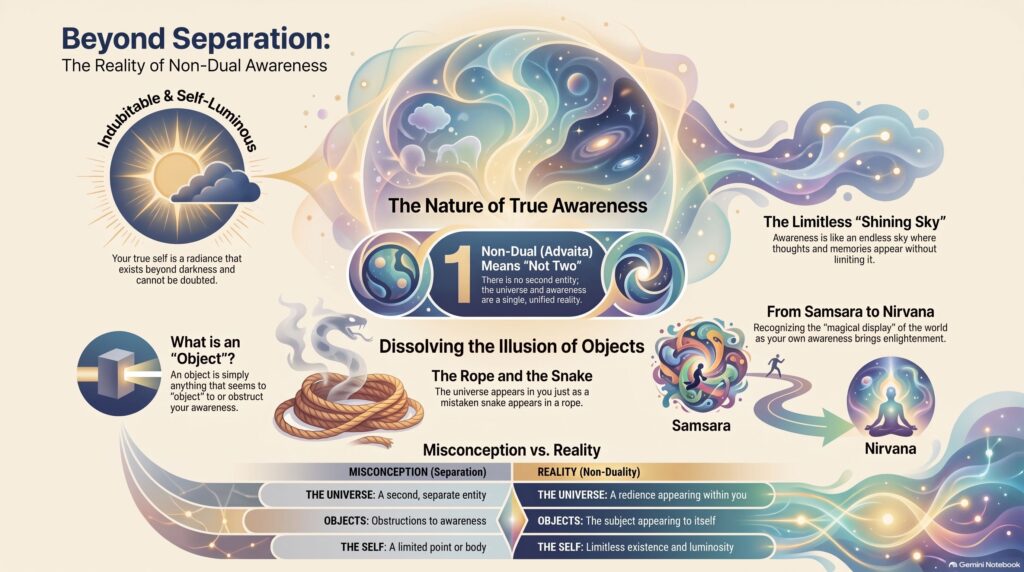
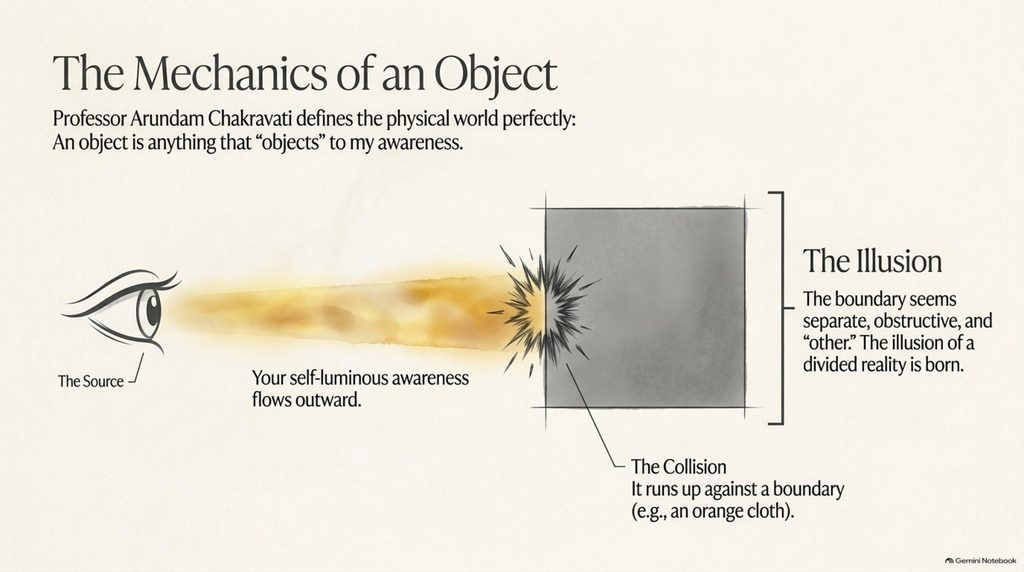
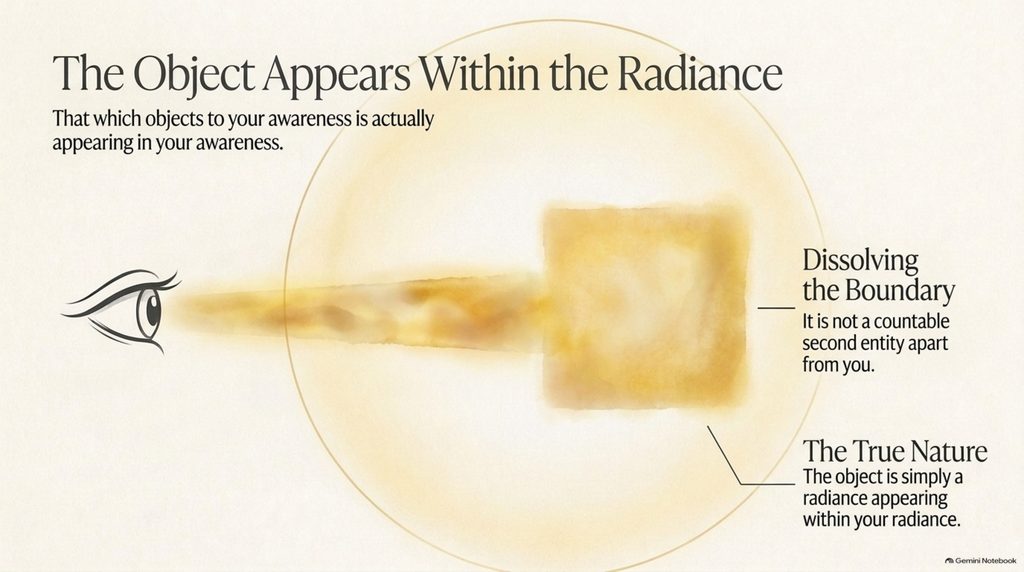
- Professor Arindam Chakrabarti defines an object as anything that “objects” to awareness, meaning it appears to obstruct or stand apart from one’s awareness (00:00:34).
- Advaita Vedanta posits that what appears to object to awareness is actually contained within that awareness and is not separate from it (00:01:05).
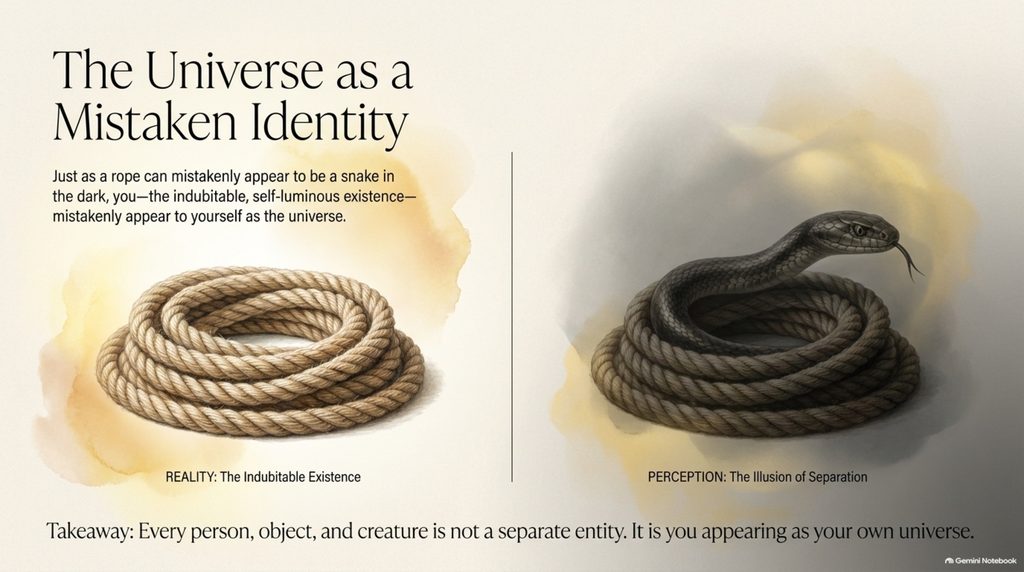
- The universe appears within this self-luminous existence, similar to how a snake appears on a rope (00:01:22).
- The individual, as the indubitable and self-luminous existence, is the “rope” upon which the universe appears (00:01:35).
- Every object, person, and creature, whether living or non-living, is an appearance of this fundamental self (00:01:49).
What is an “Object”?
Objecting to Awareness (00:02:00)
- The universe and all objects within it, including non-living things, are not separate from the individual when viewed from the perspective of awareness (00:02:00).
- The concept of “Advaitam” refers to non-duality, meaning there is no second entity apart from the self (00:02:10).
- When one takes a stand as awareness, all things are recognized as being contained within the self rather than existing as separate entities (00:02:20).
- The self is defined as existence that is indubitable, self-shining, and luminous (00:02:35).
- The mind and body appear within the self, which is characterized as limitless existence and luminosity (00:02:41).
- The self is considered limitless because nothing within the universe constitutes a boundary or limit to it (00:02:54).
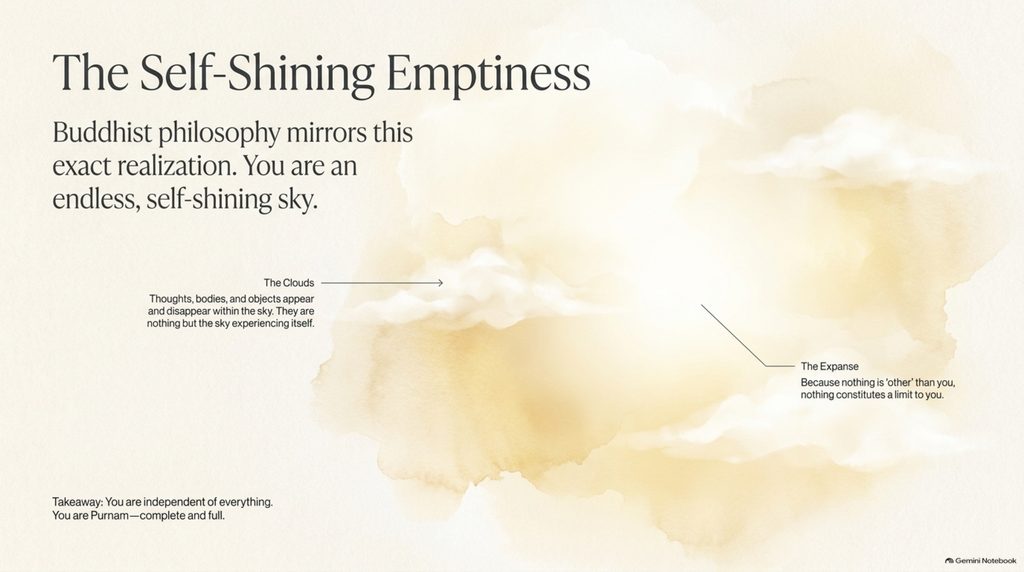
- Buddhist philosophy describes this state as “self-shining emptiness,” which can be visualized as an endless, luminous sky (00:03:09).
- Everything that appears and disappears within this metaphorical sky is ultimately nothing other than the sky itself (00:03:17).
- Because all things are not other than the self, they do not form a second reality, confirming the non-dual nature of existence (00:03:27).
- While everything is the self, the self remains independent of all things, a state described as “Purnam,” or complete and full (00:03:39).
- Because all things are literally the self, there is nothing within this reality that can be rejected (00:03:46).
The Universe Appears in You (00:04:00)
- There are four fundamental characteristics of the self: existence, indubitable existence, self-shining existence, and limitless existence. (00:04:00)
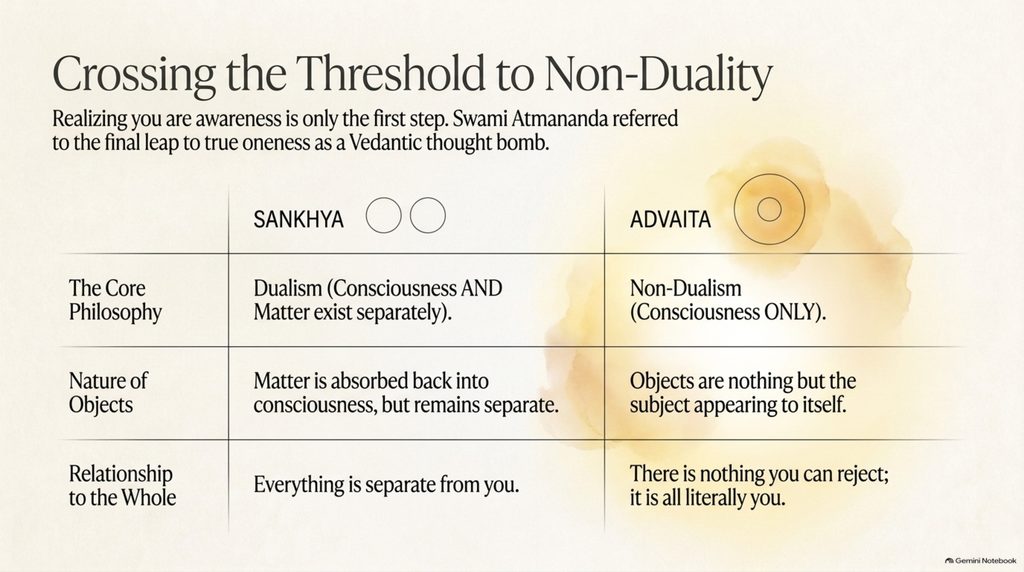
- The concept of limitless existence is described as a “Vedantic thought bomb” that transitions awareness into non-duality. (00:04:14)
- Advaita is defined as oneness, distinguishing it from the Sankhya philosophy, which posits a separation between consciousness and matter. (00:04:28)
- In the Sankhya perspective, the individual remains a point of self-shining luminosity that is separate from everything else. (00:04:34)
- When matter is absorbed back into consciousness, it no longer constitutes a second reality or an object separate from awareness. (00:04:44)
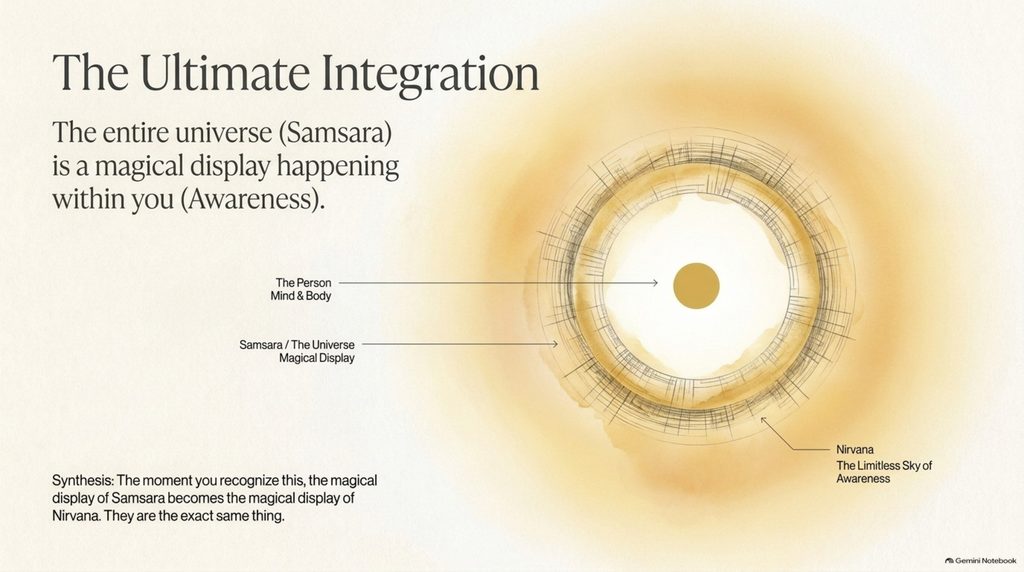
- The entire universe, or samsara, is a magical display appearing within the limitless sky of awareness, known as Chidakasha. (00:04:49)
- Recognizing that the universe is a display within awareness transforms samsara into nirvana. (00:04:57)
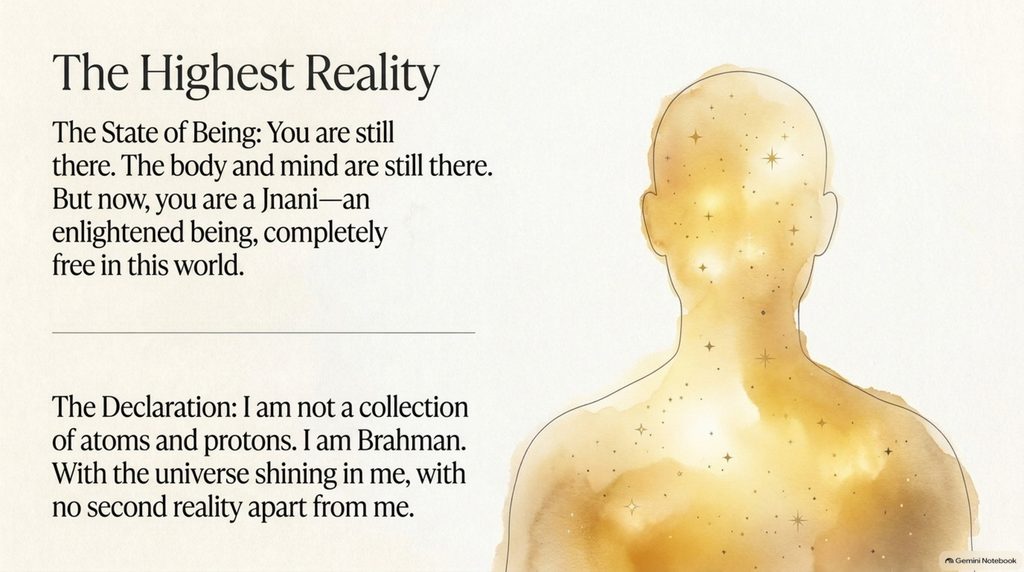
- An enlightened being who remains in the world while realizing this truth is referred to as a Jivanmukta. (00:05:12)
- The highest reality, or Purushottama, is identified as the self, characterized by existence that is indubitable, self-luminous, and infinite. (00:05:19)
- There is no second reality apart from the self, and the innumerable forms of the universe appear within it, similar to how a snake is mistakenly perceived in a rope. (00:05:40)
- The realization of this truth is expressed as “Brahma Aham,” meaning “I am that Brahman.” (00:05:48)
Non-Duality:
No Second Entity Apart from You (00:06:01)
- Brahman is not a collection of physical components such as atoms or protons. (00:06:01)
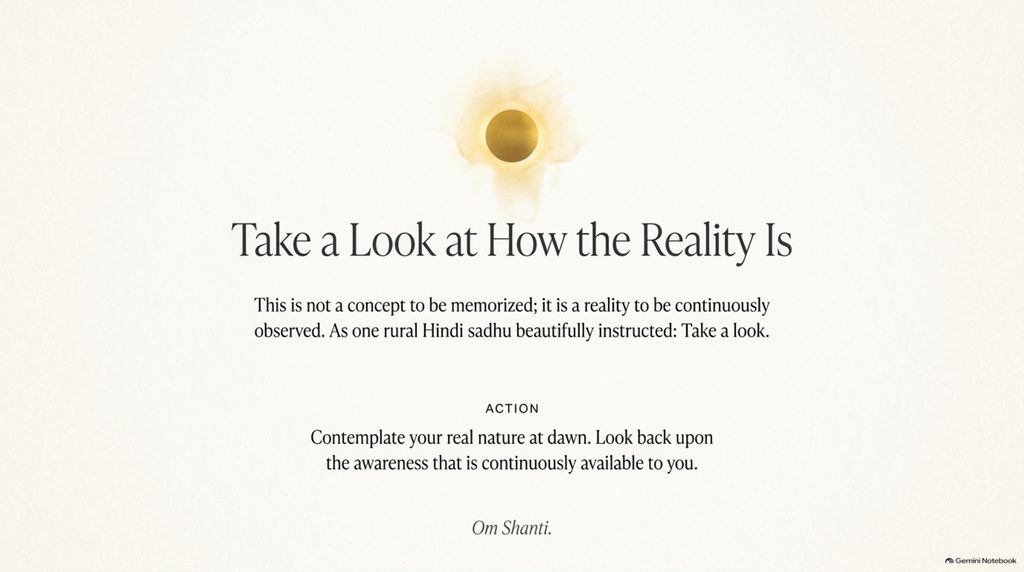
- The contemplation of Brahman, which is the contemplation of one’s true nature, can be performed at dawn or at any other time. (00:06:11)
- The reality of one’s true nature is continuously available to be examined. (00:06:17)
- An individual is encouraged to look back upon and examine the nature of reality. (00:06:23)
- The process of understanding reality involves taking a look at what that reality actually is. (00:06:30)
- Reality is located within the individual. (00:06:36)
- The session concludes with a peace chant, specifically “Om Shanti Shanti Shantihi,” followed by “Hari Om Tat Sat Shri Ramakrishna Arpanam Astu.” (00:06:42)
Leave a Reply