Summary via getrecall.it
Detailed summary
The Princeton Math That Didn’t Make Sense (00:00:00)
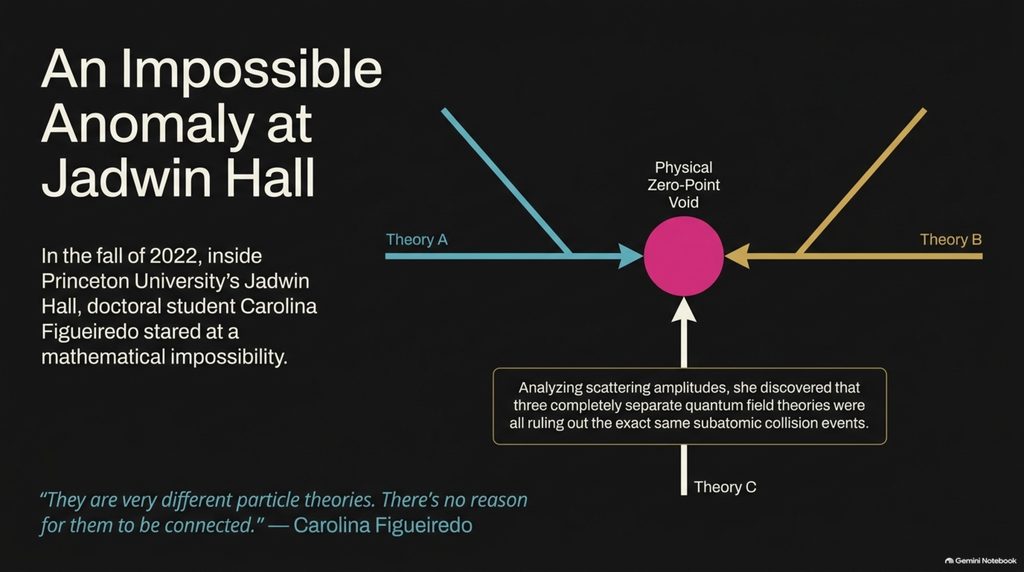
- In the fall of 2022, doctoral student Carolina Figueiredo was working on calculations regarding scattering amplitudes at Jadwin Hall at Princeton University (00:00:00).
- Scattering amplitudes are used by physicists to analyze the behavior of subatomic particles when they collide at speeds approaching the speed of light (00:00:18).
- Figueiredo observed that three distinct quantum field theories, which describe different sets of real and hypothetical particles, all excluded the same subatomic collision events (00:00:18).
- Figueiredo noted that because these particle theories are very different, there was no apparent reason for them to be connected (00:00:38).
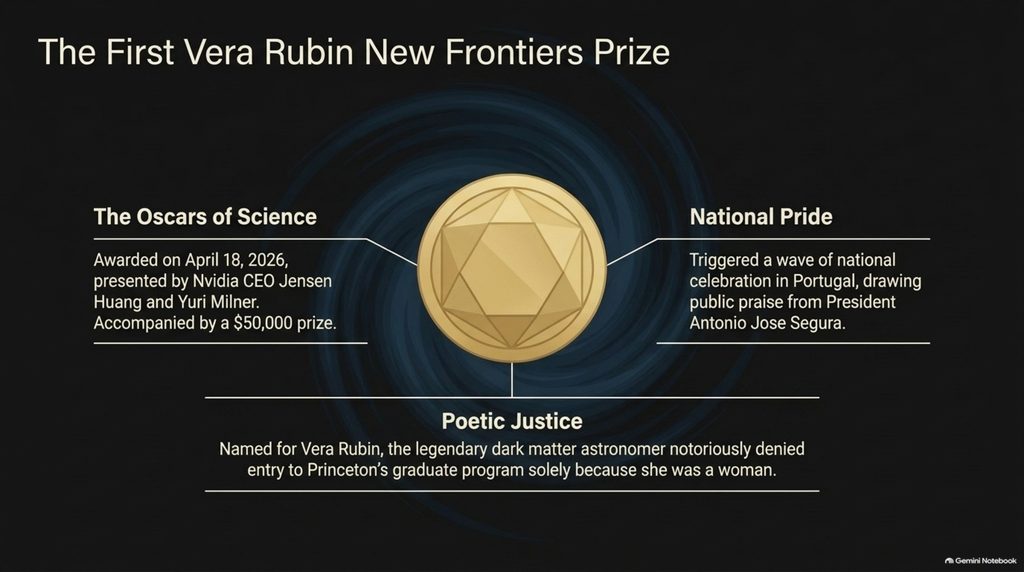
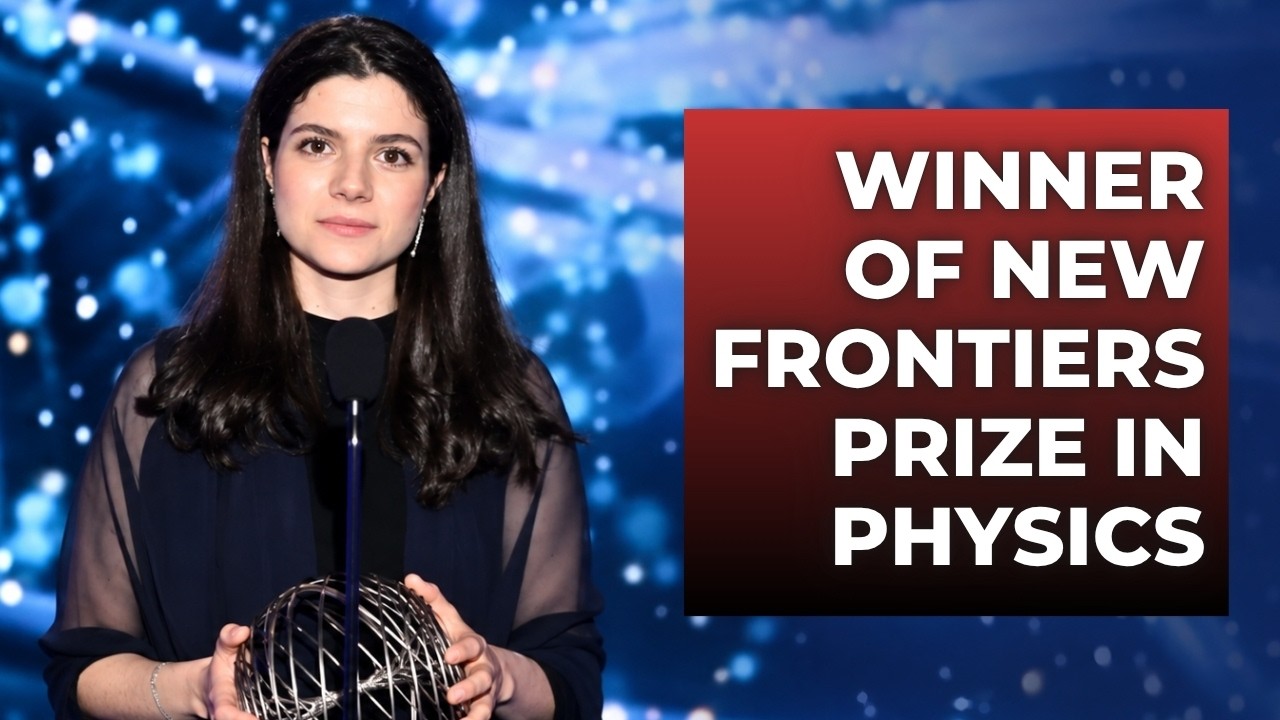
- On April 18, 2026, at a ceremony in Santa Monica, California, Carolina Figueiredo was awarded the inaugural Vera Rubin New Frontiers Prize for her discovery (00:00:38).
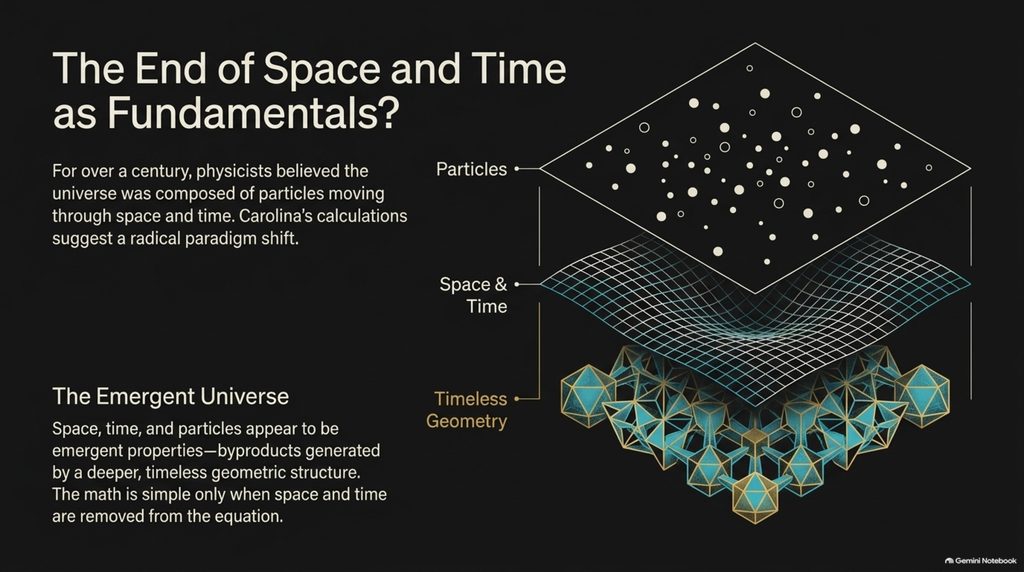
- While physics has traditionally held that the universe consists of particles interacting within space and time, Figueiredo’s calculations proposed that space, time, and particles might not be the fundamental components of reality (00:00:58).
- The findings suggest that space, time, and particles may emerge from a deeper, timeless geometric structure (00:01:18).
- Nvidia CEO Jensen Huang presented the award to Figueiredo, prompting questions regarding how this discovery was made after a century of physics research had overlooked it (00:01:18).
- Figueiredo expressed that after four centuries of scientific progress, fundamental physics has reached a point where the origins of space and time can be addressed (00:02:03).
- Figueiredo highlighted the mystery of why the universe can be described by simple mathematical laws that are intelligible to humans (00:02:19).
Lisbon Beginnings: Music, Relativity, and Riemannian Manifolds (00:02:40)
- Carolina grew up in Lisbon, Portugal, where she developed an early interest in both music and the sciences. (00:02:40)
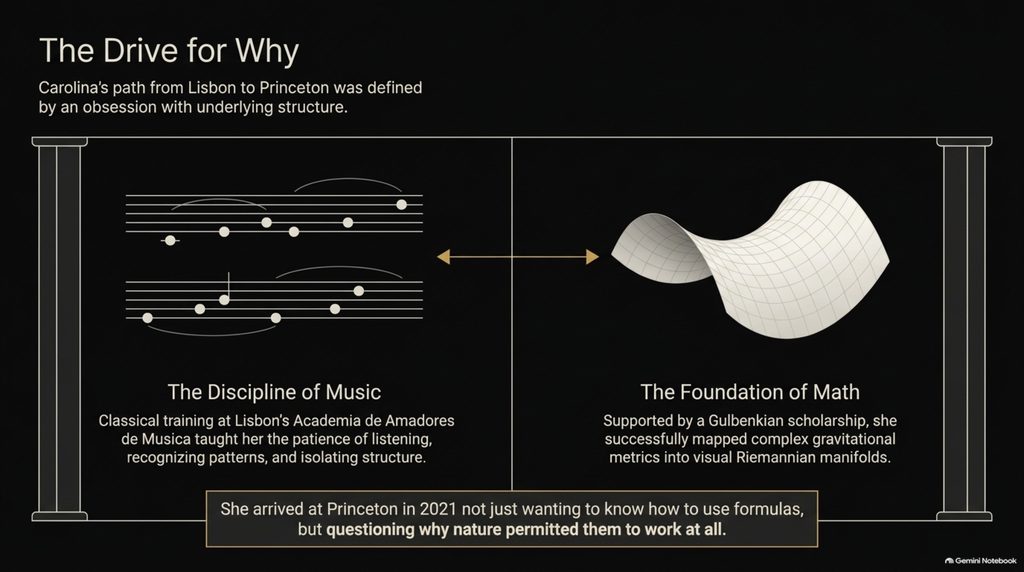
- During her time at the public high school Escola Secundária Rainha Dona Leonor, teachers noted her tendency to question the fundamental reasoning behind mathematical formulas rather than simply applying them. (00:03:00)
- She enrolled in the engineering physics program at Instituto Superior Técnico, which is recognized as Portugal’s top engineering school. (00:03:17)
- A Gulbenkian scholarship in mathematics allowed her to bypass certain standard engineering courses to focus on the study of relativity. (00:03:37)
- Under the mentorship of professor José Natário, she conducted research on mapping static spacetimes to curved positive definite Riemannian manifolds. (00:03:37)
- In September 2020, Carolina and Natário co-authored a paper titled “Riemannian manifolds dual to static spacetimes,” published in the journal General Relativity and Gravitation. (00:04:00)
- The research demonstrated a one-to-one correspondence between the paths of test particles in General Relativity and geodesics on curved surfaces. (00:04:00)
- This methodology enabled the conversion of complex gravitational metrics—including Schwarzschild black holes, wormhole models, and de Sitter or anti-de Sitter universes—into simpler visual Riemannian manifolds. (00:04:22)
- After completing her undergraduate degree, she began a master’s program in applied mathematics and computation at Instituto Superior Técnico before deciding to leave the program to apply for a PhD in physics at Princeton University. (00:04:39)
- She arrived at Princeton in the fall of 2021, during a period when the university was still recovering from the COVID-19 pandemic. (00:04:56)
- At Princeton, she began working with Nima Arkani-Hamed, a theoretical physicist and winner of the 2012 Breakthrough Prize in Fundamental Physics. (00:05:15)
- Under Arkani-Hamed’s guidance, she joined a research community spanning Princeton University and the Institute for Advanced Study that sought to simplify the mathematical methods used to calculate quantum interactions. (00:05:59)
- The research group aimed to develop a more elegant description of physics that does not rely on traditional concepts of space and time. (00:06:16)
- The research process involved reconceptualizing the nature of quantum mechanics, spacetime, and the vacuum, initially by stepping back from complex cosmological questions to address the problems in a more manageable setting. (00:06:34)
The Problem with Feynman Diagrams in Particle Physics (00:07:01)
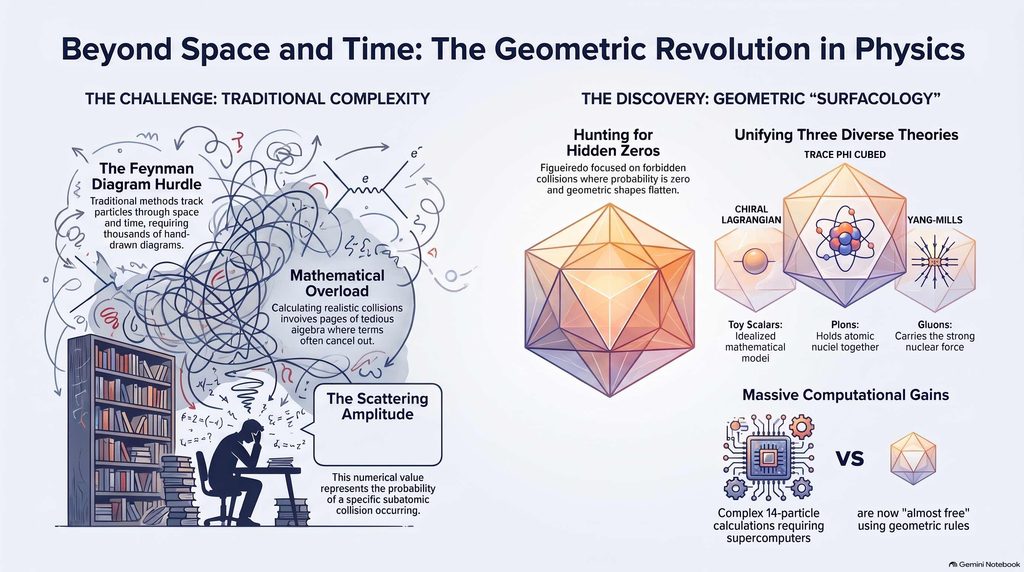
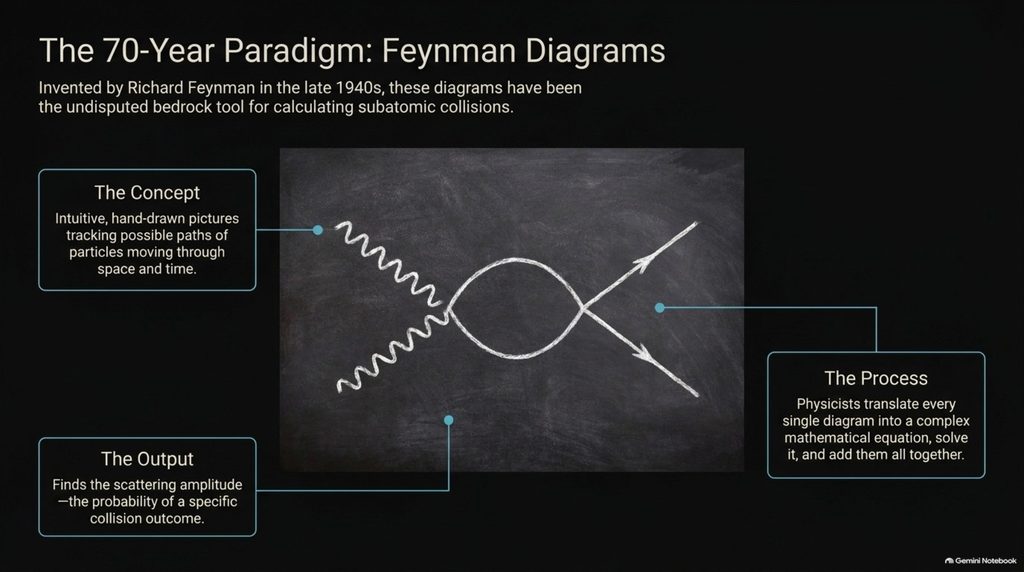
- Feynman diagrams, invented by Richard Feynman in the late 1940s, serve as the primary method for visualizing and tracking the paths of subatomic particles as they collide, split, and merge (00:07:01).
- To determine the probability of a specific collision outcome, known as a scattering amplitude, physicists must convert each diagram into a complex mathematical equation and sum the results (00:07:23).
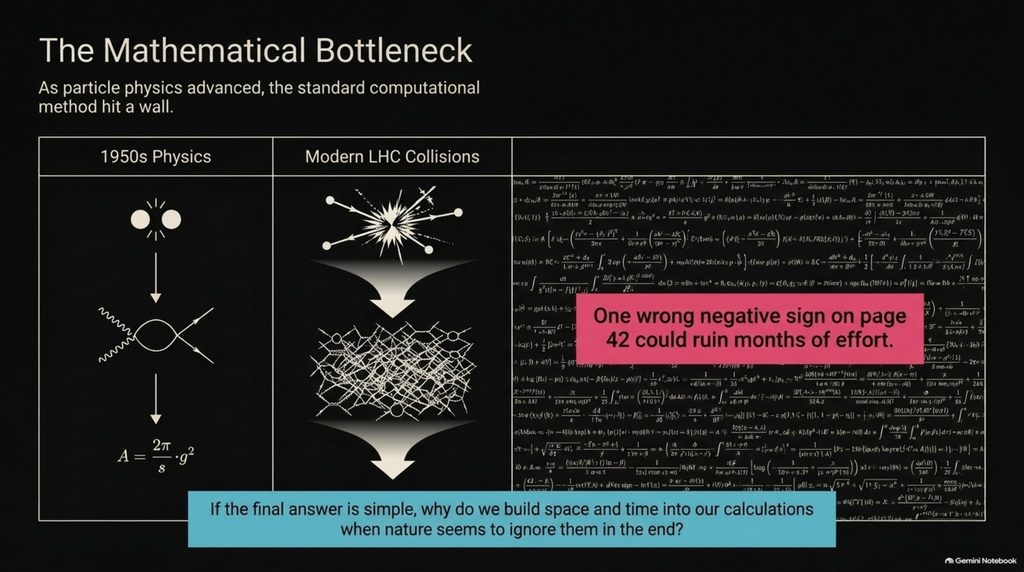
- While the process is manageable for simple scenarios, calculating realistic collisions, such as those occurring at the Large Hadron Collider at CERN, involves thousands of diagrams and extensive, tedious algebra (00:07:42).
- Physicists often discover that after months of performing these complex calculations, the majority of the terms cancel out, resulting in a surprisingly simple and elegant final answer (00:08:01).
- Carolina experienced significant frustration during the pandemic while performing these calculations, noting that a single minor error could invalidate months of work despite the simplicity of the final result (00:08:22).
- This frustration led Carolina to question why space and time are integrated into calculations if nature ultimately produces a simple outcome that appears to ignore those constraints (00:08:41).
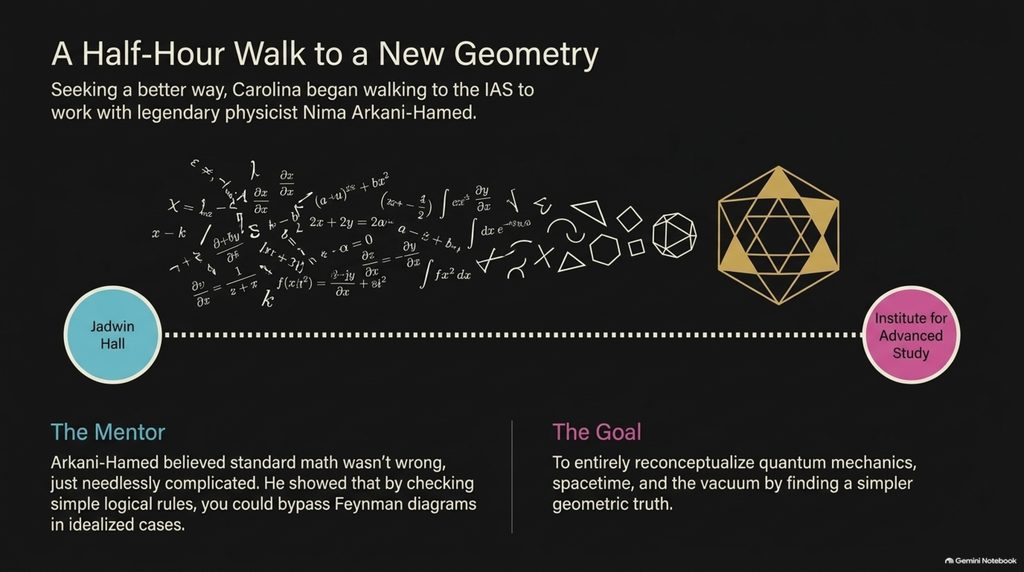
- Through a series of online lectures, Nima Arkani-Hamed demonstrated that in certain ideal cases, it is possible to bypass Feynman diagrams by applying basic logical rules directly to the final answers (00:09:01).
- This approach allows for the derivation of the correct formula without the need to track every individual step of a particle’s movement through space and time (00:09:01).
- Inspired by this methodology, Carolina began traveling from Princeton’s campus to the Institute for Advanced Study (IAS) to collaborate with Arkani-Hamed (00:09:21).
- At the IAS, Carolina and Arkani-Hamed engaged in intensive sessions at the blackboard, debating and refining the mathematics of quantum field theory (00:09:40).
- During these collaborative sessions, Carolina identified a pattern in the equations that had previously gone unnoticed by others (00:09:40).
What Are Singularities vs. Zeros in Quantum Field Theory? (00:10:04)
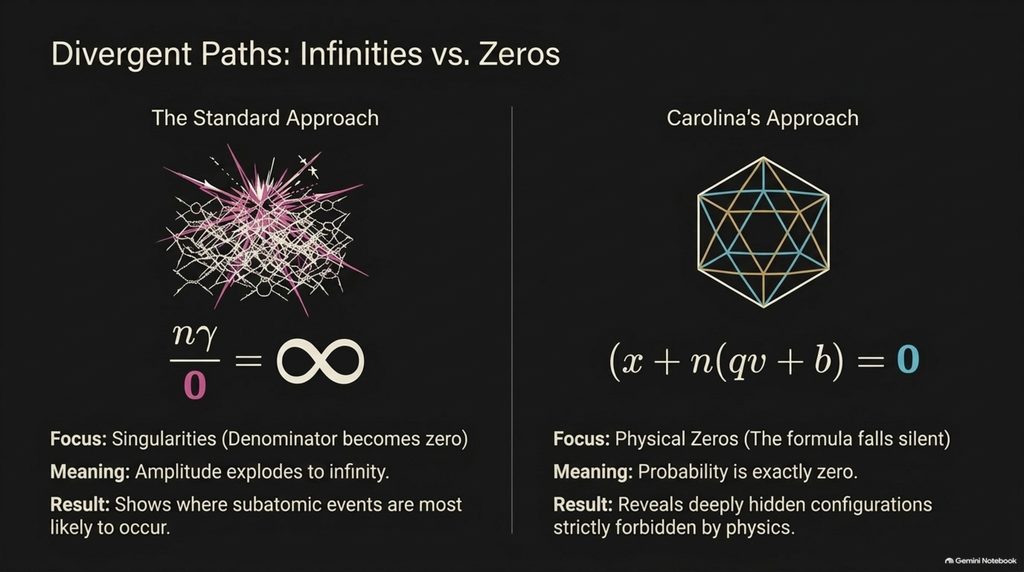
- In particle collision mathematics, probability formulas are typically represented as fractions where the denominator becoming zero causes the amplitude to reach infinity, a phenomenon known as a singularity that indicates where subatomic events are most likely to occur (00:10:04).
- Carolina focused her doctoral research on zeros, which are specific particle collision configurations where the probability is exactly zero and the events are strictly forbidden by underlying physics (00:10:22).
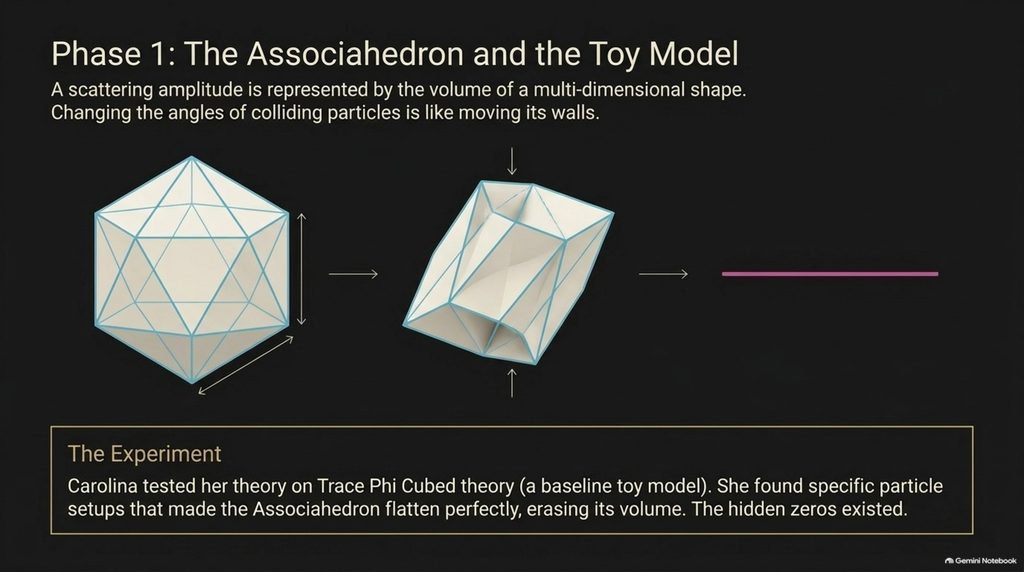
- Within Nima Arkani-Hamed’s geometric approach to physics, scattering amplitudes are derived from the volume of multi-dimensional geometric shapes, where a physical zero occurs when the shape is squeezed flat and its volume disappears (00:11:04).
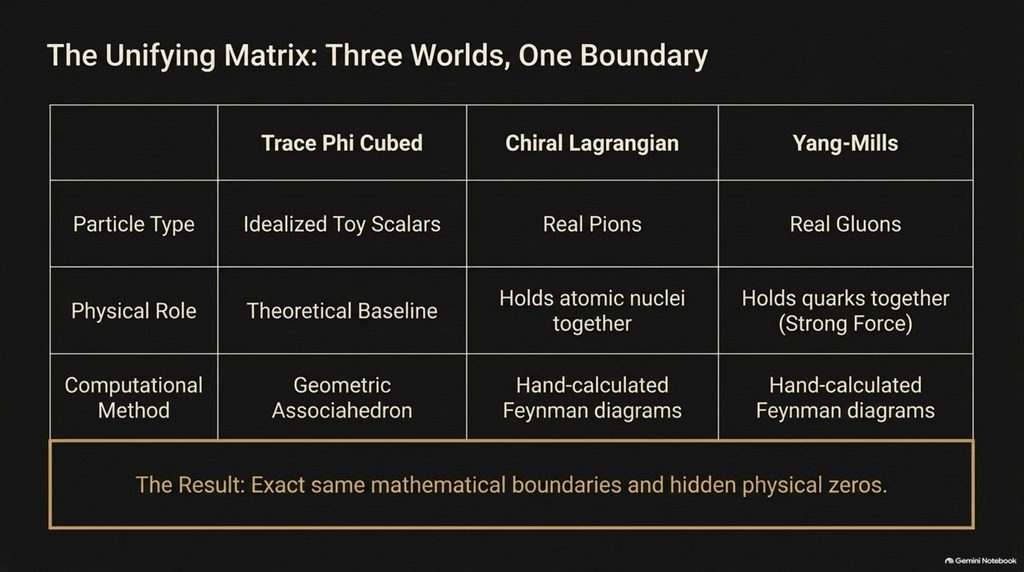
- Initial research utilized an idealized model called trace phi cubed theory and a geometric object known as the associahedron to identify setups that caused the shape to flatten and the volume to vanish (00:11:24).
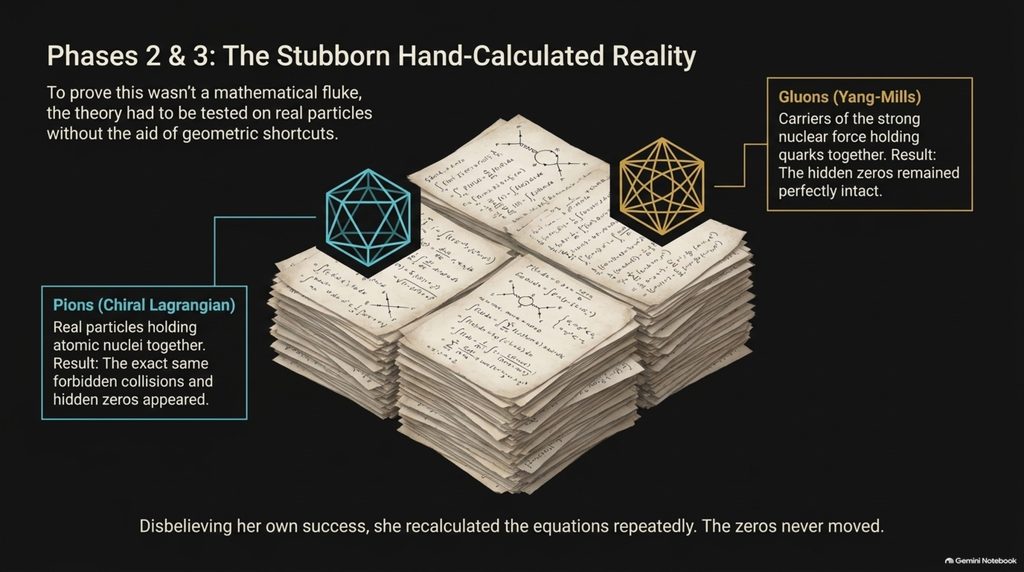
- To test if this pattern applied to real particles, Carolina performed manual calculations using traditional Feynman diagrams for pions, which are described by the complex chiral Lagrangian theory and lack the simple geometric tools of the toy model (00:11:45).
- The same forbidden collisions and hidden zeros identified in the toy model were present in the pion equations, a result that persisted even after repeated verification of the calculations (00:12:04).
- Further testing on gluons, which carry the strong nuclear force, revealed the same set of hidden zeros within the math of Yang-Mills theory (00:12:25).
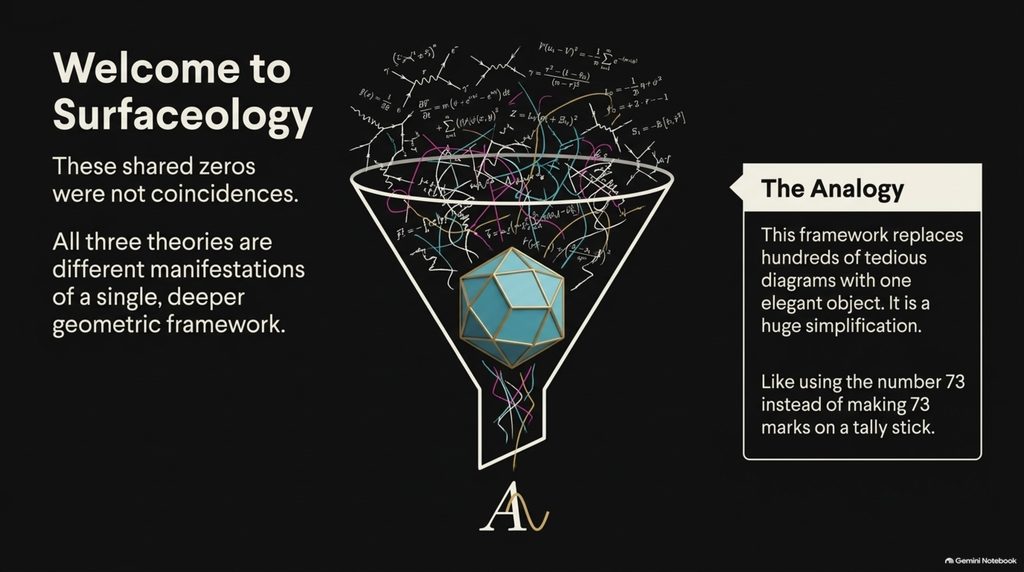
- The discovery that three distinct physical theories—toy scalar particles, pions, and gluons—shared the same mathematical boundaries indicated that these theories are different manifestations of a deeper geometric framework called surfacology (00:12:45).
- Surfacology serves as a simplification that replaces hundreds of Feynman diagrams with a single mathematical object (00:13:27).
- When these findings were presented at a physics conference, the simplicity of the geometric approach was met with skepticism regarding its ability to match decades of standard calculations (00:14:08).
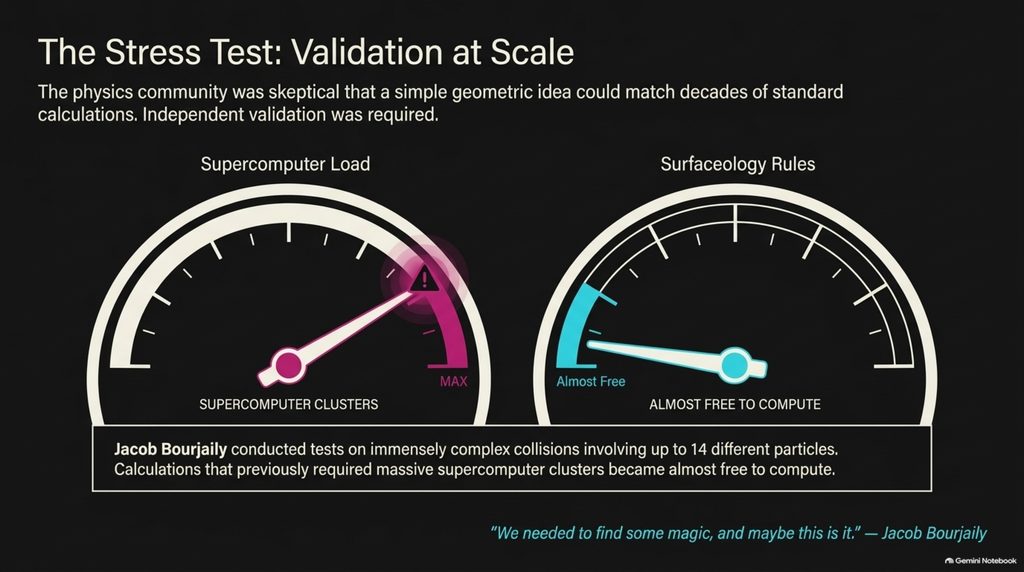
- Physicist Jacob Bourjaily of Pennsylvania State University verified the claims by calculating complex collisions involving up to 14 particles, finding that the geometric rules made calculations that typically require supercomputers significantly easier (00:14:27).
Winning the Vera Rubin New Frontiers Prize at the Breakthrough Awards (00:15:04)
- The Breakthrough Prize, often referred to as the “Oscars of Science,” was established by Sergey Brin, Mark Zuckerberg, Julia and Yuri Milner, and their respective foundations to provide scientific achievements with the same level of public recognition as film, sports, and entertainment (00:15:04).
- The program awards major prizes in life sciences, fundamental physics, and mathematics, while also providing support for early-career researchers (00:15:23).
- The Breakthrough Prize Foundation hosts an annual ceremony in Los Angeles that brings together figures from technology, business, the arts, and research to highlight scientific discoveries for a global audience (00:15:44).
- At the 2026 ceremony, Nvidia founder Jensen Huang and co-founder Yuri Milner announced the inaugural Vera Rubin Prize, which honors the American astronomer whose work on galactic rotation provided essential evidence for dark matter (00:16:07).
- Vera Rubin faced significant professional barriers during her career, including being denied admission to Princeton’s graduate astronomy program because the university did not accept women at that time (00:16:27).
- Carolina became the first recipient of the Vera Rubin Prize, receiving $50,000 for her research into hidden connections among quantum field theories (00:15:23).
- Carolina was unaware of the prize’s existence prior to being selected and expressed feeling honored and surprised by the recognition (00:16:44).
- The award prompted national celebration in Portugal, with public congratulations from President Antonio Jose Segura and a statement from the Ministry of Education, Science, and Innovation acknowledging her impact on particle physics (00:17:06).
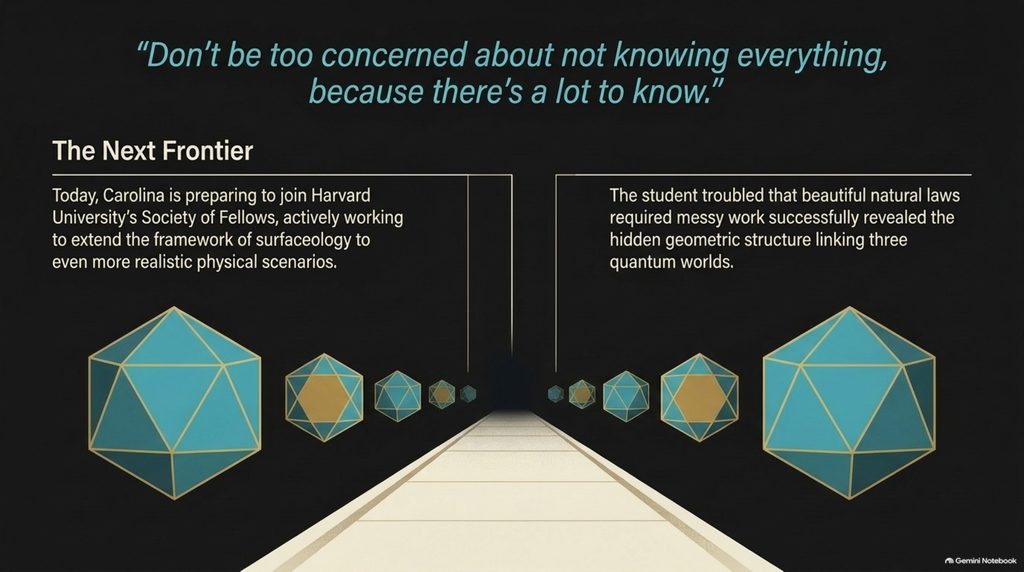
- Carolina is characterized by a desire to understand physical laws with simplicity and advises future scientists not to be discouraged by the vast amount of knowledge in their fields (00:17:25).
- Music has been a significant part of Carolina’s life since age eight, and she credits her training at Lisbon’s Academia de Amadores de Musica with teaching her the discipline and patience necessary for theoretical research (00:17:46).
- Following the completion of her PhD at Princeton, Carolina is set to join the Society of Fellows at Harvard University as a junior fellow (00:18:07).
- Her current research involves extending the geometric framework of surfaceology to apply to more realistic physical scenarios (00:18:27).
- During her time as a graduate student at Princeton, Carolina sought to address the complexity of standard physical laws, eventually helping to uncover a hidden geometric structure that connects three distinct quantum worlds (00:18:46).
Concise summary
Discovery of Geometric Foundations (00:00:00)
- In 2022, doctoral student Carolina Figueiredo discovered that three distinct quantum field theories, which describe different particle groups, all ruled out the same subatomic collision events (00:00:18)
- This research suggests that space, time, and particles may not be the most fundamental aspects of reality, but rather emerge from a deeper, timeless geometric structure (00:01:18)
- Figueiredo received the inaugural Vera Rubin New Frontiers Prize in April 2026 for this work, which challenges the century-old scientific consensus that the universe is primarily defined by particles interacting within space and time (00:00:58)
Academic Background and Early Research (00:02:40)
- Raised in Lisbon, Portugal, Figueiredo studied engineering physics at Instituto Superior Técnico, where she focused on the mathematics of space and time (00:03:00)
- Under the guidance of professor José Natário, she co-authored a 2020 paper demonstrating a one-to-one link between particle paths in General Relativity and geodesics on curved Riemannian manifolds (00:04:00)
- This research provided a method to represent complex gravitational metrics—including black holes and wormholes—as simpler visual Riemannian manifolds (00:04:22)
Transition to Princeton and Mentorship (00:04:39)
- After leaving a master’s program in Portugal, Figueiredo enrolled in the physics PhD program at Princeton University in 2021 (00:04:56)
- She began working with Nima Arkani-Hamed, a professor at the Institute for Advanced Study, who sought to simplify the mathematical description of quantum interactions by moving away from traditional concepts of space and time (00:05:15)
- The research group aimed to find more elegant methods for calculating physics, as they believed existing approaches were unnecessarily complex (00:05:59)
Challenges with Feynman Diagrams (00:07:01)
- Since the late 1940s, physicists have used Feynman diagrams to calculate scattering amplitudes, a process that becomes mathematically overwhelming when applied to realistic collisions like those at the Large Hadron Collider (00:07:01)
- Figueiredo became frustrated by the discrepancy between the tedious, error-prone algebra required to solve these diagrams and the simple, elegant answers that often resulted from the calculations (00:08:01)
- Inspired by Arkani-Hamed’s lectures on bypassing Feynman diagrams by applying logical rules directly to final answers, Figueiredo began collaborating with him at the Institute for Advanced Study to identify patterns in quantum field theory equations (00:08:41)
Singularities and Zeros in Quantum Field Theory (00:10:04)
- In particle physics, singularities represent points of infinite probability where subatomic events are most likely to occur (00:10:22)
- Research into zeros focuses on specific particle collision configurations that are strictly forbidden by underlying physics, resulting in a probability of zero (00:10:43)
- Within a geometric approach to physics, a physical zero occurs when the multi-dimensional shape representing scattering amplitudes is squeezed flat, causing its volume to disappear (00:11:04)
Discovering a Unified Geometric Framework (00:11:24)
- Initial research using the associahedron in trace phi cubed theory revealed that specific particle properties could cause the geometric shape to flatten (00:11:24)
- Subsequent manual calculations for pions and gluons confirmed that these same forbidden collisions and hidden zeros persist across three distinct physical theories (00:12:04)
- These shared mathematical boundaries indicate that the theories are manifestations of a single geometric framework known as surfacology, which simplifies complex Feynman diagram calculations (00:13:27)
- Physicist Jacob Bourjaily verified these findings by demonstrating that complex particle collision calculations, which previously required supercomputers, could be performed efficiently using these geometric rules (00:14:27)
Recognition and the Vera Rubin New Frontiers Prize (00:15:04)
- The Vera Rubin New Frontiers Prize, part of the Breakthrough Prize program, was established to support early-career researchers and provide public recognition for scientific achievements (00:15:04)
- Carolina became the first recipient of the $50,000 prize for her work in uncovering connections among quantum field theories (00:15:23)
- Named after astronomer Vera Rubin, the award honors a scientist who overcame significant gender-based barriers in her career (00:16:07)
- The achievement prompted national recognition in Portugal, including public congratulations from the country’s president and the Ministry of Education, Science, and Innovation (00:17:06)
Research Philosophy and Future Directions (00:17:25)
- Driven by a desire to simplify physical laws, the researcher credits her musical training with providing the discipline and structural recognition necessary for theoretical work (00:17:46)
- Following the completion of her PhD at Princeton, she is set to join the Harvard University Society of Fellows as a junior fellow (00:18:07)
- Current research efforts are focused on extending the surfacology framework to encompass more realistic physical scenarios (00:18:27)
Leave a Reply