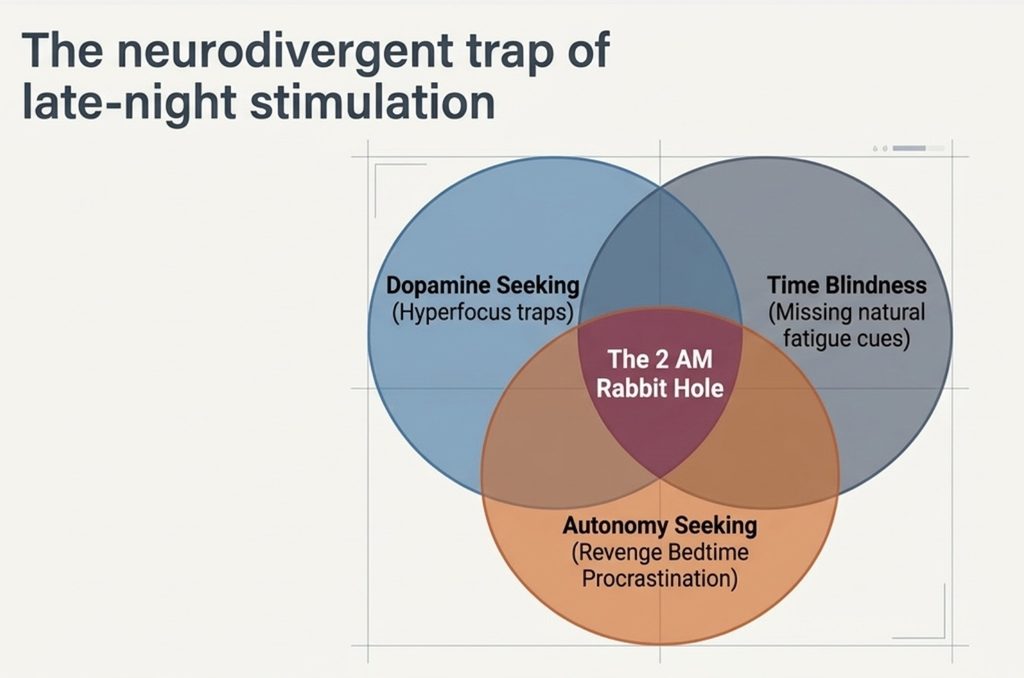
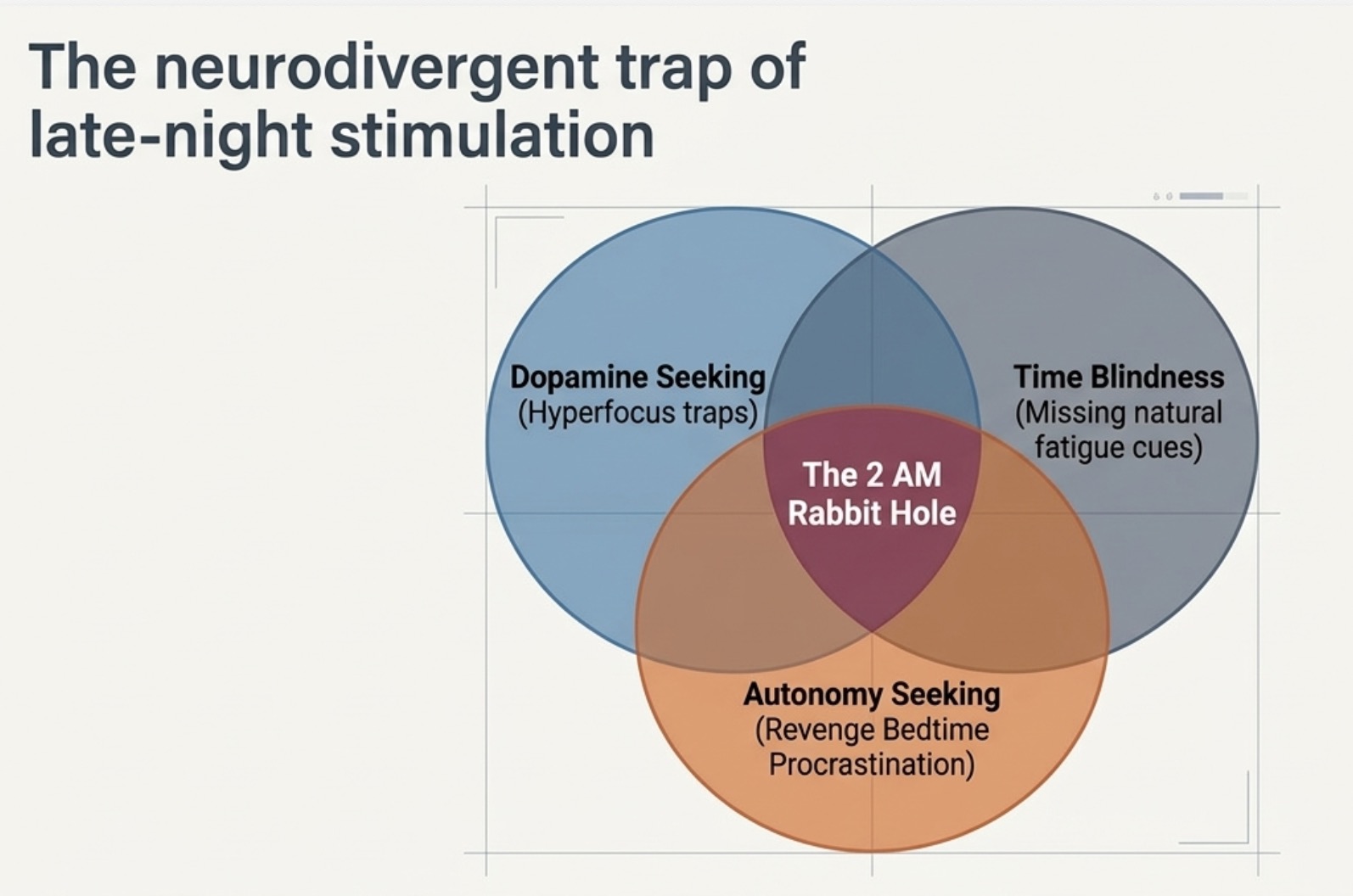
Diagram: NotebookLM
Claude.ai:
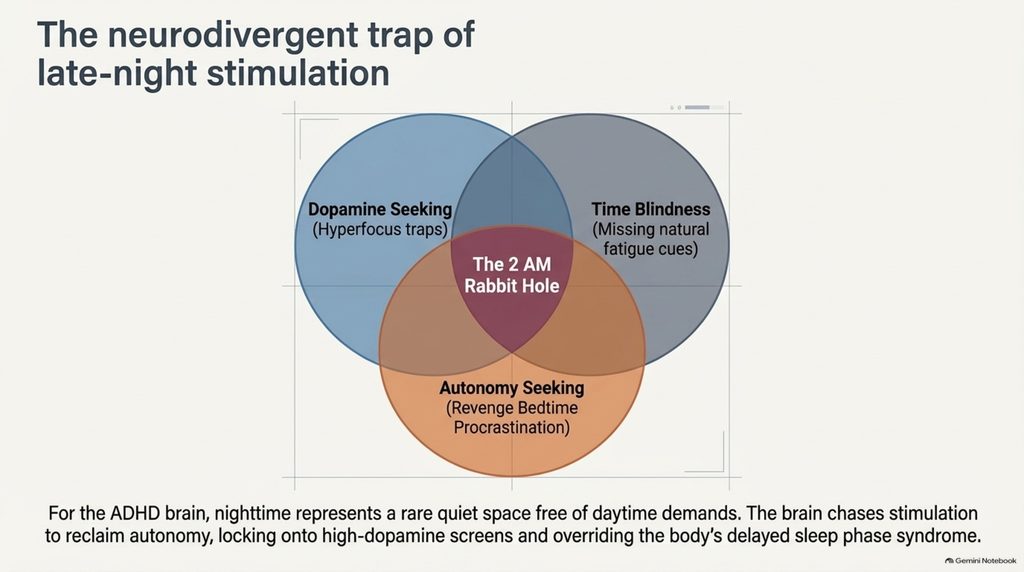
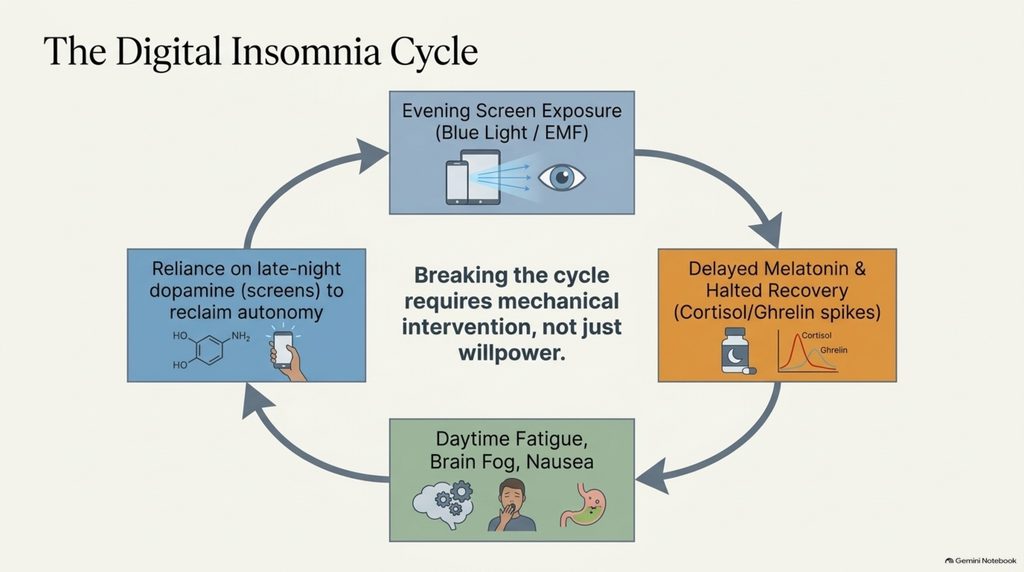
“Autonomy seeking” in that diagram refers to what’s usually called revenge bedtime procrastination: staying up late not because you aren’t tired, but because the late hours are the only part of the day that feels like yours.
The basic mechanism
If your day is dominated by obligations like work, other people’s needs, schedules, and chores, then by evening you have had very little time where you chose what to do. Going to bed means the day ends without you ever getting “your” time, and tomorrow’s obligations arrive sooner. So you stay up, scrolling, reading, or tinkering, even though you know you’ll pay for it. The “revenge” is against the day that took your time.
The defining feature is that nothing external is keeping you up, and you’re aware of the cost. That is what separates it from insomnia or simply being a night owl.
Why it hits neurodivergent people harder
- The day costs more. Masking, forcing focus on unstimulating tasks, and working within structures built for other brains take sustained effort, so the hunger for unstructured, demand-free time is larger by evening.
- Night is uniquely low-demand. Nobody is emailing, nobody expects anything, and there are no interruptions. For many people with ADHD or autism, it’s the first time all day their attention is entirely self-directed.
- Bedtime is itself a demand. “I should go to bed” is one more instruction, and for people with strong demand avoidance, it can trigger resistance even when it comes from themselves.
- Self-control is at its lowest. Stopping something enjoyable to do something boring takes executive function, which is most depleted late at night.
The trap
Less sleep makes the next day harder and less self-directed, which increases the need to reclaim time the following night. The freedom at 1 AM also tends to be low quality: you’re too tired to do anything satisfying, so it rarely scratches the itch.
What tends to help
Since the root problem is an autonomy deficit rather than a sleep problem, generic sleep hygiene advice often misses.
- Get autonomy earlier. Even 30–60 minutes of protected, unstructured time in the early evening reduces the pressure to take it from sleep.
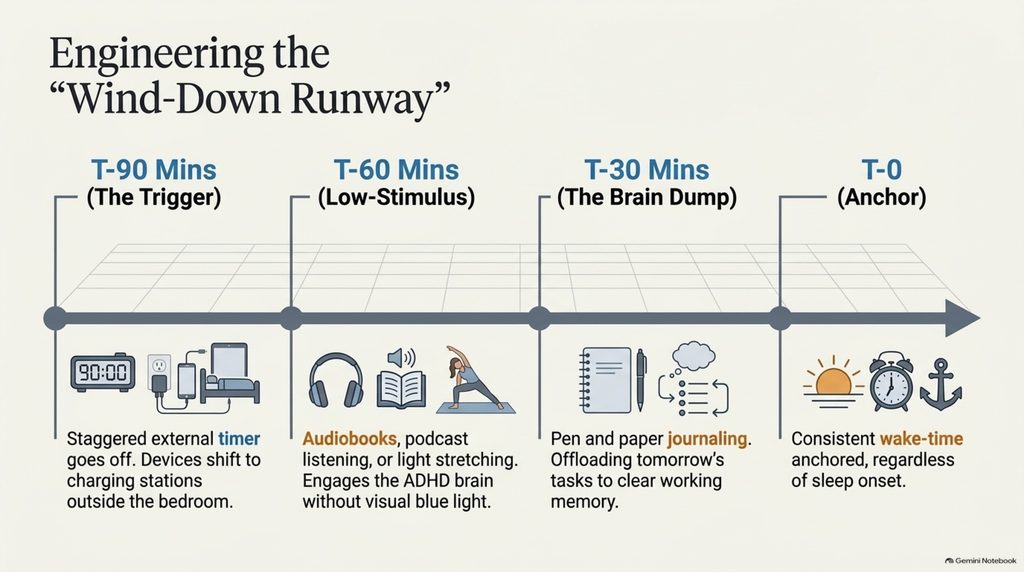
- Make winding down something you want. A book, show, or podcast saved for bed turns bedtime into part of your free time rather than the end of it.
- Lower the transition cost. Doing the tedious parts (teeth, locking up) early means going to bed later is just one small step.
- Frame it as a choice. “I’m choosing to be rested tomorrow” lands differently than “I have to go to bed” for a demand-resistant brain.
On the evidence: bedtime procrastination is a studied phenomenon, linked in research to self-regulation difficulties. The “revenge” and autonomy framing comes more from popular culture than from rigorous study. It resonates with many people and is plausible, but treat it as a useful lens rather than established science.
Since the root problem is an autonomy deficit rather than a sleep problem, generic sleep hygiene advice often misses…

Leave a Reply